Phtah
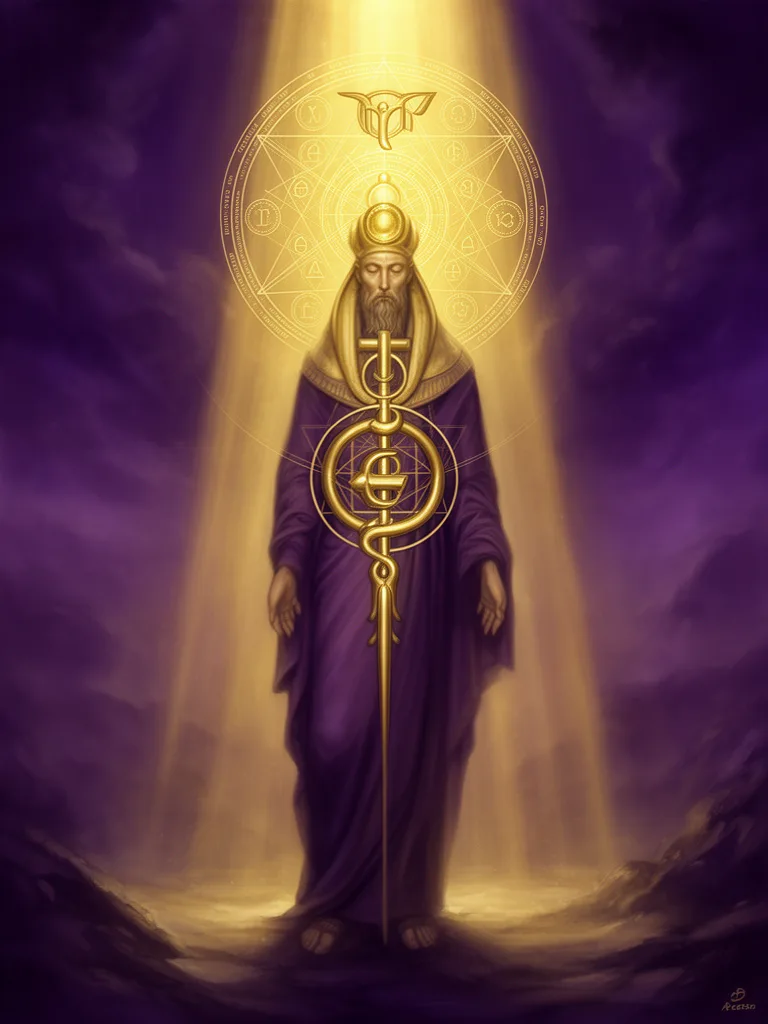
Ptah is an ancient Egyptian creator deity, often depicted as a sculptor and craftsman. He is associated with the primordial mound of creation, the breath of life, and the divine intelligence that brought the cosmos into being. Ptah represents the cosmic artisan, the architect of reality.
Where the word comes from
The name "Ptah" (Egyptian: pꜣ-ṯḥ) is of uncertain etymology. Some scholars suggest a connection to the verb "ptḥ" meaning "to open," possibly alluding to his role in creation. It first appeared in Old Kingdom texts, around the 3rd millennium BCE, and is central to the Memphis theology.
In depth
The God of death; similar to Siva, tiif destroyer, in later Egyptian mythology a sun-god. It is the seat or locality of the Sun and its occult Genius or Regent in esoteric philo.sophy.
How different paths see it
What it means today
The ancient Egyptians, in their profound reverence for the cosmos, conceived of Ptah not merely as a god, but as the very principle of divine craftsmanship. He is the Demiurge, the cosmic artisan, whose thoughts and words, uttered in the primordial silence, brought the universe into being. Mircea Eliade, in his seminal works on the history of religions, often highlighted the significance of primordiality and creation myths, and Ptah's story is a potent example. He is the sculptor who shapes the primordial mound, the very first land to emerge from the waters of chaos, and from this solid ground, all else unfolds.
This concept of a divine artisan is not unique to Egypt. We see echoes in the Gnostic traditions, where the Demiurge, though sometimes viewed with ambiguity, is the architect of the material realm. In Hermeticism, the idea of divine intelligence actively shaping existence is paramount. Ptah’s connection to the breath of life, the ba, further emphasizes the animating force that imbues the sculpted form with consciousness and vitality. This is not a distant, indifferent creator, but one intimately involved in the very fabric of existence, a divine artist whose studio is the cosmos.
For the modern seeker, Ptah offers a compelling perspective on creation. It suggests that the universe is not merely a random assembly of particles, but a work of profound intention and design. It invites us to see the inherent order and beauty in the world, to recognize the divine intelligence that underpins all phenomena. Furthermore, Ptah's role as a craftsman can serve as an inspiration for our own creative endeavors. If the divine can manifest such intricate beauty through art and craft, then perhaps we too are imbued with a spark of that creative fire, capable of shaping our own realities through focused intention and skillful action. The contemplation of Ptah is an invitation to appreciate the artistry of existence and to recognize the divine artisan within ourselves.
Related esoteric terms
No reflections yet. Be the first.
Share your interpretation, experience, or question.
