Path
The Path refers to the spiritual journey or disciplined practice undertaken by an individual seeking enlightenment, liberation, or union with the divine. It implies a progression through stages of understanding and transformation, often requiring effort, intention, and adherence to specific principles or teachings.
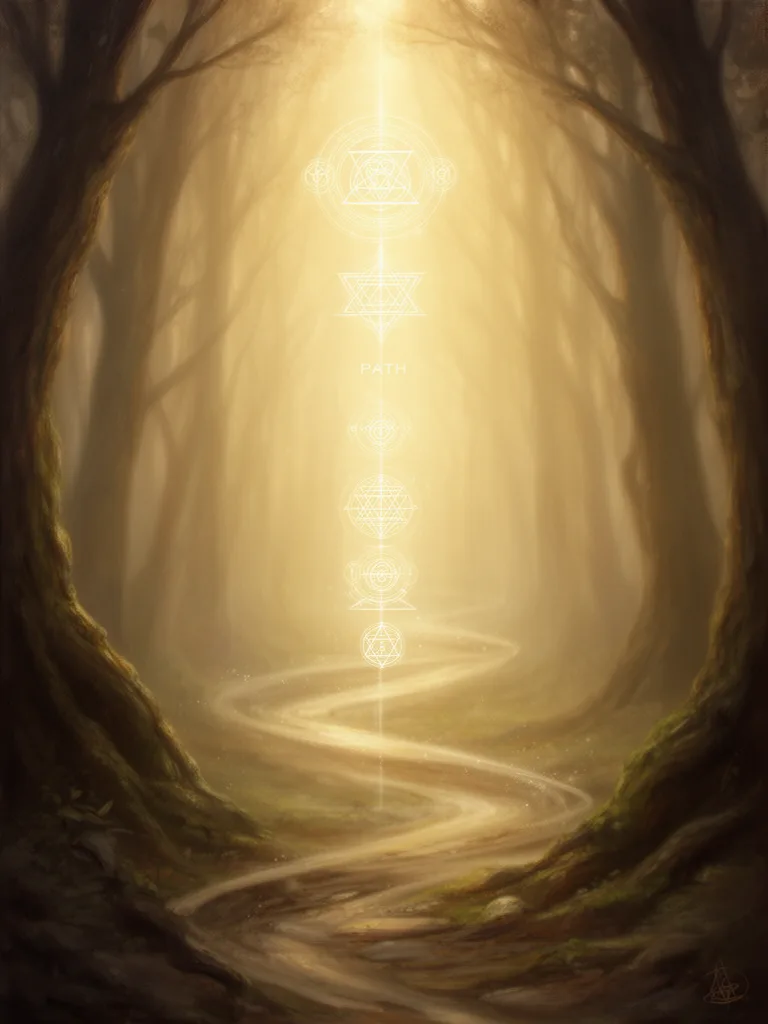
Where the word comes from
The English word "Path" derives from the Old English "pæþ," related to the Proto-Germanic "paþuz." It signifies a way, course, or track, a route taken to a destination. In spiritual contexts, it metaphorically represents the ordered progression toward a transcendent goal.
In depth
Chhassidi or Chasdim. In the Septuagint Assidm, and in English
How different paths see it
What it means today
The notion of a "Path" resonates deeply across human spiritual traditions, offering a framework for understanding the arduous yet purposeful movement toward a transcendent reality. It speaks to our innate desire for direction, for a map through the labyrinth of existence. Mircea Eliade, in his seminal work on myth and reality, explored how sacred geography often delineates these spiritual journeys, turning ordinary landscapes into conduits for the divine. The Path is not merely a metaphor for progress; it is an active engagement with the forces of transformation.
In Sufism, the Tariqa, or Path, is a highly structured discipline, often guided by a Sheikh, where the disciple undertakes a rigorous regimen of remembrance, meditation, and ethical refinement. Idries Shah chronicled the practical, often subtle, methods employed by Sufi masters to awaken consciousness, emphasizing that the Path is not always overtly dramatic but can be found in the mundane. Similarly, the Buddhist concept of the Noble Eightfold Path provides a comprehensive guide to ethical living, mental discipline, and wisdom, illustrating that the Path is built brick by brick through conscious action and mindful awareness.
The Path acknowledges that spiritual attainment is rarely instantaneous. It requires intention, perseverance, and a willingness to confront the shadows within oneself. Carl Jung’s concept of individuation, the process of psychological integration and self-realization, shares a profound kinship with these spiritual Paths, suggesting that the journey inward is as vital and as challenging as any outward quest. It is a recognition that the sacred is not only found in distant heavens but in the very soil of our being, waiting to be cultivated. The Path, then, is the art of cultivating the soul, a lifelong endeavor in which the traveler becomes the landscape and the destination.
Related esoteric terms
Books on this concept



No reflections yet. Be the first.
Share your interpretation, experience, or question.
