Norns
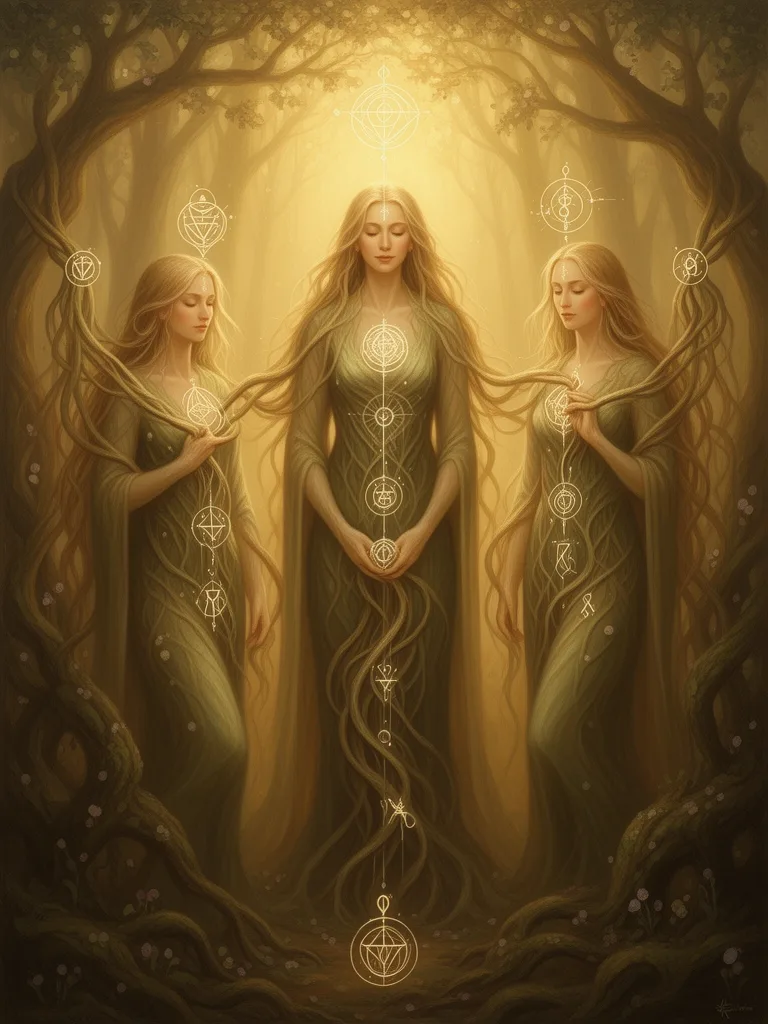
The Norns are three sister goddesses from Norse mythology who embody fate, weaving the destinies of gods and mortals. They represent the past, present, and future, influencing events from their dwelling at the root of the world tree, Yggdrasil.
Where the word comes from
The term "Norn" likely derives from Old Norse "norn," meaning "to twist" or "to spin," directly referencing their role in weaving fate. Related terms appear in Germanic languages, suggesting a shared Proto-Germanic root connected to destiny and weaving. The concept of fate-weavers is ancient, predating the written Eddas.
In depth
Tlie tliree sister goddesses in the Edda, who make known to men the degrees of Orlog or Fate. They are shown as coming out of the unknown distances enveloped in a dark veil to the Ash Yggdrasil (q.v.), and "sprinkle it dail.v with water from the Fountain of Urd, that it may not wither but remain green and fresh and strong" {Asgard and the Gods). Their names are "Urd", the Past; "Werdandi", the Present; and "Skuld", the Future, "which is either rich in hope or dark with tears". Thus they reveal the degrees of Fate "for out of the past and present the events and actions of the future are born" {loc. cit.).
How different paths see it
What it means today
The Norns, those three sister goddesses of Norse myth, offer a potent image for understanding the relentless flow of existence. They are not distant, indifferent deities but active participants in the unfolding of reality, tending to the world tree Yggdrasil with water from the Well of Urd. This act of watering, as Mircea Eliade might note, is a ritual of renewal, a constant infusion of life into the cosmic structure, preventing its wilting into oblivion. Their names—Urd (Past), Verðandi (Present), and Skuld (Future)—are more than mere labels; they are the very warp and weft of causality.
The Norns embody a deeply immanent understanding of fate, one that is woven, not inscribed. This contrasts with more deterministic views where destiny is a fixed script. Here, the future is born from the past and present, suggesting a continuous creation, a dance of possibility shaped by what has been and what is. The future, Skuld, is not a foregone conclusion but a realm of potential, "either rich in hope or dark with tears," a testament to the agency inherent even within the grand sweep of cosmic time. This is not a passive acceptance of fate, but an engagement with its continuous, intricate construction. The very act of their tending to Yggdrasil implies a responsibility, a participation in maintaining the integrity of the cosmos.
Their dwelling at the roots of Yggdrasil, a nexus of worlds, places them at the very heart of existence, where the threads of all lives converge. This imagery speaks to the interconnectedness of all things, a concept echoed in various mystical traditions. The Norns remind us that while we may perceive ourselves as separate entities, our destinies are inextricably linked, woven into the same grand, ever-changing fabric of reality. Their presence suggests that understanding the past and present is not merely an academic exercise but a vital practice for shaping the unfolding future.
RELATED_TERMS: Fate, Destiny, Karma, Time, Causality, Mythology, World Tree, Norse Mythology
Related esoteric terms
Books on this concept


No reflections yet. Be the first.
Share your interpretation, experience, or question.
