Magic
Magic is the ancient practice and belief in a sacred science, often intertwined with religion, that allows humans to influence natural or supernatural forces through ritual, knowledge, and will. It was considered a profound discipline by early civilizations.
Where the word comes from
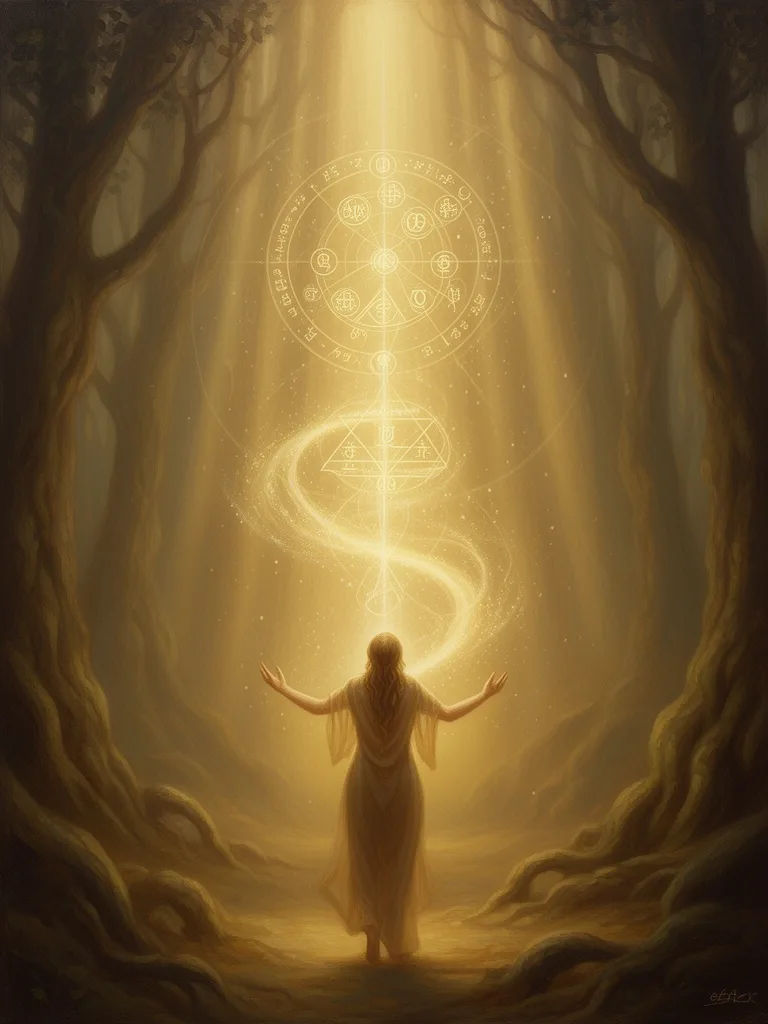
The term "magic" likely derives from the Old Persian word "maguš," referring to a priestly caste, and subsequently entered Greek as "mageia." In antiquity, it encompassed a wide range of practices, from divination and astrology to ritualistic influence over the natural world.
In depth
The great "Science". According to Deveria and other Orientalists, "magic was considered as a sacred science inseparable from ivligion" by tlie oldest and most civilized and learned nations. The Egyptians, for instance, were one of the most sincerely religious nations, as were and still are the Hindus. "IMagic consists of, and is acquired by the worship of tlie gods", said Plato. Could then a nation, which, owing to the irrefragable evidence of inscriptions and papyri, is proved to have firmly bclived in magic for thousands of years, have been deceived for so long a time. And it is likely that generations upon generations of a learned and pious hierarchy, many among wiiom led lives of selfmatrydom, lioliness and asceticism, would have gone on deceiving themselves and the people (or even only the latter) for the pleasure of perpetuating belief in "miracles"? Fanatics, we aj*e told, will do anything to enforce belief in their god or idols. To this we reply : in such case. Brahmans and Egyptian Ft khfj( t-(nn( us (q.v.) or Ilicropiiants would not have popularized belief in the power of man hy magic practices to commanel the services of the gods: which gods, are in truth, but the occult powers or potencies of Nature, personified by the learned priests themselves, in which they reverenced only the attributes of the one unknown and nameless Principle. As Proclus the Platonist ably puts it : "Ancient priests, when they considered that there is a certain alliance and sympathy in natural things to each other, and of things manifest to occult powers, and discovered that all things subsist in all, fabricated a sacred science from this mutual sympathy and similarity and applied for occult purposes, both celestial and terrene natures, by means of which, through a certain similitude, they deduced divine virtues into this inferior abode". ]\Iagic is the science of communicating with and directing supernal, supramundane Potencies, as well as of commanding those of the lower spheres; a practical knowledge of the hidden mysteries of nature known to only the few, because they are so difficult to acquire, without falling into sins against nature. Ancient and mediffival mystics divided magic into three classes — Theurgia. Goctia and natural Magic. "Tlieurgia has long since been appropriated as the peculiar spliere of the theosophists and metaphysicians", says Kenneth jMackenzic. Goetia is black magic, and "natural (or white) magic has risen with healing in its wings to the prou
How different paths see it
What it means today
Blavatsky's definition, echoing Plato and ancient traditions, positions magic not as mere trickery but as a "sacred science," an endeavor inseparable from religion and profound knowledge. This perspective challenges our modern, often dismissive, view of magic as superstition. Mircea Eliade, in his seminal works on religion and shamanism, explored how early societies perceived a fundamental interconnectedness between the human and the divine, a realm where rituals could bridge worlds. The Egyptian priests and Hindu Brahmans, as she notes, were not simply charlatans; they were custodians of a worldview where the cosmos was alive with forces accessible to the initiated. This is not so different from the alchemical pursuit described by Hermeticists, where the transformation of base metals mirrored the spiritual refinement of the soul, a "Great Work" requiring both precise knowledge and unwavering intent. The Sufi tradition, too, speaks of ecstatic states and divine whispers that can influence the world, a form of spiritual potency. For Jung, the archetypes of the collective unconscious often manifest in magical thinking, revealing a deep human need to find meaning and exert influence in a seemingly chaotic universe. The modern seeker, often adrift in a secularized world, might find resonance in this ancient understanding of agency, a reminder that the power to effect change, whether internal or external, may lie not in external forces, but in the disciplined cultivation of one's own consciousness and understanding of the world's hidden currents. It invites us to consider the possibility that the universe is not merely a mechanism to be observed, but a dynamic field responsive to our deepest intentions.
Related esoteric terms
Books on this concept




No reflections yet. Be the first.
Share your interpretation, experience, or question.
