Ma
Ma, meaning "five" in Sanskrit, is a significant number in Hindu cosmology, often associated with the five elements (earth, water, fire, air, ether) and the five senses. It represents wholeness and the fundamental building blocks of existence, linking the microcosm of human experience to the macrocosm of the universe.
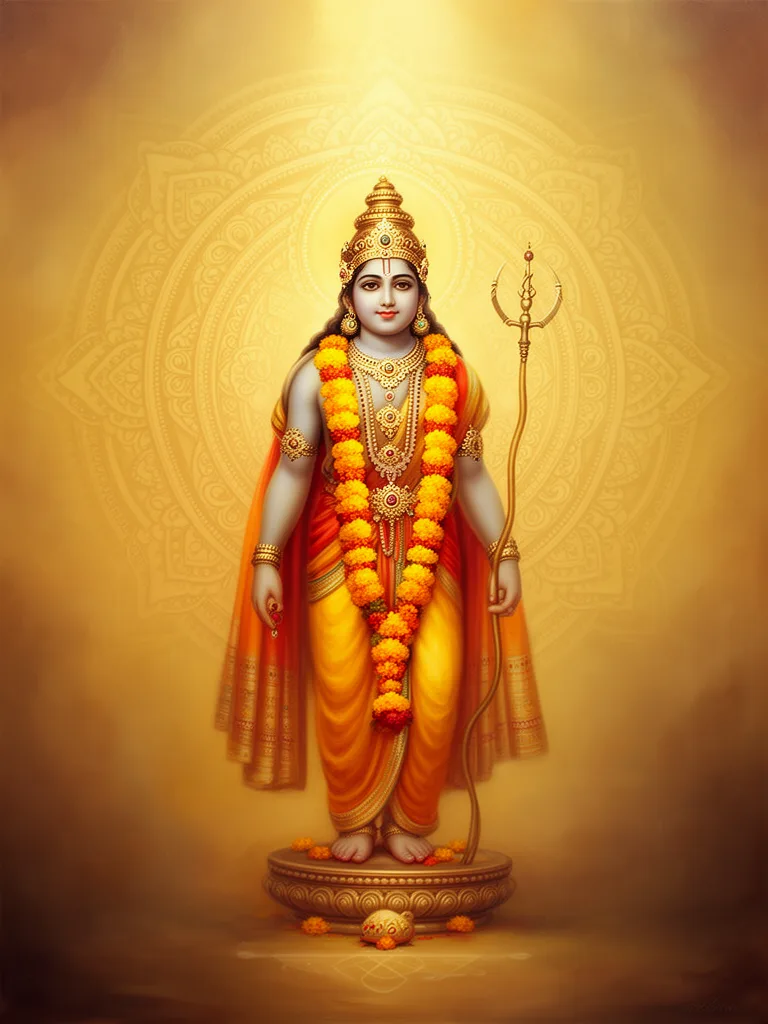
Where the word comes from
The Sanskrit word "Ma" (मा) signifies the number five. This numerical root is found across Indo-European languages, pointing to a common ancient understanding of the number. In Hindu traditions, the number five is deeply symbolic, representing the Pancha Mahabhutas (five great elements) and the Pancha Indriyas (five senses).
In depth
Lit., "five". A name of Lakshmi. Ma, Mut (Eg.). The goddess of the lower world, auotliciform of Isis, as she is nature, the eternal mother. She was the sovereign and Ruler of the North "Wind, the precursor of the overflow of the Nile, and thus called "the opener of the nostrils of the living". Slie is represented offering the ankJi, or cross, emblem of physical life to her worshippers, and is called the "Lady of Heaven". Machagistia. ]\lagie, as once taught in Persia and Chaldea, and raised in its occult practices into a religio-magianism. Plato, speaking of Machagistia, or Magianism, remarks that it is the purest form of the worship of things divine.
How different paths see it
What it means today
The concept of "Ma" as five, while seemingly a simple numerical designation, resonates deeply within the Hindu worldview as a fundamental structuring principle. It is the number that enumerates the Pancha Mahabhutas, the five great elements that, according to ancient Indian philosophy, comprise all of existence. These are Prithvi (earth), Apas (water), Agni (fire), Vayu (air), and Akasha (ether). This elemental framework is not merely a scientific classification but a profound metaphysical statement about the interconnectedness of all things, from the grossest physical matter to the most subtle vibrations of consciousness.
Furthermore, "Ma" extends to the Pancha Indriyas, the five sensory organs and their corresponding faculties of perception. These are the eyes, ears, nose, tongue, and skin, which allow us to interact with and interpret the material world. The confluence of the five elements and the five senses highlights a crucial aspect of esoteric understanding: the universe is not an external object to be passively observed, but an experience actively co-created through our sensory apparatus. The esoteric insight here is that the macrocosm of the universe is mirrored in the microcosm of the human being, with both being composed of these five fundamental forces and perceived through these five gateways.
This dual aspect of "Ma" invites a practice of mindful awareness, encouraging us to recognize the elemental composition of our surroundings and the way our senses shape our reality. It suggests that true wisdom lies in understanding the dance between the objective existence of the elements and the subjective experience of their perception. As Mircea Eliade observed in his studies of comparative religion, such numerical symbolism often serves as a cosmic map, guiding the seeker towards an understanding of universal order. The seemingly simple number five, therefore, becomes a key to unlocking a more profound comprehension of our place within the grand, elemental unfolding of existence. It is a reminder that the universe is not just what we see, but how we see it, and what it is made of.
Related esoteric terms
No reflections yet. Be the first.
Share your interpretation, experience, or question.
