Law
The fundamental principle governing existence, encompassing cosmic order, causality, and the inherent nature of reality. It is the underlying structure that dictates how phenomena arise, interact, and transform across all planes of being.

Where the word comes from
The English word "Law" derives from the Old English "lagu," meaning something laid down or fixed. Its conceptual roots are ancient, found in notions of cosmic order (Dharma in Sanskrit, Ma'at in Egyptian) and divine decree across numerous philosophical and religious systems.
In depth
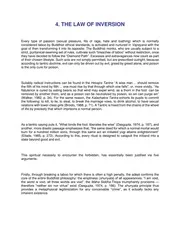
The divine name connected with this letter is Bnkhonr." {R. M. Cyclop.).
How different paths see it
What it means today
Blavatsky's brief mention, linking "Law" to a divine name, hints at a conception far removed from the dry pronouncements of jurisprudence. In the esoteric traditions, Law is not an imposed decree but the very fabric of reality, the inherent logic woven into the cosmos by its divine architect or, in more immanent views, the self-organizing principle of existence itself. Mircea Eliade, in his exploration of archaic religions, frequently points to the ancient human impulse to discern and live in accordance with these cosmic rhythms, whether it be the predictable cycles of the sun and moon or the moral order of society.
This is not a passive acceptance of fate, but an active engagement with the underlying principles. The Hindu concept of Dharma, for instance, is not merely a set of rules but the intrinsic nature of a thing, its proper functioning. To live in accordance with Dharma is to align oneself with the natural order, much as a river flows downhill. Similarly, the Sufi understanding of Sunnat Allah invites the mystic to observe the divine patterns in creation, seeing the hand of God not just in miracles but in the consistent workings of the universe. This is where the esoteric differs from the exoteric; it seeks the immanent Law within the manifest world, the divine grammar of existence.
For the modern seeker, grappling with a world often perceived as chaotic or meaningless, the concept of universal Law offers a profound antidote. It suggests that beneath the surface of apparent randomness lies a deep, intelligible structure. The Hermetic Principle of Cause and Effect, often simplified, speaks to a universe where actions have predictable, though perhaps complex, consequences, encouraging a mindful approach to one's life. This is not about predestination but about understanding the interconnectedness of all things, a notion echoed in the Buddhist understanding of Karma, where intention and action create ripples that shape future experiences. The Law, therefore, becomes a guide, not a jailer, a framework for understanding one's place and potential within the grand, unfolding design. It is the silent, ever-present intelligence that holds the stars in their courses and the atoms in their dance, inviting us to attune our own existence to its profound, harmonious rhythm.
Related esoteric terms
Books on this concept






No reflections yet. Be the first.
Share your interpretation, experience, or question.
