Hler
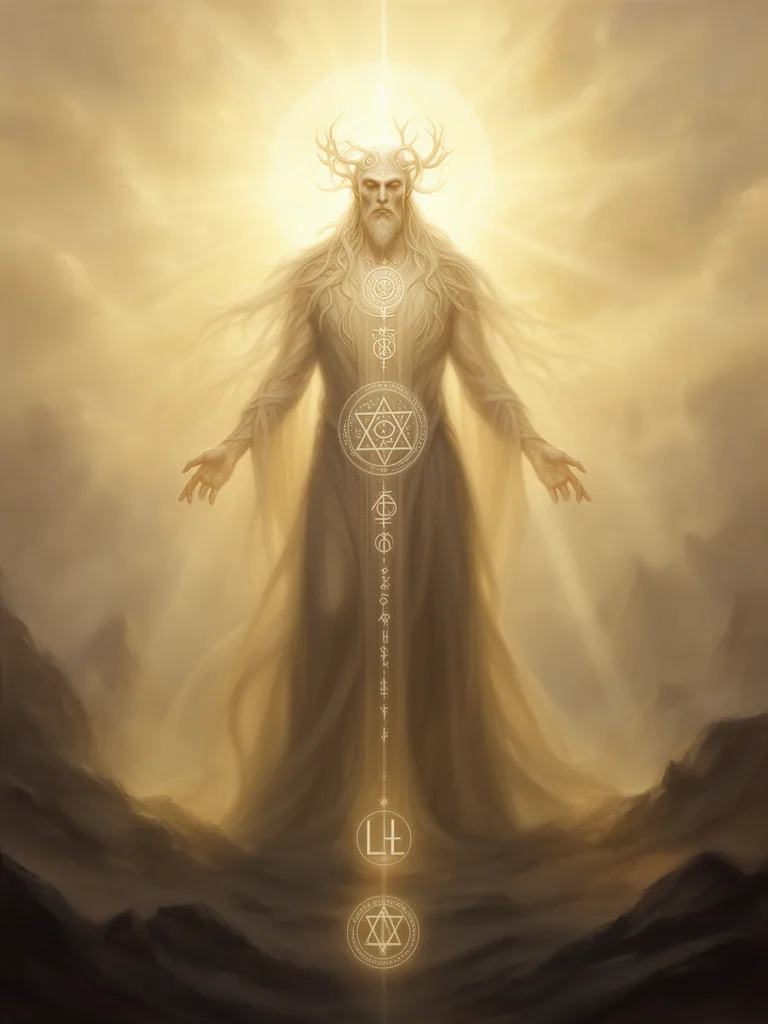
Hler is a figure from Norse mythology, identified as the god of the sea. He is depicted as one of the three sons of Ymir, the primordial frost giant, alongside Kari (god of air and storms) and Logi (god of fire). This trio represents a cosmic trinity.
Where the word comes from
The name "Hler" is of Old Norse origin. While its precise etymological root is debated, it is often associated with words relating to the sea or water. It appears in Norse sagas and Eddas as a divine entity.
In depth
The god of the sea. One of the three mighty sons of the Frost-giant, Ymir, These sons were Kari, god of the air and the storms; Hler of the Sea; and Logi of the Fire. They are the Cosmic trinity of the Xor.semen. ULOSSAKV 138 Hoa (Jlib.J. Tliat, from wliicli procft-ils Ah. tin"Father"; thiTcfore the Couceakd Logos.
How different paths see it
What it means today
Blavatsky's identification of Hler as a "god of the sea" places him within a pantheon of elemental deities, a common feature across mythologies. The notion of Ymir's sons—Kari, Hler, and Logi—as a "Cosmic trinity" of air, sea, and fire resonates with ancient attempts to map the cosmos through fundamental forces. Mircea Eliade, in his seminal work "The Myth of the Eternal Return," explored how primal myths often establish an order out of chaos, with deities personifying these very forces. This trinity can be seen as a symbolic representation of the dynamic interplay of creation and dissolution, much like the Hindu Trimurti, though focused on elemental rather than cosmic functions. The sea, in particular, has long been a potent symbol of the unconscious, the source of life, and the realm of the unknown. Hler's dominion over it suggests a primal power that is both generative and potentially overwhelming, a characteristic often attributed to the deep ocean. This conceptualization of cosmic forces as divine entities reflects a worldview where the natural world is imbued with spirit and agency, a perspective that offers a stark contrast to modern mechanistic understandings. The very act of naming and categorizing these forces, as seen in the Eddas, is an act of imposing order and meaning onto a world that might otherwise appear capricious. It is an ancient human endeavor to find coherence in the face of the sublime and the untamed.
Related esoteric terms
Books on this concept








No reflections yet. Be the first.
Share your interpretation, experience, or question.
