Sati
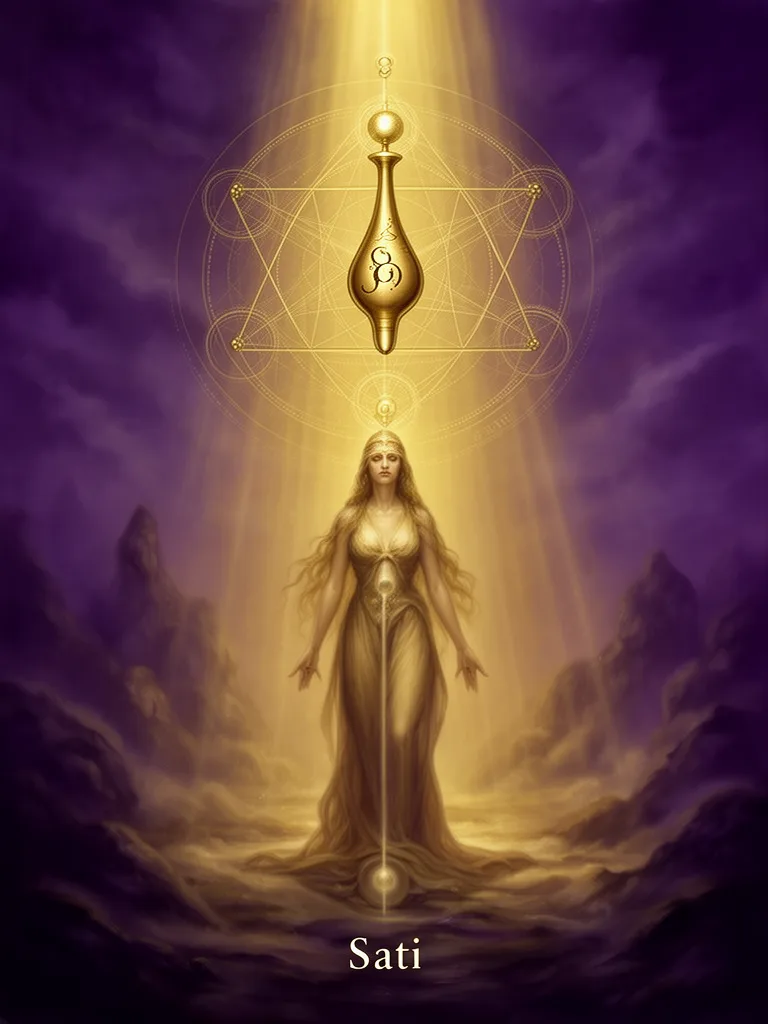
Sati refers to a triadic goddess in ancient Egyptian religion, specifically linked to the god Khnoum and the goddess Anuket. This divine triad represents a complex interplay of divine energies or aspects within the Egyptian pantheon.
Where the word comes from
The term "Sati" in this context derives from ancient Egyptian, likely connected to concepts of divine essence or being. Its specific linguistic roots are debated, but it is associated with the divine family of Khnoum, a creator deity, and Anuket, a goddess of the Nile.
In depth
The triadic goddess, with Anouki of the Egyptian god Khnoum.
How different paths see it
What it means today
The mention of Sati within the context of Egyptian divinity, specifically as a triadic goddess alongside Khnoum and Anuket, invites contemplation on the ancient Egyptian understanding of divine multiplicity within unity. Mircea Eliade, in his exploration of sacred history, often pointed to the ways ancient cultures perceived the divine not as a singular, static entity but as a vibrant, relational presence. The triad of Khnoum, a creator god often depicted with a ram's head, Sati, and Anuket, goddess of the Nile's inundation, suggests a cosmic order rooted in generative forces and the life-giving river. This structure mirrors the Hermetic principle of "As Above, So Below," where macrocosmic divine arrangements find their reflection in the microcosm.
The association of Sati with Khnoum, the divine craftsman and potter who shapes humanity from clay, and Anuket, who governs the vital waters of the Nile, positions Sati as a potentially mediating or complementary aspect within this creative and life-sustaining process. It speaks to a sophisticated theological imagination that understood the divine as a complex, perhaps even familial, network of powers. The very idea of a triadic goddess challenges simplistic notions of divinity, hinting at a recognition of the multifaceted nature of existence and the various energies that sustain it. This ancient Egyptian perspective, preserved through fragmented texts and iconography, offers a rich vein for modern seekers grappling with the perceived fragmentation of the modern world, suggesting that wholeness may lie not in singularity, but in the harmonious interplay of diverse forces. The divine, in this ancient vision, is a dynamic dance, not a solitary throne.
Related esoteric terms
Books on this concept






No reflections yet. Be the first.
Share your interpretation, experience, or question.
