Hell
A concept representing a state of suffering, punishment, or spiritual isolation, often depicted as a place or condition from which return is difficult or impossible. It signifies a profound existential void or the consequence of severe spiritual or ethical failings.
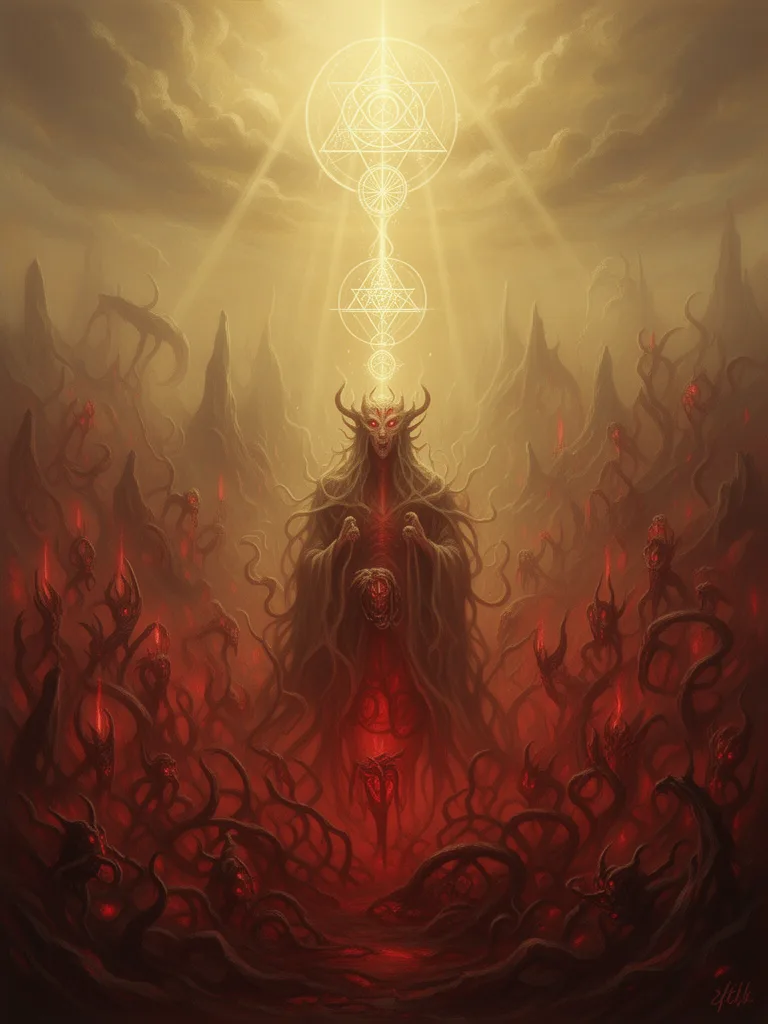
Where the word comes from
The English word "hell" derives from Old English "hel," related to Germanic words for "to cover" or "to conceal." Its roots suggest a hidden or underworld place. The concept of a post-mortem realm of punishment is ancient and appears in various forms across cultures, predating the specific term.
In depth
The worst of all was the Hall of the eternal Sleep and Darkness. As Lepsius has it. the defunct "sleep (therein) in incorrupiibU forms, tlicy wake jiot to ser their hrethren. they reeojj:ni/,e no lon<rer father and mother, their hearts feel nouj^ht towai-d their wife and children. This is the dwellinjj of the fjod All-Dead. . . . Hach trembles to pray to him. for he hears not. Nobody can prai.se liim, for he rep:ards not tliose who adore liim. Neither does he notice any olferin<? brouf^nt to him." This pod is Karmic Decree; tiie land of Silence — the abode of those who ilie abst)lute ilisbelievers. those dead from accident before their allotted time, and iinally the dead on the threshold of Avitchi, which is never in Amcnti or any other subjective state, save in one ease, but on this laud of forced re-birth. These tarried not very long even in their state of heavy sleep, of oblivion and darkness, but. were carried more or less speedily toward Amh the "exit gate".
How different paths see it
What it means today
Blavatsky’s definition, drawing from Egyptian esotericism and a broader karmic understanding, offers a compelling counterpoint to simplistic notions of eternal damnation. She describes a "Hall of the eternal Sleep and Darkness," a place of oblivion and non-recognition, governed by "Karmic Decree." This resonates with Mircea Eliade’s observations on the phenomenology of the sacred and profane, where certain states represent a radical absence of being, a descent into a primordial darkness. The "dwellinjj of the God All-Dead" is not a vengeful deity but the impersonal, inexorable force of consequence.
This conception of hell as a state of profound spiritual inertia, a place where recognition and connection dissolve, speaks to a modern existential anxiety. It’s the fear not of fire and brimstone, but of meaninglessness, of becoming so disconnected that one ceases to truly be. Carl Jung, in his exploration of the collective unconscious, might see such realms as archetypal representations of the shadow, the unacknowledged aspects of the psyche that, when repressed, can lead to profound internal suffering and fragmentation. The "absolute disbelievers" and those "dead from accident before their allotted time" suggest a disruption of natural order, a premature cessation of a destined unfolding, leading to a state of forced, unfulfilled re-birth. This is a hell not of active torment, but of passive, unending non-existence, a spiritual coma.
The idea of a "forced re-birth" on this "land of oblivion" is particularly striking. It implies a cosmic mechanism that, even in its harshest manifestations, seeks a form of resolution, albeit one born from the deepest darkness. It’s a stark reminder that the consequences of spiritual ignorance or ethical failure can manifest as a profound lack of awareness, a state where the self is unable to perceive or connect, a terrifying stillness that precedes whatever comes next. This state, far from being a static punishment, is a dynamic void, a prelude to a necessary, if arduous, transition. It compels us to consider what it means to truly awaken, to remain conscious, and to maintain the threads of connection that bind us to existence itself.
Related esoteric terms
Books on this concept







No reflections yet. Be the first.
Share your interpretation, experience, or question.
