Hawk
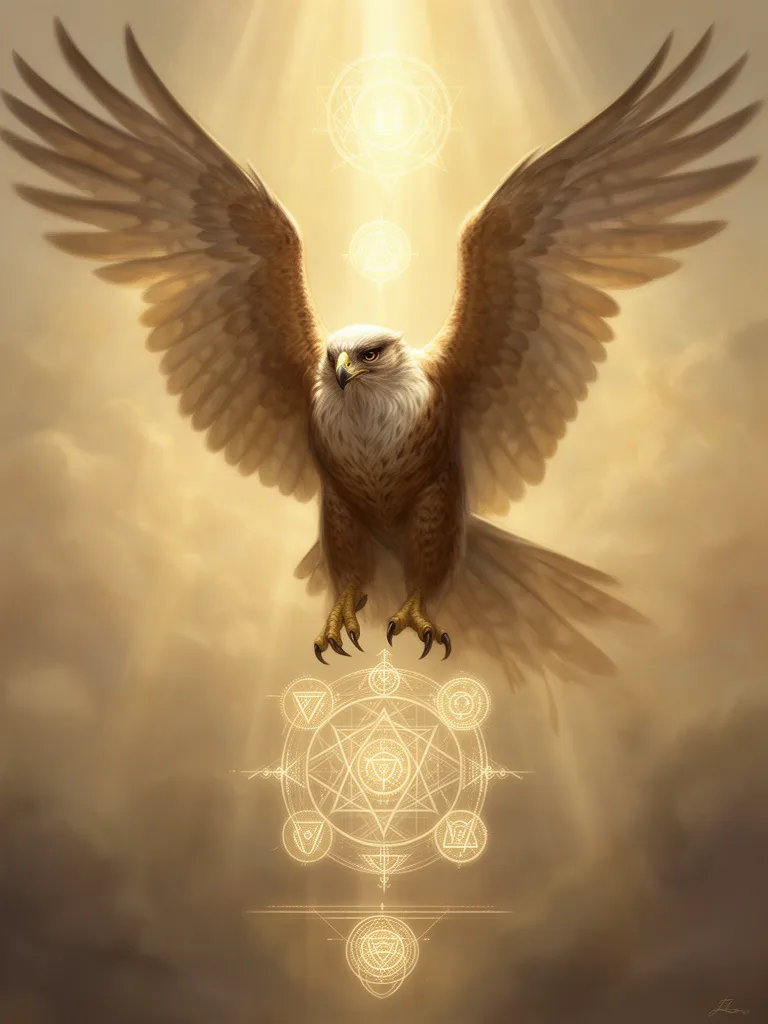
The hawk symbolizes the soul's journey, representing transition, spiritual resurrection, and the conscious reintegration of the soul after death or profound transformation. Its postures in ancient Egyptian iconography convey stages of existence and rebirth.
Where the word comes from
The word "hawk" derives from Old English "hafoc," ultimately from Proto-Germanic "habukaz." Its symbolic use is ancient, particularly prominent in Egyptian hieroglyphs where it represented the soul (Ba) and divine power.
In depth
The Hieroglyphic aiul type of tlie Soul. The same varies with the postures of the bird. Thus when lying as dead it represents the transition, larva state, or the pa.ssage from the state of one life to another. When its wings are opened it means that the defunct is resurrected in Amenti and once more in conscious possession of his soul. The chry.salis has become a butterfly.
How different paths see it
What it means today
The hawk, as depicted in ancient Egyptian iconography and echoed in various spiritual traditions, serves as a potent emblem for the soul's odyssey. Blavatsky's description of its varying postures—lying as dead or wings opened—speaks to a fundamental human understanding of transformation. This is not merely about the afterlife but about the cyclical nature of consciousness itself, a concept explored by Mircea Eliade in his studies of shamanism and archaic religions, where death is often a prelude to rebirth or a new mode of being. The hawk's stillness can represent the liminal space, the chrysalis state where the old self dissolves, a period of profound introspection and potential dissolution that precedes a radical re-emergence. When its wings are unfurled, it signifies not just a return to life but a conscious possession of the soul, a reclaiming of spiritual agency. This resonates with Carl Jung's ideas on individuation, the process of integrating the conscious and unconscious aspects of the psyche to achieve wholeness. The hawk, with its sharp vision and ability to survey vast territories from above, embodies this integrated awareness, seeing the world with clarity and detachment. It is the soul that has transcended its immediate circumstances, achieving a bird's-eye view of its own existence and the cosmos. The metaphor of the chrysalis becoming a butterfly, as Blavatsky notes, is a timeless symbol of metamorphosis, a testament to the soul's inherent capacity for renewal and ascension. This imagery invites us to consider our own moments of transition, not as endings, but as necessary passages towards a more conscious and liberated state of being. The hawk's silent, powerful flight across the sky becomes a call to recognize the soul's enduring potential for resurrection, not as a passive event, but as an active, conscious reclaiming of one's essential nature.
RELATED_TERMS: Soul, Ba, Spirit, Resurrection, Metamorphosis, Individuation, Liminality, Consciousness
Related esoteric terms
Books on this concept








No reflections yet. Be the first.
Share your interpretation, experience, or question.
