Gunas
The Gunas are three fundamental qualities or modes of nature in Hindu philosophy, comprising Sattva (purity, goodness), Rajas (passion, activity), and Tamas (inertia, darkness). They are the essential constituents of all manifested existence, influencing consciousness and behavior.
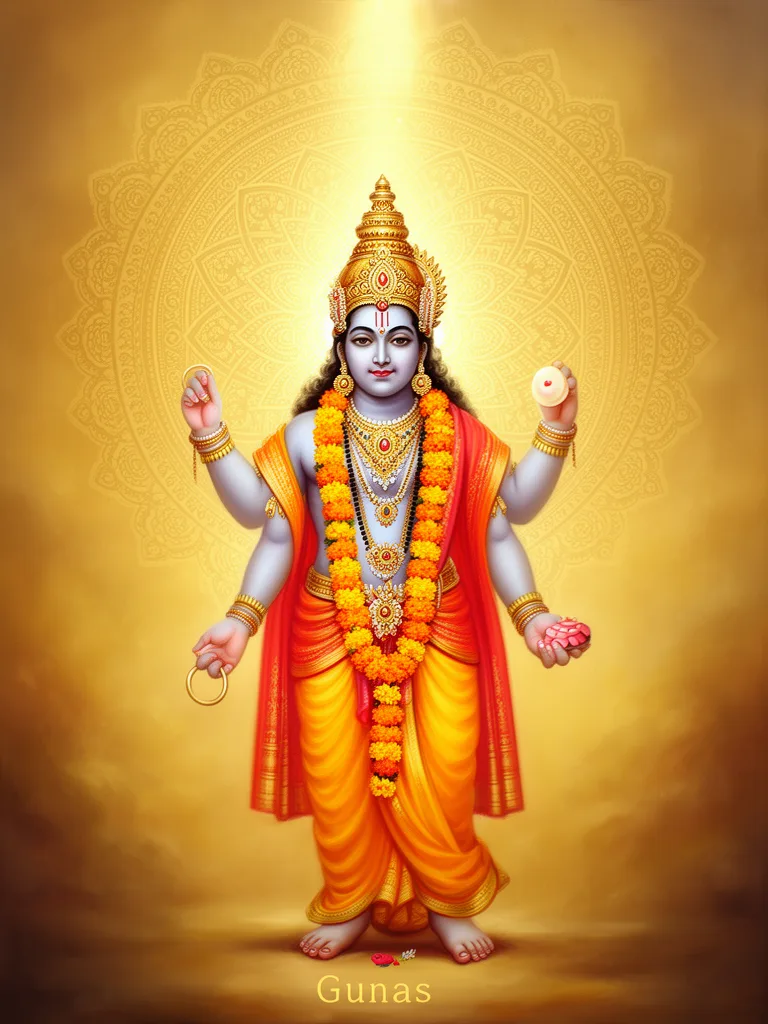
Where the word comes from
The Sanskrit word "guna" (गुण) literally means "quality," "attribute," or "strand." It is believed to originate from a Proto-Indo-European root related to "knowing" or "recognizing." The concept is central to Samkhya philosophy, which posits that these three gunas are the fundamental constituents of Prakriti, or primordial matter, and are present in all phenomena.
In depth
Qualities, attributes (See "Triguna"^ : a thread, also a cord,
How different paths see it
What it means today
The Gunas, as articulated in the Samkhya and Vedanta schools of Hindu philosophy, present a profoundly nuanced understanding of the fabric of reality. They are not static entities but rather vibrant threads woven into the very loom of Prakriti, the primordial substance from which all that is manifest arises. Sattva, the quality of purity, clarity, and luminescence, is often associated with wisdom, peace, and spiritual aspiration. Rajas, the principle of passion, activity, and motion, drives ambition, desire, and the ceaseless churn of the world. Tamas, the inertia of darkness, ignorance, and heaviness, leads to lethargy, delusion, and resistance to change.
Mircea Eliade, in his explorations of comparative religion, highlights how such tripartite divisions often serve as cosmogonic and anthropological models, providing order to the apparent chaos of existence. The Gunas are not merely descriptive; they are prescriptive, guiding the practitioner towards a state of equilibrium. The Bhagavad Gita, for instance, extensively discusses how actions performed with attachment to their fruits are colored by the Gunas, and how liberation (moksha) involves transcending their influence.
For the modern seeker, the Gunas offer a potent lens through which to examine their own inner landscape. Instead of a simplistic good-versus-evil dichotomy, they provide a spectrum of energies that are all part of the natural order. Understanding which guna is predominant in a given situation or within oneself can lead to a more compassionate and effective approach to personal challenges. It is not about eliminating Rajas or Tamas, but about cultivating Sattva and harmonizing the interplay of all three. This understanding resonates with psychological insights, such as Carl Jung's exploration of archetypes and the shadow, where acknowledging and integrating all aspects of the psyche, even the darker ones, is crucial for wholeness. The Gunas suggest that even in states of inertia or passion, there is a cosmic logic, a necessary function within the grand unfolding of existence.
The challenge, as tradition suggests, lies in recognizing the Gunas at play without becoming enslaved by them, discerning the luminous quality of Sattva without succumbing to spiritual pride, and understanding the necessity of Rajas and Tamas without being consumed by their less desirable manifestations. It is a call to mindful observation, an invitation to dance with the inherent qualities of nature rather than to fight against them, recognizing that true freedom lies in the wisdom of balance and transcendence.
RELATED_TERMS: Prakriti, Sattva, Rajas, Tamas, Samsara, Moksha, Karma, Bhagavad Gita
Related esoteric terms
Books on this concept




![BHAGAVAD GITA AS IT IS [NEPALI LANGUAGE].](/img/thumb/bhagavad-gita-as-it-is-nepali-language-ac-bhaktivedanta-swami-prabhupada-883290.webp)



No reflections yet. Be the first.
Share your interpretation, experience, or question.
