Four of Cups
The Four of Cups in Tarot symbolizes a period of introspection, where a perceived offer or opportunity is overlooked due to apathy, contentment, or a focus on what is missing rather than what is present. It represents emotional stagnation and a missed connection.
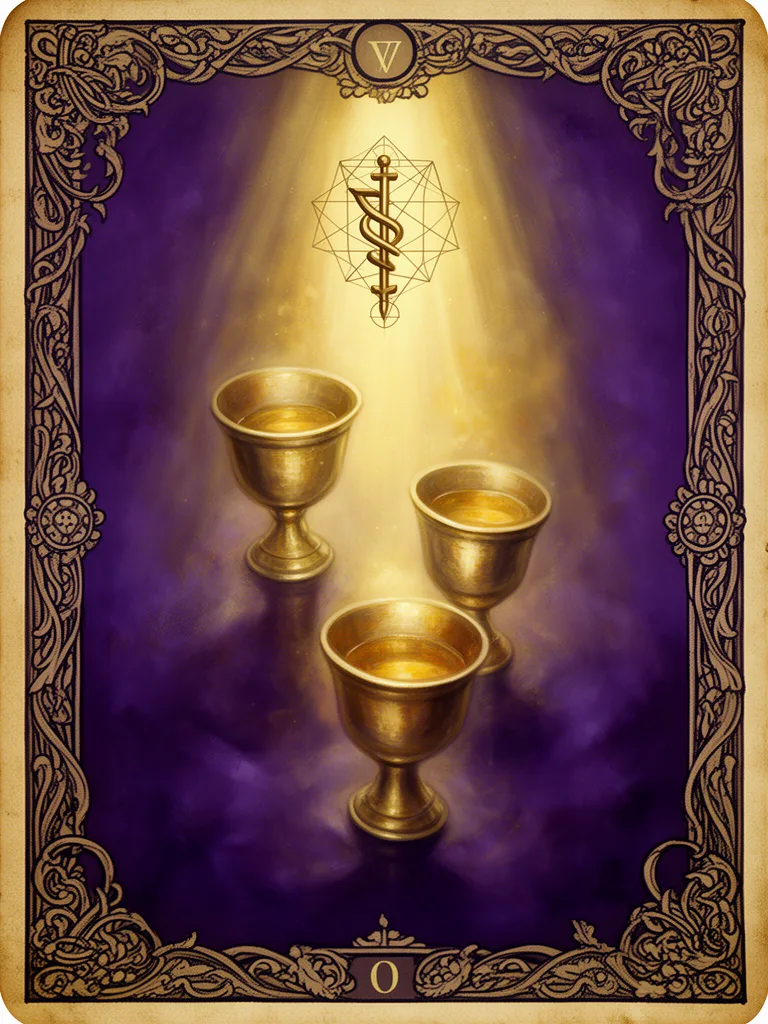
Where the word comes from
The term "Four of Cups" originates from the Tarot, a deck of cards whose origins are debated but likely emerged in 15th-century Northern Italy. The "Cups" suit is associated with the element of Water, representing emotions, intuition, and relationships, and the number "four" often signifies stability, completion, or a plateau.
In depth
The Four of Cups is a Minor Arcana tarot card. It is associated with the element of Water and is the fourth card in the Suit of Cups. Tarot cards are used throughout much of Europe to play tarot card games. In English-speaking countries, where the games are largely unknown, tarot cards came to be utilized primarily for divinatory purposes.
How different paths see it
What it means today
The Four of Cups, a quiet sentinel in the Minor Arcana, offers a potent, albeit often uncomfortable, reflection for the modern seeker. It is less about a dramatic external event and more about the internal landscape, the subtle currents of discontent that can flow even when the external world presents a seemingly generous hand. Mircea Eliade, in his exploration of the sacred and the profane, might see this as a moment where the profane world offers its gifts, but the individual, caught in a spiritual inertia, fails to recognize their numinous quality. Carl Jung's concept of the anima, the unconscious feminine aspect in men, could be at play here, a passive, receptive force that, when not integrated, can lead to a melancholic withdrawal from the vital energies of life.
This card speaks to the human tendency to perpetually look over the horizon for happiness, a habit that Mircea Eliade identified as a form of spiritual alienation, a forgetting of the sacred in the mundane. The figure on the card, often depicted as seated and disengaged, represents a state of emotional torpor, a refusal to engage with the offered chalice, perhaps because it is not the chalice one envisioned. It is the quiet echo of dissatisfaction, the whisper that says, "Is this all there is?" even when a perfectly good drink is being offered. This isn't a call to passive acceptance of mediocrity, but a prompt to examine the source of one's dissatisfaction. Is it a genuine lack, or is it a projection, a phantom limb of desire reaching for what is not and perhaps never will be? The challenge lies in shifting one's gaze from the perceived void to the tangible offering, a practice that requires a conscious redirection of attention, a turning inward to cultivate gratitude for what is present, rather than lamenting what is absent. It is a subtle yet crucial recalibration of the soul's compass, guiding us from the shores of discontent towards the harbor of equanimity.
RELATED_TERMS: Ennui, Apathy, Contentment, Disenchantment, Spiritual Stagnation, Emotional Receptivity, Self-Deception
Related esoteric terms
No reflections yet. Be the first.
Share your interpretation, experience, or question.
