Five of Coins
The Five of Coins represents material hardship, loss, and a sense of isolation or destitution. It signifies periods of financial struggle, illness, or the feeling of being an outcast, often arising from external circumstances or poor choices.
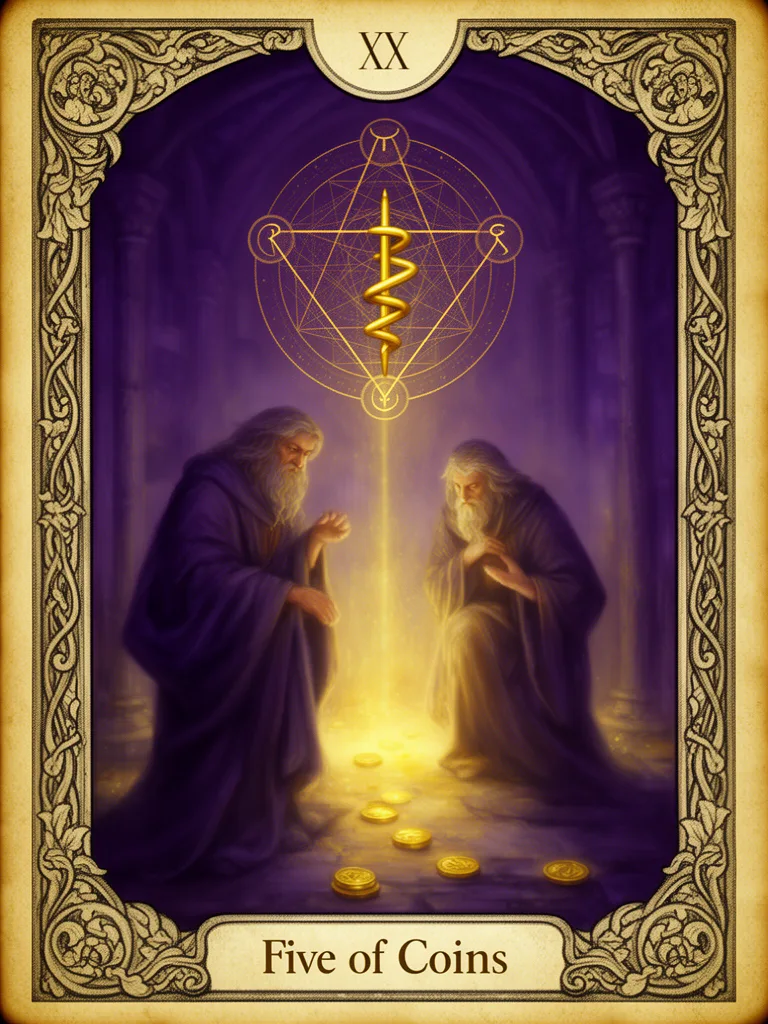
Where the word comes from
The term "Five of Coins" originates from the Italian "cinque di denari," a card within the Minor Arcana of Tarot decks. The "coins" or "denari" suit historically symbolized material wealth, possessions, and worldly affairs, with the number five often denoting challenge or instability.
In depth
Five of Coins is a card used in Latin-suited playing cards which include tarot decks. It is part of what tarot card readers call the "Minor Arcana". Tarot cards are used throughout much of Europe to play tarot card games. In English-speaking countries, where the games are largely unknown, tarot cards came to be utilized primarily for divinatory purposes.
How different paths see it
What it means today
The Five of Coins, a card often met with trepidation, invites a deeper contemplation than its surface-level depiction of hardship might suggest. It is not an indictment but an illumination, a stark reminder of the ephemeral nature of worldly security. Mircea Eliade, in his exploration of sacred and profane time, would recognize in this card the disruptive force that shatters the illusion of ordinary, mundane existence, compelling a confrontation with existential realities.
In the Hermetic tradition, where the correspondence between the macrocosm and microcosm is paramount, the Five of Coins speaks to the dense, material plane's capacity for obstruction and decay. It is a manifestation of the lower quaternary, the realm of physical limitations and the often-painful lessons learned through lack. This is not to say it is a card of despair, but rather one of stark awareness, akin to the alchemist's understanding that purification often requires the dissolution of impure substances.
For the modern seeker, this card serves as a powerful prompt to examine their relationship with material possessions and their definition of security. It challenges the pervasive narrative that equates worth with wealth and stability with accumulation. Carl Jung's concept of the shadow might find resonance here, as the card can bring to the fore anxieties about inadequacy and the fear of not being enough, which are often projected onto external circumstances. The isolation it depicts can be a profound, albeit uncomfortable, invitation to self-reliance and the discovery of inner resources previously untapped.
The Five of Coins, in its starkness, can also be a catalyst for spiritual growth, much like the desert ascetics who found profound spiritual clarity through material deprivation. It compels a turning inward, away from the clamor of acquisition and toward the quiet strength of being. It is in these moments of perceived loss that the soul may discover its true, unassailable wealth. The lesson lies not in avoiding the fall, but in learning how to rise anew from the dust.
RELATED_TERMS: Loss, Poverty, Hardship, Materialism, Isolation, Suffering, Impermanence, Material Plane
Related esoteric terms
No reflections yet. Be the first.
Share your interpretation, experience, or question.
