Ezra
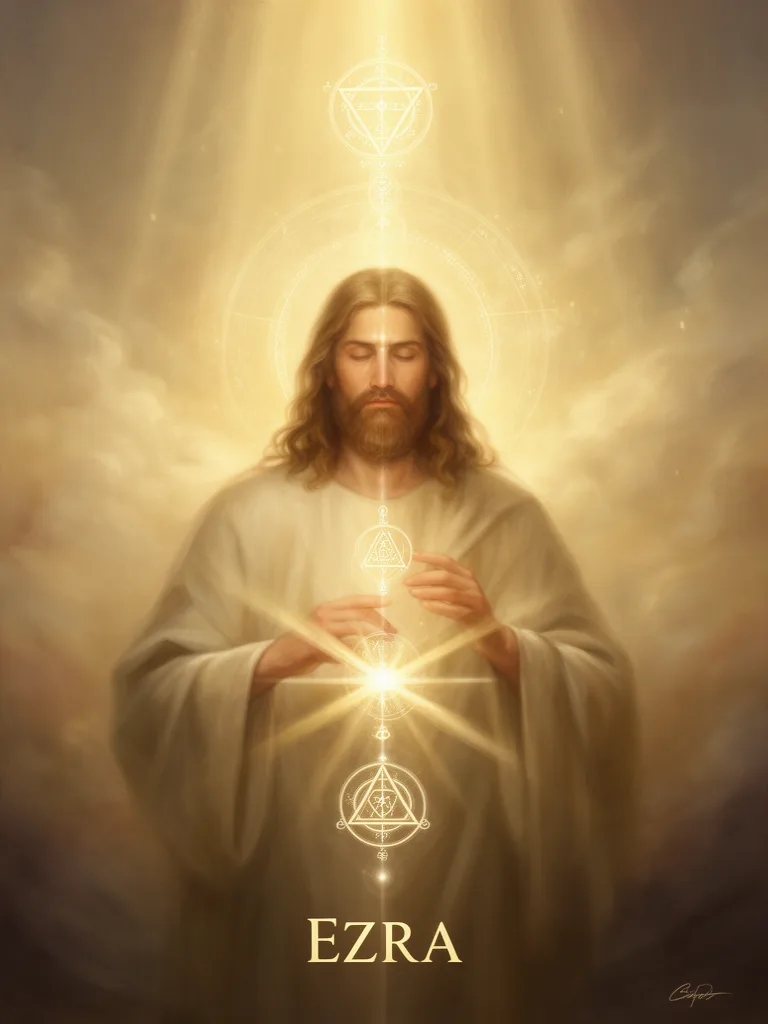
Ezra, a prominent figure in Jewish tradition, is recognized as a priest, scribe, and compiler of the Pentateuch and other Old Testament texts around 450 BCE. He is also associated with Kabbalistic traditions, where Rabbi Azriel ben Manahem, a 12th-century Spanish Kabbalist, is linked to the name.
Where the word comes from
The name Ezra derives from the Hebrew 'Ezra' (עֶזְרָא), meaning "help" or "aid." This root is common in biblical names, signifying divine assistance. The figure's significance in compiling sacred texts and his later association with Kabbalistic lore underscore this meaning.
In depth
The Jewisli priest and scribe, who, circa 450 B.C., compiled the Pentateuch (if indeed he was not author of it) and the rest of the Old Testament, except Nehemiah and Malachi. [w.w.w.] Ezra (H(h.). The same as Azareel and Azriel, a great HebreAv Kabbalist. His full name is Rabbi Azariel ben Manahem. He flourished at Valladolid, Spain, in the twelfth century, and was famous as a philosopher and Kabbalist. He is the author of a work on the Ten Sephiroth. ULU^SAKV 109 F. r . — The sixth letter of the English alpluilx't. for wiiieh there is no equivalent in Hebrew. It is the donbh* Fj of the ^Eolians which becamtthe Digamma for some mysterious reasons. It corresponds to the Greek phi. As a Latin numeral it denotes 40. witii a dash over the letter (F) 400,000. Faces (Kabbalisiic), or, as in Hebrew, Fartzuphccm. The word usualhrefers to Arechh Anpecn or Long Face, and Zcir-Aiiprn, or Short Face, and Rcsha Hivrah the "White Head" or Face. The Kabbala states that from the moment of their appearance (the hour of differentiation of matter) all the material for future forms was contained in the three Heads which are one, and called Attcckuh Kadosha, (Holy Ancients and the Faces). It is when the Faces look toward each other, that the "Holy Ancients" in three Heads, or Attcckah Kadosha, are called Areek Appayem, i.e., "Long Faces". (See Zohar iii.. 292a.) This refers to the three Higher Principles, cosmic and human.
How different paths see it
What it means today
The figure of Ezra, as presented in the historical and esoteric traditions, offers a compelling duality for the modern seeker. Initially recognized as the priest and scribe who meticulously compiled the Pentateuch, his role transcends mere archival work. He is the architect of sacred narrative, the one who gathered and ordered the foundational texts of a people, implying a profound understanding of the power of codified wisdom. This act of preservation and organization is itself a form of spiritual technology, shaping collective consciousness through shared stories and laws.
However, Blavatsky's inclusion of Ezra within a Kabbalistic context, specifically referencing Rabbi Azriel ben Manahem, opens a more profound dimension. This association shifts the focus from the literal compilation of scripture to the interpretation of its hidden, structural underpinnings. The Kabbalah, with its intricate system of the Sephiroth, seeks to map the divine emanations that structure reality. Ezra, through this lens, becomes not just a collector of words but a conduit to the underlying principles of creation, an interpreter of the divine blueprint.
This duality resonates with the perennial quest for meaning, which often involves both the diligent study of established forms and the intuitive exploration of their deeper, often mystical, resonances. As Mircea Eliade observed in his studies of shamanism and myth, the sacred text, like the myth, is not merely a historical artifact but a living entity that connects the human to the divine, offering access to primordial truths. Ezra’s legacy, therefore, embodies the dual path of the sage: one who masters the outer form and simultaneously apprehends the inner essence, bridging the gap between the exoteric and the esoteric.
The modern reader might see in Ezra a model for engaging with tradition. It suggests that true understanding comes not only from accepting inherited knowledge but from actively engaging with its potential for deeper, more transformative insight. The scribe who orders the law also holds the key to its mystical interpretation, a testament to the layered nature of wisdom itself.
Related esoteric terms
Books on this concept





No reflections yet. Be the first.
Share your interpretation, experience, or question.
