Demon
In ancient mythologies, a "demon" (from Greek *daimon*) originally referred to a divine or semi-divine being, a spirit, or a guiding force, not necessarily malevolent. The concept evolved to encompass malevolent entities in later religious traditions.
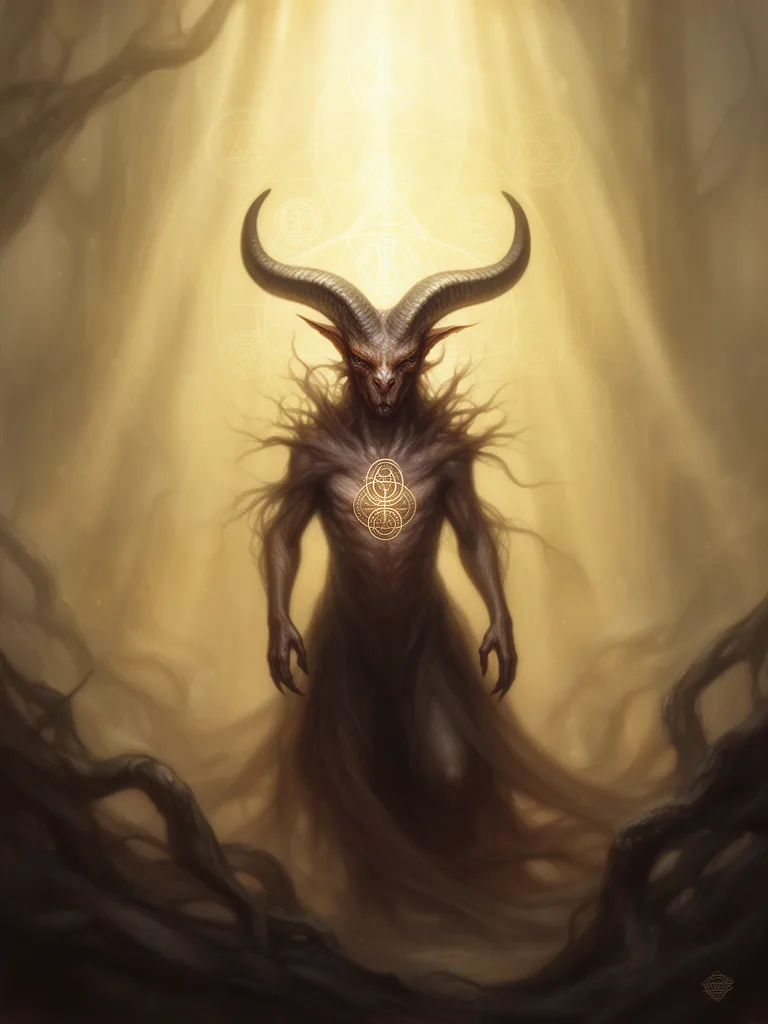
Where the word comes from
The English word "demon" derives from the Greek daimon, meaning "divine power" or "spirit." Initially neutral, it denoted a supernatural being, often a guiding spirit or an intermediary between gods and humans, as seen in Plato. Over time, particularly with the rise of Abrahamic religions, its connotation shifted towards malevolent entities.
In depth
Dracontia (Gr.). Temples dedicated to the Dragon, tiie emblem of tile Sun, tile symbol of Deity, of Life and Wisdom. The Egyptian Karnac, the Carnac in Britanny, and Stonehenge are Dracontia well known to all. Drakon (Gr.). or JJranon. Now considered a "mythical" monster, ]»erpetuated in the West only on seals, etc., as a heraldic griffin, and the Devil slain by St. George, etc. In fact an extinct antediluvian mon.ster. In Babylonian antiquities it is referred to as the "scaly one" and connected on many gems with Tiamat the sea. "The Dragon of the Sea" is repeatedly mentioned. In Egypt, it is the star of the Dragon (then the North Pole Star), the origin of the connection of almost all the gods with the Dragon. Bel and the Dragon, Apollo and Python, Osiris and Typhon, Sigur and Fafnir, and finally St. George and the Dragon, are the same. They were all solar gods, and wherever we find the Sun there also is the Dragon, the symbol of Wisdom — Thoth-IIermes. The Hierophants of Egypt and of Bal)ylon styled tliemselves "Sons of the St-rpcntGod" and the "Sons of tlie Dragon". "I am the Serpent, 1 am a Druid", said the Druid of the Celto-Britannic regions, for the Serpent and the Dragon were botii types of Wisdom, Immortality and Rebirth. As the serpent casts its old skin only to reappear in a new one, so does the immortal Ego east off one personality but to assume another.
How different paths see it
What it means today
The word "demon" carries such a heavy freight of negative connotation in contemporary parlance that it is difficult to approach its ancient roots with an open mind. Blavatsky's reference to dracontia and the dragon as a symbol of wisdom, drawing from Egyptian, Babylonian, and Celtic traditions, offers a vital corrective. She points us toward a time when the serpent or dragon was not solely an emblem of evil, as it became in the West through the influence of Gnostic and later Christian interpretations, but a potent symbol of cosmic forces, primal energy, and even divine knowledge. Mircea Eliade, in his studies of shamanism and archaic religions, often highlighted the ambivalent nature of spirits and supernatural beings, suggesting that what appears as "demonic" can often be understood as a manifestation of the sacred's terrifying aspect, the numinous that both attracts and repels. Carl Jung, in his exploration of the collective unconscious, would similarly frame such primal forces as "shadow" aspects, necessary components of the psyche that, when unacknowledged, can project outward as external malevolence. The transformation of daimon from a neutral spirit, a divine power, or even a personal guiding genius as described by Plato, into the devil figure of later theology, is a testament to humanity's need to categorize and control the vast, often unsettling, forces of existence. It is a journey from a complex, multifaceted understanding of the cosmos to a more Manichean dualism, a simplification that, while offering moral clarity, risks obscuring the intricate interplay of light and shadow that constitutes reality. This ancient term, therefore, invites us to reconsider our inherited dualities and to explore the possibility that what we label as "evil" might, in a broader cosmic perspective, be an essential, albeit challenging, facet of the whole.
Related esoteric terms
Books on this concept








No reflections yet. Be the first.
Share your interpretation, experience, or question.
