Daath
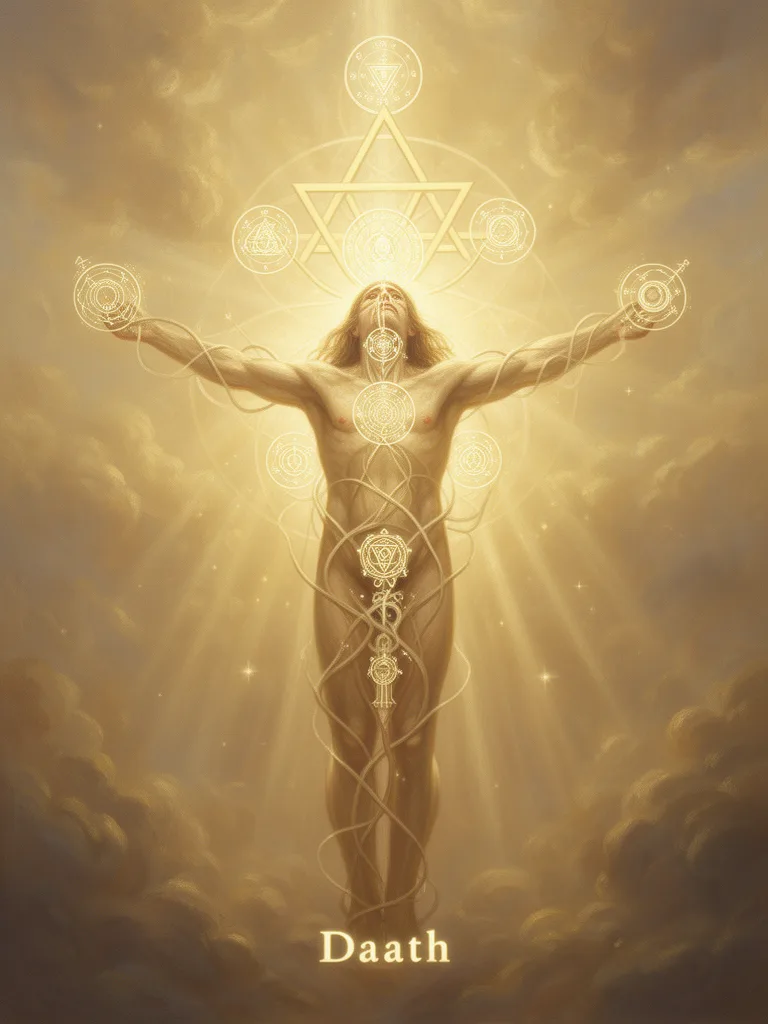
Daath, often translated as "Knowledge," represents a mystical state or sephirah in Kabbalistic thought, signifying the union of Wisdom (Chokmah) and Understanding (Binah). It is considered a gateway, a point of transition between higher and lower spiritual realms, and a place where divine and earthly consciousness can momentarily converge.
Where the word comes from
The Hebrew term "Da'at" (דעת) translates to "knowledge." While Blavatsky notes its connection to Chokmah and Binah, it is not traditionally counted among the ten Sefirot of the Tree of Life, but rather as a state or an abyss between them, a concept explored in later Kabbalistic interpretations.
In depth
Knowledge; "the conjunction of Ciickmah and Binah, Wisdom and Understanding: sometimes, in error, called a Sephira. [w.w.w.]
How different paths see it
What it means today
In the intricate architecture of the Kabbalistic Tree of Life, Daath occupies a unique and often debated position. It is not a discrete emanation in the same vein as the Sefirot, but rather a state, an experiential nexus where the potent forces of Chokmah (Wisdom) and Binah (Understanding) conjoin. This union, this profound "Knowledge," transcends mere data accumulation. It is the intuitive grasp, the sudden flash of insight that illuminates the interconnectedness of all things. Mircea Eliade, in his exploration of sacred time and space, might recognize in Daath a liminal zone, a threshold where the mundane world touches the divine, a place where the veil between the seen and the unseen thins.
Carl Jung, in his pursuit of the collective unconscious, could see Daath as the archetypal point of integration, where opposing psychic forces meet and, in their conjunction, give birth to new consciousness. It is the alchemical marriage, the sacred union that allows for transformation. The act of becoming aware of Daath is not an academic exercise but a spiritual practice, akin to the Sufi concept of fana, the annihilation of the self in the divine, or the Buddhist ideal of prajna, wisdom that sees the true nature of reality. It is the silence that follows the thunder of revelation, the quiet knowing that underpins all existence. For the modern seeker, Daath offers a compelling metaphor for the pursuit of integrated wisdom, a reminder that true understanding arises not from fragmented information but from the profound synthesis of intellect and intuition, a state of being that resonates with the very pulse of creation. This is the space where the universe's deepest truths are not told, but felt.
Related esoteric terms
Books on this concept







No reflections yet. Be the first.
Share your interpretation, experience, or question.
