Buddha
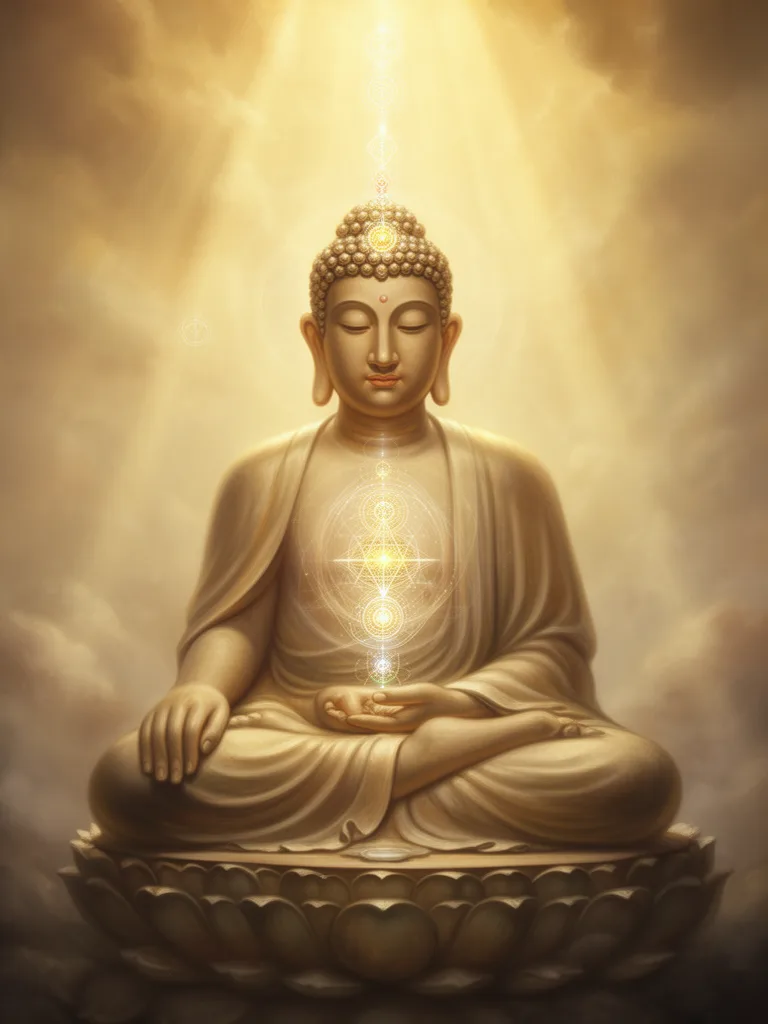
The title "Buddha" signifies an awakened being, one who has attained perfect enlightenment and liberation from suffering. It refers not only to Siddhartha Gautama, the historical founder of Buddhism, but also to any individual who achieves this profound state of spiritual realization and compassion.
Where the word comes from
The term "Buddha" originates from the Sanskrit root budh, meaning "to awaken" or "to know." It is a title, not a proper name, signifying an enlightened one. The concept predates Siddhartha Gautama, referring to a lineage of awakened beings within ancient Indian spiritual traditions.
In depth
Lit., the "Body of Compensaticm" (See Voice of the Silence, Glo.ss<'iry iiii. (.)f such Buddhakshetrus there are .seven, those of Nirmanakaya, Sand^hogakaya and Dharmakaya. belonging to the Trikdya, or three-fold quality.
How different paths see it
What it means today
Blavatsky's definition, linking "Buddha" to the "Body of Compensation" and the Trikaya, offers a profound esoteric lens, moving beyond the popular image of the serene sage. The Trikaya, or three bodies, are crucial to Mahayana Buddhist cosmology. The Dharmakaya is the body of truth or essence, the ultimate reality itself. The Sambhogakaya is the enjoyment body, the celestial form experienced by advanced bodhisattvas. The Nirmanakaya is the emanation body, the earthly manifestation, like Siddhartha Gautama, who appears in the world to teach the Dharma.
This tripartite structure suggests that enlightenment is not merely a personal cessation of suffering but a cosmic principle that manifests in multiple dimensions. The "Body of Compensation" hints at a cosmic balance, where awakened beings play a role in the unfolding of existence, perhaps by offering a counterpoint to ignorance and suffering. Mircea Eliade, in his studies of shamanism and archaic religions, often explored the concept of the mediator, the one who bridges the human and divine realms. The Buddha, in this esoteric interpretation, functions as such a cosmic mediator, his being a testament to the possibility of liberation and a source of spiritual sustenance for all beings. This understanding invites us to see the Buddha not just as a historical figure or a distant ideal, but as an active, multidimensional presence within the fabric of reality, a cosmic force of awakening. The challenge for the modern seeker is to recognize this potential not only in the external figure but within the depths of their own consciousness, a journey that requires both intellectual understanding and profound inner transformation.
RELATED_TERMS: Enlightenment, Nirvana, Bodhisattva, Samsara, Dharma, Trikaya, Shunyata, Awakening ---
Related esoteric terms
Books on this concept








No reflections yet. Be the first.
Share your interpretation, experience, or question.
