Bride
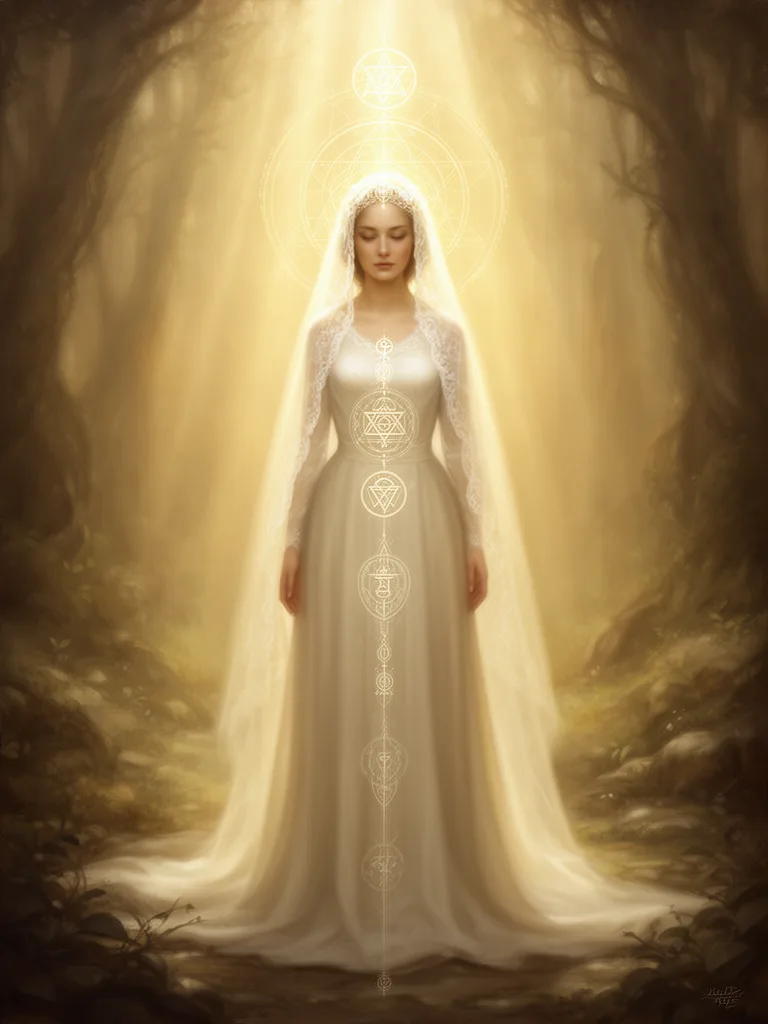
The Bride, in esoteric traditions, symbolizes the receptive, manifested aspect of the divine, often identified with the material universe or the human soul awaiting spiritual union. It represents the potential for divine presence to be embodied and experienced.
Where the word comes from
The term "Bride" originates from Old English "bryd," related to Germanic roots signifying "to cook" or "to prepare," referencing the bride's preparation for marriage. In mystical contexts, it signifies readiness for union with the divine, a concept found across various spiritual traditions.
In depth
The tenth Sephira, Malkuth. is caHed by the Kabbalists the Bride of Microprosopus ; she is the final He of the Tetragrammaton ; in a similar manner the Christian Church is called the Bride of Christ. [w.w.w.]
How different paths see it
What it means today
The concept of the Bride, as evoked in Blavatsky's definition, transcends a simple marital analogy. It speaks to a profound dynamic of divine immanence, the universe as a willing partner in the ongoing creation and revelation of the sacred. In Kabbalah, Malkuth, the Bride, is not merely the lowest Sephira, the material world, but the culmination of divine emanation, the receptive vessel for the divine light to be experienced in form. She is the final 'Heh' of the Tetragrammaton, the breath that gives life to the manifested name.
This echoes the rich imagery in Christian mysticism, where the soul, or the Church, is depicted as the Bride of Christ. This is not a subservient relationship but one of profound intimacy and ecstatic longing, a spiritual marriage. Think of the poets like John Donne, whose "Hymn to God, my God, in my Sickness" speaks of being "a little dead child," ready to be reborn into God's embrace. The Bride is the soul prepared, purified, and yearning for the ultimate union, a state of being that transcends individual identity, as Mircea Eliade would describe in his studies of the sacred and the profane.
The resonance extends to the devotional practices of Hinduism, particularly in Bhakti yoga. The intense, often erotic, love poems of the Alvars towards Vishnu, or the Gopis towards Krishna, embody this bridal longing. The soul surrenders completely, becoming the devoted Bride to the divine Beloved, seeking not just union but ecstatic absorption. This is a path of surrender, where the ego is dissolved in the overwhelming presence of the divine, a concept explored by scholars like Wendy Doniger.
In Sufism, the Beloved is often male, and the seeker, male or female, is the lover yearning for union with God. While the explicit "Bride" metaphor might be less frequent, the underlying principle of passionate devotion and the dissolution of the self into the divine is identical. The ecstatic utterances of mystics like Rumi speak of this burning desire, this bridal readiness for the divine kiss.
The modern non-dual perspective can see the Bride as the manifest universe, the totality of phenomena, which is the receptive ground for the ultimate reality, the 'Bridegroom.' The realization of non-duality is the moment of union, where the perceived separation between the manifest and the unmanifest dissolves. It is the recognition that the Bride and Bridegroom are not two, but one existence. This bridal metaphor, therefore, is not about a static state but a dynamic, ongoing process of divine indwelling and reciprocal relationship, a cosmic dance of manifestation and return. RELATED_TERMS: Shekhinah, Anima, Divine Union, Shakti, Maya, Ecclesia, Devotion, Beloved
Related esoteric terms
Books on this concept








No reflections yet. Be the first.
Share your interpretation, experience, or question.
