Baubo
Baubo is a figure in ancient Greek mythology associated with mystery rites and the earth goddess Demeter. She is often depicted as an old woman who uses obscenity to alleviate Demeter's grief, symbolizing a potent, primal feminine power that can restore joy and fertility through shocking, earthy humor.
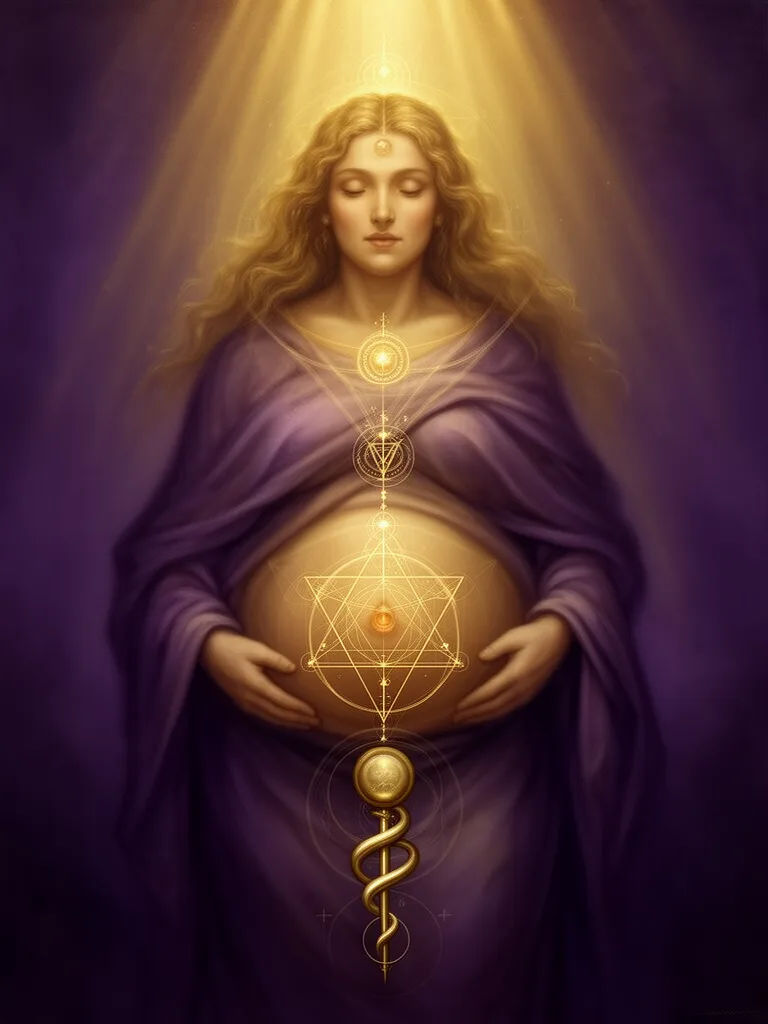
Where the word comes from
The name Baubo (Ancient Greek: Βαυβώ) has uncertain etymology. Some scholars suggest a connection to the onomatopoeic sound of babbling or a child's speech, implying something primal and unrefined. Others propose links to Phrygian or other Anatolian languages, hinting at deeper, pre-Hellenic roots for this chthonic figure.
In depth
Baubo (Ancient Greek: Βαυβώ) is a minor figure in Greek mythology who does not appear in surviving sources before the fourth century BCE. A fragment from Asclepiades of Tragilus states that she is the wife of Dysaules, who was said to be autochthonous; that they had two daughters, Protonoe and Misa; and that the couple welcomed Demeter into their house. The fifth century CE Greek grammarian Hesychius recorded the name Baubo in his lexicon, stating that she was the nurse of Demeter. He gives the meaning...
How different paths see it
What it means today
Baubo, a figure seemingly minor in the grand pantheon, emerges from the shadows of Eleusinian lore as a potent symbol of the earth's raw, untamed power. Her encounter with the grieving Demeter, where she lifts her tunic to reveal her vulva, is not mere vulgarity but a sacred act of cosmic rebalancing. This is the power of the chthonic, the generative force that lies beneath the surface of civilization, a force that, as Mircea Eliade observed in his studies of shamanism and archaic religions, is often accessed through ecstatic states and encounters with the primal.
Her obscenity, a jarring disruption, functions as a form of psychic catharsis. It’s the laughter that breaks the spell of sorrow, the earthy realism that confronts the abstract pain of loss. This is not the detached, intellectual contemplation of the stoic, but a visceral engagement with the cycle of life, death, and rebirth. The vulva, the portal of creation, becomes a symbol of renewal, a reminder that even in the depths of despair, the potential for life and joy persists.
In a world that often sanitizes emotion and separates the sacred from the somatic, Baubo’s story calls us back to a more integrated understanding of existence. It echoes the insights of Carl Jung, who recognized the importance of the shadow, the repressed, and the instinctual in the individuation process. Baubo forces a confrontation with the unseemly, the bodily, the aspects of life we often deem unworthy of the divine, yet which are, in fact, its very foundation. Her laughter, a primal sound, reminds us that the divine can be found not only in celestial realms but in the fertile earth, in the belly laugh that shakes the soul, and in the unapologetic expression of our embodied selves. She invites us to consider that the most profound spiritual insights may be found in the very things we are taught to hide.
RELATED_TERMS: Demeter, Eleusinian Mysteries, Shakti, Chthonic deities, Sacred marriage, Vulva symbolism, Primal feminine, Catharsis
Related esoteric terms
No reflections yet. Be the first.
Share your interpretation, experience, or question.
