Aum
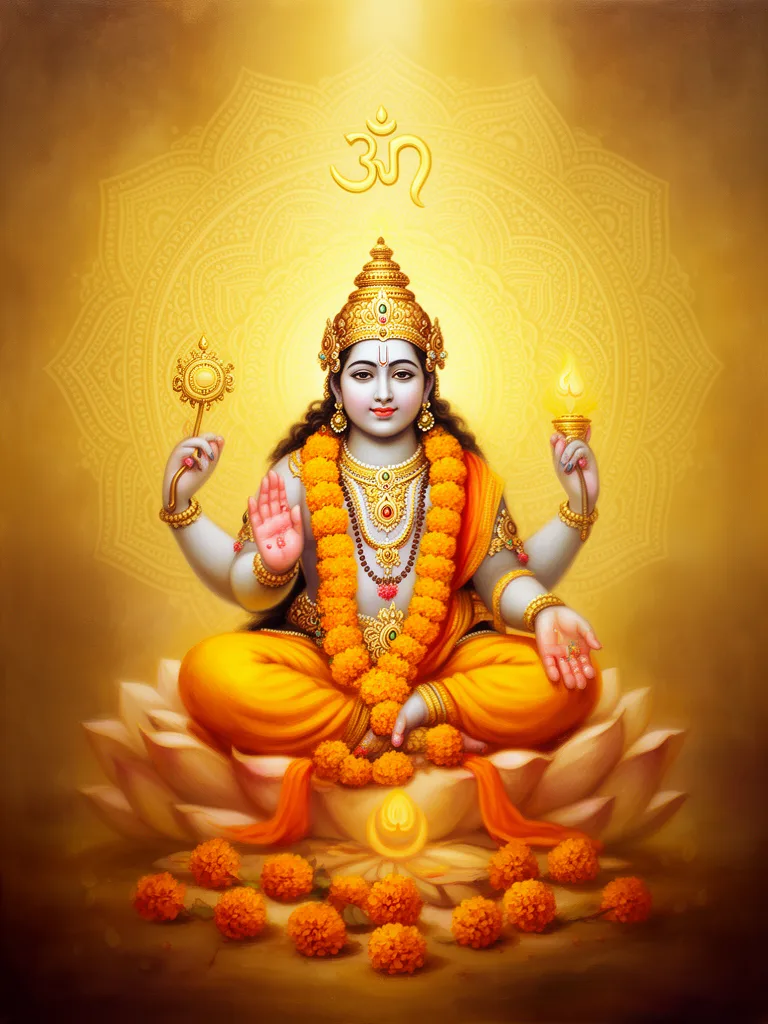
Aum is a sacred sonic syllable in Hinduism, representing the primordial sound of creation and the totality of existence. It embodies the three states of consciousness—waking, dreaming, and deep sleep—and the transcendent state beyond them, often equated with Brahman, the ultimate reality.
Where the word comes from
The Sanskrit word "Aum" (also transliterated as Om) derives from ancient Vedic traditions. Its root is believed to be related to the verb av, meaning "to protect" or "to pervade." It first appears in the Upanishads, becoming a foundational mantra in Hindu philosophy and practice.
In depth
The sacred syllable; the tripledettered unit; li.-nce the ti-iiiity in one. Aura (fir. and LafJ. A subtle invisible essence or Huid that eTuanates from human and animal bodies and even things. It is a psychic effluvium, i)artaking of both the mind and the body, as it is the electrovital, and at the same time an electro-mental aura ; called in Thecsophy the akasic or magnetic aura.
How different paths see it
What it means today
The syllable Aum, a sonic cornerstone of Hindu thought, is far more than a mere utterance. It is a sonic mandala, a cosmogram that, as Mircea Eliade might suggest, allows the participant to re-enter the sacred time of creation. The three phonetic components—A, U, M—are not arbitrary sounds but represent the fundamental modes of existence and consciousness. The 'A' signifies the waking state, the manifest world of form and activity; the 'U' represents the dream state, the realm of subtle experience and imagination; and the 'M' embodies deep sleep, the unmanifest, the potentiality from which all arises.
Yet, the true power of Aum, as elucidated in texts like the Mandukya Upanishad, lies in the silence that follows the final M. This silence is the fourth aspect, the turiya, the transcendent consciousness that is the ground of all being, the pure awareness beyond all states. It is the silence where the individual self, the Atman, realizes its identity with the universal consciousness, Brahman. This is the profound non-dual realization that the sound itself points towards.
The practice of chanting Aum, therefore, is an act of sonic meditation, a journey inward through the layers of perception to the still point at the heart of existence. It is a practice that, much like the Sufi dhikr or the Christian mystic's contemplative prayer, seeks to attune the individual soul to the divine presence, to dissolve the illusion of separation. The subtle vibrations, as Helena Blavatsky herself noted, are believed to have a direct impact on the psycho-spiritual constitution, harmonizing the inner energies and preparing the mind for deeper insights. In its simplicity, Aum offers a profound pathway to understanding the universe and our place within it, not through intellectual abstraction, but through direct, embodied experience. To utter Aum is to acknowledge the cosmic hum, the underlying vibration that sustains all that is, and to recognize that we, too, are part of that eternal song.
Related esoteric terms
Books on this concept






No reflections yet. Be the first.
Share your interpretation, experience, or question.
