Asana
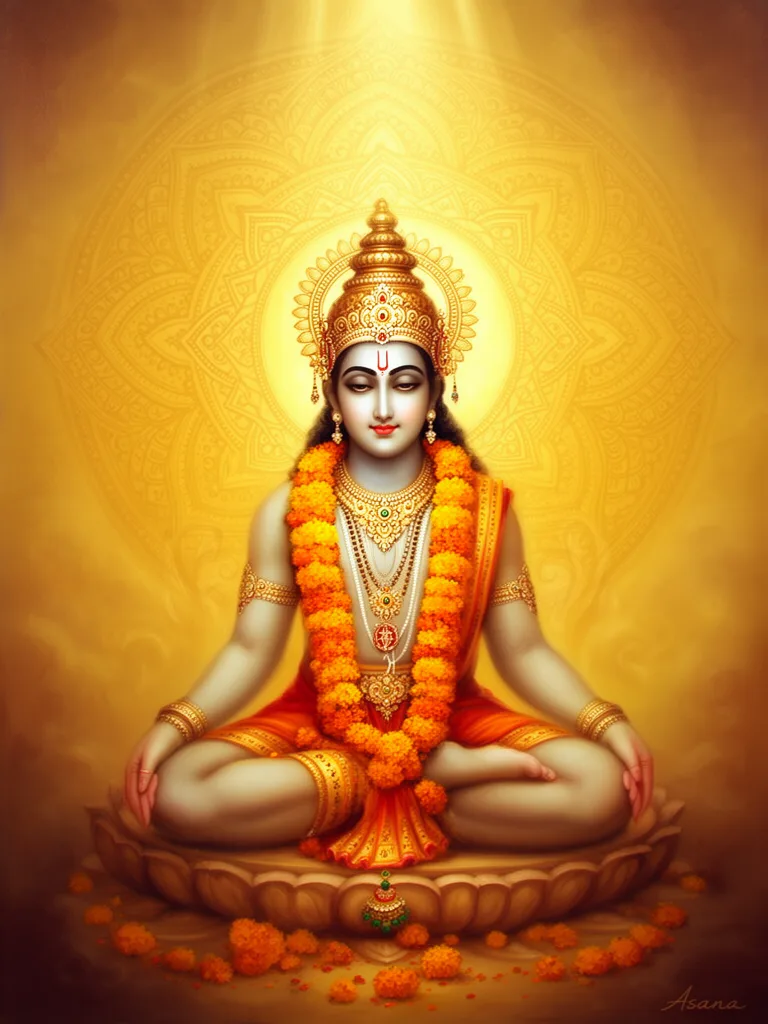
Asana refers to a specific posture or seat adopted for meditation or yogic practice. It is the third limb of Ashtanga Yoga, emphasizing stability and comfort to facilitate prolonged stillness and concentration.
Where the word comes from
The Sanskrit word "asana" (आसन) derives from the root "as," meaning "to sit" or "to be." It first appeared in ancient Indian texts, notably the Yoga Sutras of Patanjali, describing a steady, comfortable posture for yogis.
In depth
The third stage of Ildtli/i Yoya, one of the prescribed postures of meditation.
How different paths see it
What it means today
In the vast lexicon of yogic philosophy, "asana" might initially appear as a purely physical discipline, a series of contortions for the flexible. Yet, as Mircea Eliade illuminated in his seminal work on yoga, the postures were never intended as an end in themselves, but as a means to an end. Patanjali, in his Yoga Sutras, defines asana simply as "sthira sukham asanam"—a steady, comfortable seat. This deceptively simple formulation points to a profound principle: the body, when rendered stable and at ease, becomes a reliable foundation for the mind's ascent. It is not about achieving an aesthetically pleasing form, but about creating a state of being where the practitioner can remain undisturbed, a calm ocean upon which the waves of thought may gently break without capsizing the vessel.
The modern fascination with asana often focuses on its physical benefits—flexibility, strength, balance—and indeed, these are valuable byproducts. However, the original intent was to discipline the body into a state of non-resistance, to teach it to hold a position with such equanimity that the mind is freed from its constant need to adjust and fidget. This physical stillness is a potent metaphor for the mental stillness sought in meditation. As the body learns to be at ease in a particular posture, the mind can begin to detach from the incessant stream of sensory input and internal chatter. It is a practice of embodiment, of anchoring awareness in the physical present, thereby creating the conditions for introspection and spiritual insight. The asana, therefore, is not merely a pose; it is a carefully constructed locus of attention, a physical anchor that allows the consciousness to settle and deepen. It is in this stable, comfortable seat that the yogi, as T. Krishnamacharya emphasized, can truly begin to understand the self.
RELATED_TERMS: Prana, Pranayama, Dhyana, Samadhi, Hatha Yoga, Ashtanga Yoga, Yama, Niyama
Related esoteric terms
Books on this concept








No reflections yet. Be the first.
Share your interpretation, experience, or question.
