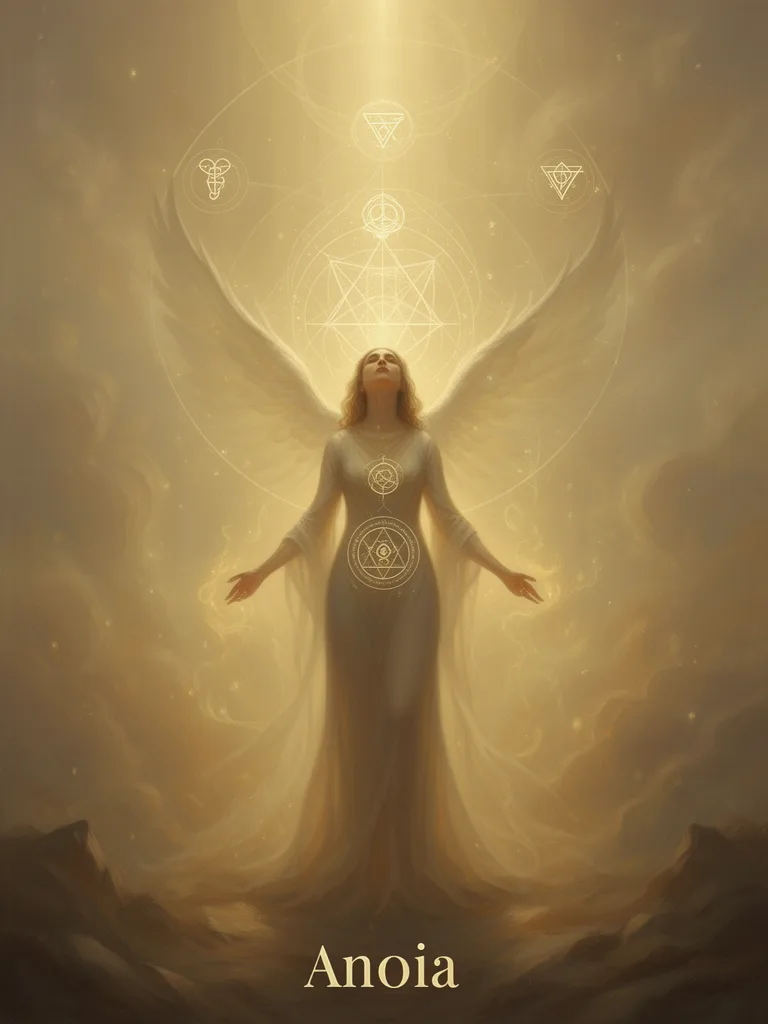
Anoia
Anoia signifies a profound lack of understanding or irrational folly, particularly when the intellect (Manas) becomes entangled with base desires (Kama). It represents a state of ignorance, akin to a spiritual or intellectual blindness that hinders true knowledge and wisdom.
Where the word comes from
The term "Anoia" is presented as a Greek word signifying "want of understanding" or "folly." Blavatsky suggests a connection to the Sanskrit term ajñāna (ignorance, irrationality, absence of knowledge), indicating a shared conceptual root across Indo-European languages concerning a deficiency in wisdom. The Greek root nous (mind) with the privative prefix a- likely forms its basis.
In depth
"Want of undiTstandinjr". "folly". Anoia is tlu* name jrivt-n l>y IMato and others to the lower Manas when too closely allied with Kama, which is iri'ational (Uf/iioid). The (!reek word (iptuiin is evidently a derivation from and co«;nate to the Sanskrit word ajnann (phonetically. a<j»]iana) or iffnoraiice, irrationality, absence of knowlcd<re. (See "A«;noia" an<l " Ajrno.stic".) Anouki l Ek.). A form of Isis; the poddess of life, from which nam-the Hebrew Auk, life. (See "Anuki").
How different paths see it
What it means today
The term "Anoia," as presented by Blavatsky, offers a piercing lens through which to examine the persistent human struggle against a certain kind of intellectual and spiritual fog. It’s more than mere ignorance; it’s an active, often wilful, misunderstanding, a state where the faculty of reason, intended to guide, instead becomes complicit in the perpetuation of illusion. This echoes the observations of Mircea Eliade regarding the archaic worldview, where myth and ritual provided a framework for understanding, and a deviation from this framework could lead to a kind of societal and personal disorientation, a spiritual anoia.
Blavatsky’s linkage of anoia to the lower Manas (mind) allied with Kama (desire) is particularly potent. It suggests that our rational faculties, when not tempered by wisdom or higher aspiration, can become enslaved by our baser instincts, leading us to rationalize selfish or destructive impulses. This resonates with Carl Jung's exploration of the shadow, the disowned aspects of the psyche that, when not integrated, can manifest as irrational behavior and a distorted perception of reality. The intellect, in this state, does not seek truth but rather seeks validation for its own flawed premises, a cognitive dissonance that binds us.
The Sanskrit parallel, ajñāna, underscores this idea of a deficiency in true knowledge, not just factual data. It points to a lack of prajñā, wisdom, the discerning insight that arises from spiritual practice and self-awareness. In Buddhist traditions, this ignorance is the root cause of suffering (dukkha), the fundamental misunderstanding of the nature of reality, impermanence, and the illusory self. The path to liberation, therefore, involves dismantling this anoia through mindfulness and insight meditation, as eloquently described by scholars like D.T. Suzuki.
For the modern seeker, anoia serves as a stark reminder that intellectual acuity alone is insufficient. True understanding requires a cultivation of inner awareness, an ethical grounding, and a willingness to confront the ways in which our desires and conditioning shape our perceptions. It is the quiet, persistent work of aligning the mind with a deeper, more authentic truth, lest we find ourselves perpetually lost in the labyrinth of our own unexamined thoughts.
Related esoteric terms
Books on this concept








No reflections yet. Be the first.
Share your interpretation, experience, or question.
