Adon
Adon, meaning "lord" in Phoenician and related Semitic languages, signifies a divine or supreme ruler. It is often associated with a solar deity or a master of creation, embodying authority and generative power within ancient Near Eastern cosmologies.
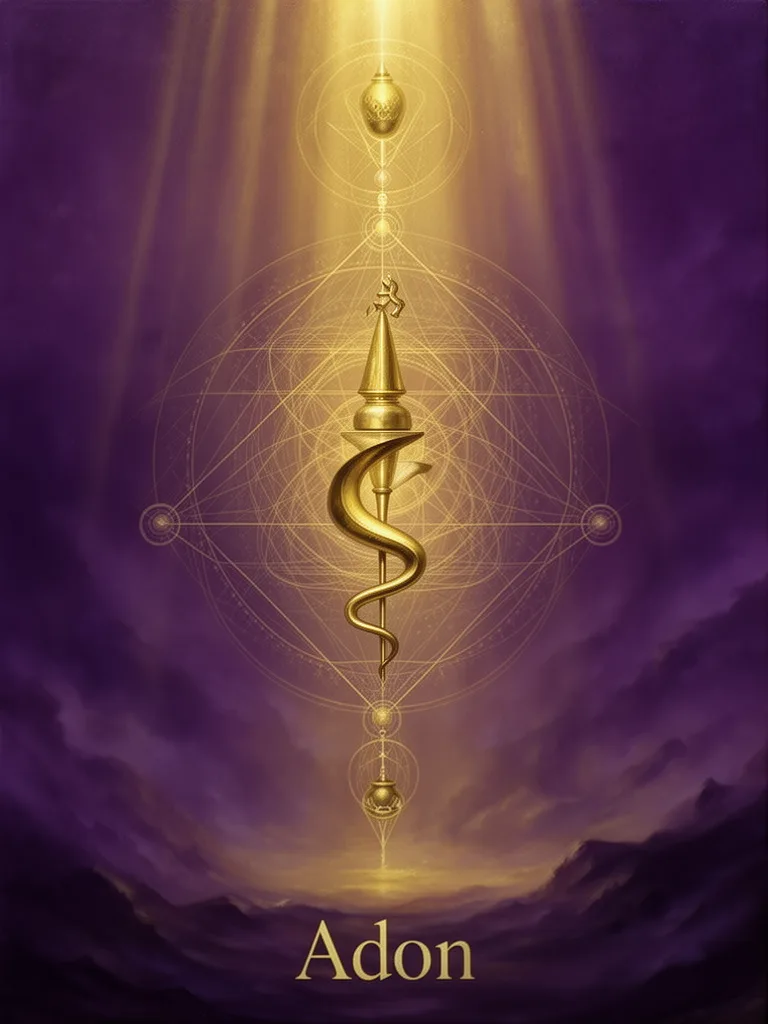
Where the word comes from
The term Adon originates from ancient Semitic languages, most notably Phoenician (𐤀𐤃𐤍). Its root is widely understood to derive from the Ugaritic ad, meaning "father," or a related Semitic root signifying "lord" or "master." This nomenclature reflects a primal concept of divine patriarchal authority.
In depth
Adon (Phoenician: 𐤀𐤃𐤍) literally means "lord." Adon has an uncertain etymology, although it is generally believed to be derived from the Ugaritic ad, “father.”
How different paths see it
What it means today
The term Adon, a resonant whisper from the ancient Levant, carries the weight of "lord" or "father." It is more than a simple designation; it is an invocation of primal authority, the generative principle from which creation springs. In the context of Hermeticism, Adon aligns with the concept of the Demiurge, the divine craftsman who orders the material realm, or even the ultimate, ineffable Godhead from which all emanates. Think of the celestial architect, not as a distant overseer, but as the very essence of ordered existence, the paternal force that fathers the cosmos into being.
This concept echoes Mircea Eliade's observations on the sacred as the opposite of the profane, the divine presence that imprints meaning onto the world. The "lord" is he who establishes dominion, who imbues the land, the heavens, and the human heart with divine law and purpose. For the modern seeker, contemplating Adon is to consider the inherent structure and intelligence that underpins reality, the benevolent, guiding hand that shapes the flux of existence. It is to recognize that within the apparent chaos, there is an underlying order, a paternal wisdom that nurtures and sustains. This understanding moves us beyond a passive reception of the divine to an active recognition of its immanent presence, a recognition that can foster a sense of cosmic belonging and responsibility. The Phoenician "lord" invites us to perceive the universe not as a random accident, but as a divinely fathered and governed enterprise, a profound and humbling perspective.
RELATED_TERMS: Logos, Demiurge, Father God, Baal, El, Creator, Divine Authority, Sovereign Power
Related esoteric terms
Books on this concept








No reflections yet. Be the first.
Share your interpretation, experience, or question.
