Adam
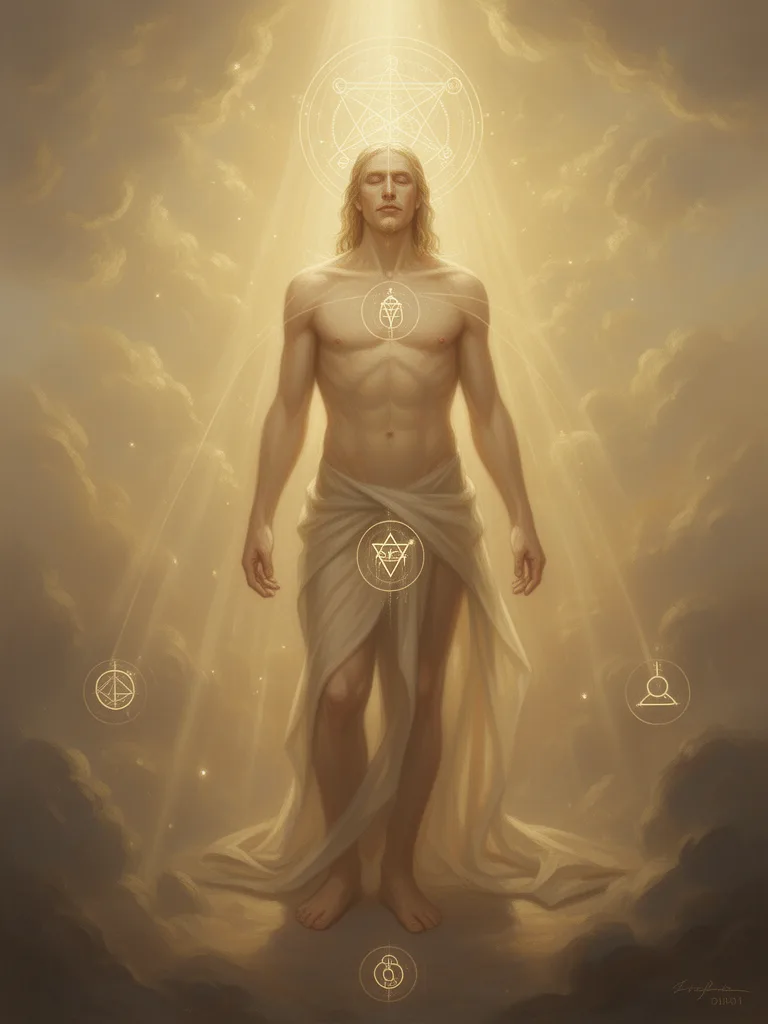
The primordial human, often depicted as made from earth, representing the initial divine spark or archetype of humanity. In Kabbalah, Adam signifies the "only-begotten" and the union of dual aspects within a single being.
Where the word comes from
The name "Adam" likely derives from the Hebrew word "adamah," meaning "earth" or "ground." This etymology underscores the concept of humanity's terrestrial origin and connection to the material world, a theme echoed in various creation myths.
In depth
In the Kahalah Adam is the "only-begotten", and means also "red earth". (See "Adam-Adami" in the Sec. Doct. II., p. 452). It is almost identical with Aihamas or Thomas, and is rendered into Greek by Didumos, the "twin" — Adam, "tiie first", in chap, i of Genesis, being shown, "male-female."
How different paths see it
What it means today
The figure of Adam, as presented in Blavatsky's definition, transcends the simple biblical narrative to become a profound esoteric archetype. The etymological link to "adamah," the Hebrew word for earth, immediately grounds this primordial human in the material reality, a stark contrast to the divine breath that animates him. This duality, the celestial spirit within the terrestrial form, is a recurring motif in mystical traditions. As Mircea Eliade observed in his work on myth and reality, such primal figures often serve as cosmic blueprints, embodying the very principles of creation and human existence.
The Kabbalistic understanding of Adam as the "only-begotten" and containing both masculine and feminine aspects (as hinted by "male-female" in Genesis) speaks to an original state of wholeness, a divine androgyne before the fragmentation of consciousness into distinct sexes and individual selves. This resonates with the concept of the Anima Mundi, the world soul, a concept explored by Neoplatonists and later by thinkers like Henry Corbin, who saw in such archetypes a bridge between the spiritual and material planes. The idea of Adam as Didymus, the twin, further emphasizes this inherent duality and the potential for integration.
For the modern seeker, Adam is not a relic of ancient scripture but a mirror reflecting our own condition. We are, like Adam, creatures of earth, bound by the physical laws of existence, yet we carry within us an ineffable spark of consciousness, a yearning for the divine. The "red earth" can be seen as our conditioning, our ingrained habits, our limitations, while the "only-begotten" aspect points to the unique, irreducible essence of our being that transcends these limitations. The journey, in many esoteric paths, involves recognizing and integrating these dualities, moving from a state of perceived separation to one of inherent unity, much like the primordial Adam before his division. This understanding invites us to see our material existence not as a prison, but as the very ground upon which the divine can manifest.
RELATED_TERMS: Archetype, Primordial Man, Divine Androgyne, Creation Myth, Soul, Consciousness, Duality, Wholeness
Related esoteric terms
Books on this concept





No reflections yet. Be the first.
Share your interpretation, experience, or question.
