Genii
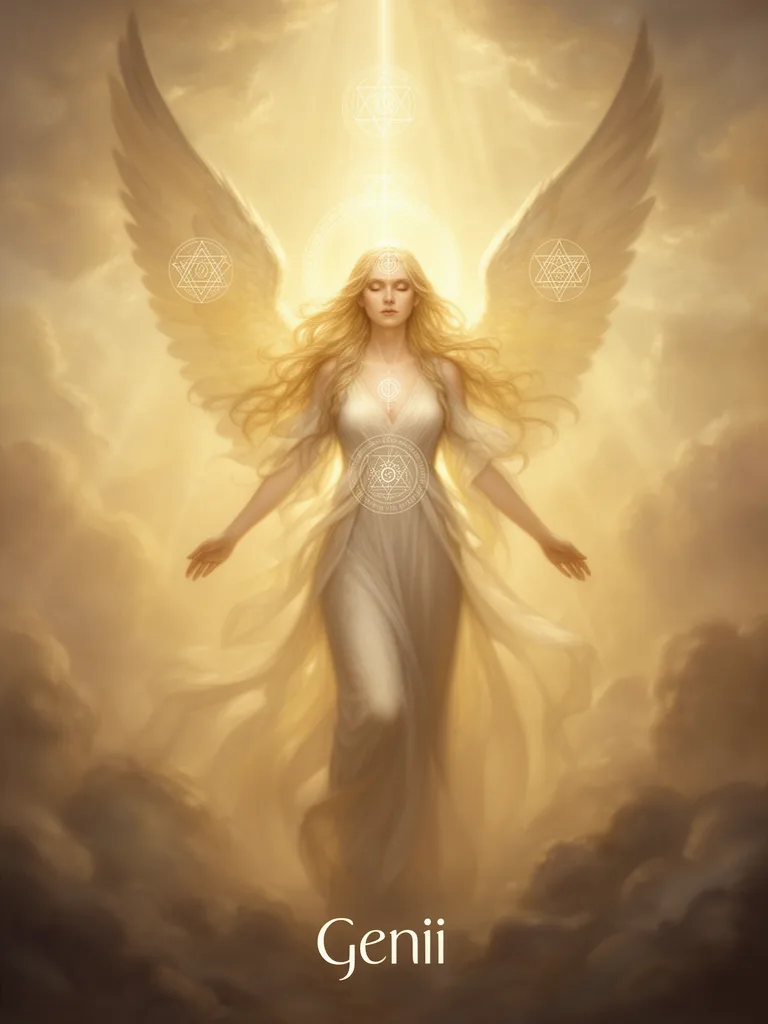
Genii are spiritual beings or divine intelligences, often associated with guardian spirits or tutelary deities. In Gnostic traditions, they represent angelic hierarchies, embodying specific cosmic forces or aspects of the divine, guiding and influencing the material world.
Where the word comes from
The term "Genii" derives from the Latin "genius," meaning spirit, guardian, or tutelary deity. It is related to the Proto-Indo-European root *ǵenh₁-, signifying "to give birth" or "to beget," suggesting a creative or generative force. The concept echoes the Greek "daimon," a divine or semi-divine being.
In depth
A name for ^ons, or angels, with the Gnostics. TW names of their hierarchies and classes are simply legion. Geonic Period. The era of the Geonim may be found mentioned ill works ti'eating of the Kabbalah; the ninth century .v.d. is implied, [w.w.w.]
How different paths see it
What it means today
The term "Genii," as presented in its Gnostic context, speaks to a universe brimming with unseen agency. It is a concept that, like the whispers of wind through ancient ruins, beckons us to consider the populated nature of reality beyond the immediately perceptible. Mircea Eliade, in his seminal works on the history of religions, often explored the human impulse to perceive the sacred immanent in the world, an impulse that finds expression in the belief in spiritual entities governing natural phenomena and human destiny. These Genii are not mere abstract notions but rather active participants, cosmic artisans shaping the very fabric of experience.
In the Gnostic cosmology, these Genii function as a celestial bureaucracy, a complex hierarchy of beings through which the ineffable divine interacts with the material plane. They are the conduits of divine will, the custodians of cosmic order, and the guardians of spiritual knowledge. This perspective offers a profound counterpoint to a purely materialistic worldview, suggesting that the universe is a dynamic arena of conscious forces, each contributing to the grand symphony of existence. The historical mention of the "Geonic Period" in relation to Kabbalah, though distinct in its specific theological framework, hints at a similar understanding of divinely appointed intelligences overseeing epochs and spiritual development.
For the modern seeker, the concept of Genii encourages a shift in perception. It invites an awareness of the subtle energies and intelligences that may permeate our environment, from the animating spirit of a place to the guiding whispers of intuition. It is an invitation to recognize that our journey is not undertaken in isolation but in communion with a vast, interconnected web of conscious beings. As Carl Jung observed, the archetypes that populate our inner world often find their external resonance in these perceived spiritual entities, reflecting the deep-seated human need to find meaning and connection within a larger cosmic order. Engaging with the idea of Genii is thus an exercise in imaginative theology, a way of re-enchanting the world and ourselves within its intricate, luminous design.
Related esoteric terms
Books on this concept





No reflections yet. Be the first.
Share your interpretation, experience, or question.
