Aaron
Aaron is recognized as the first High Priest in ancient Israelite tradition, brother to Moses, and a key figure in the transmission of divine law. His name is interpreted to signify an "enlightened one," positioning him as the progenitor of a lineage of initiated seers and spiritual leaders.
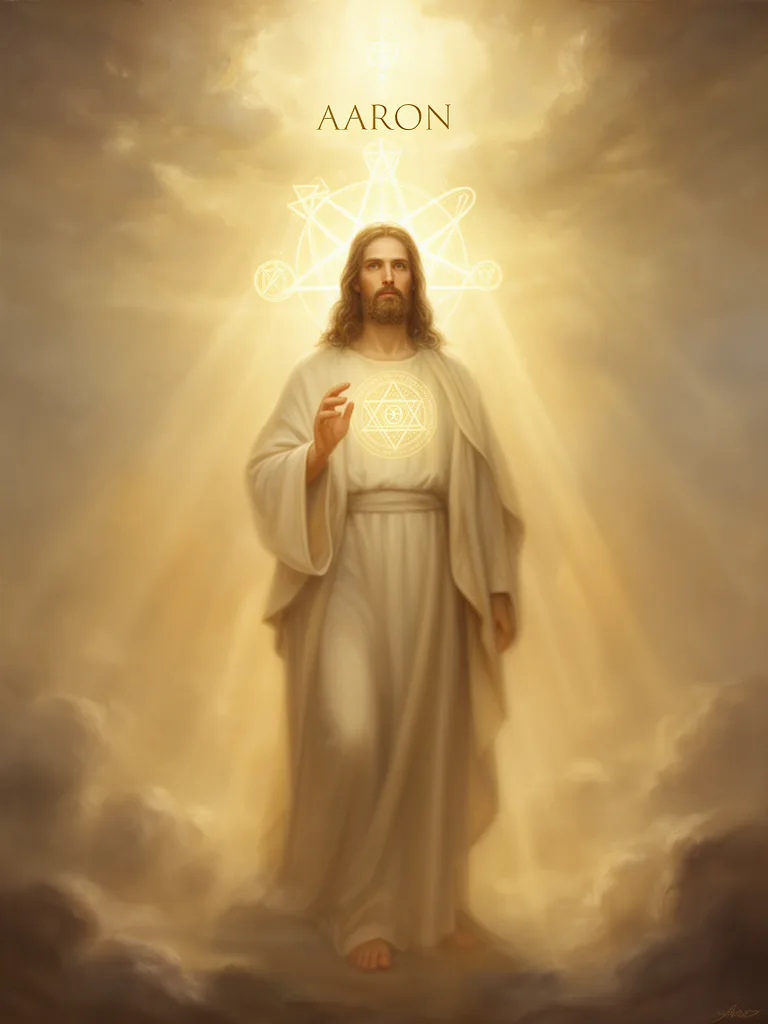
Where the word comes from
The name Aaron is of uncertain Hebrew origin, though commonly linked to the Hebrew word "a'haron," possibly meaning "exalted" or "high." Alternatively, some scholars suggest an Egyptian root, potentially from "aha-ron," meaning "great is the heart." Its first clear appearance is in biblical texts.
In depth
The elder l)rother of Moses and the firat Iniiiair of 2 THF:c)S()l'jniAL tlif IL'lu't'W La\v<.Mvi'r. Tlie iianic iiicaiis tlitlUioninttti <l, or tlio Enlight i md. Aaron tims heads tlif line, or Ilit-rarcliy. of the iiiitiatod \af)im, or SeiTs.
How different paths see it
What it means today
The figure of Aaron, as presented in the 1892 definition, transcends his biblical narrative to become a potent symbol of spiritual hierarchy and the transmission of esoteric knowledge. Blavatsky’s interpretation of his name as "the enlightened one" imbues him with a significance that resonates far beyond the confines of Mosaic law. He is not merely a historical figure but the archetypal High Priest, the first in a long line of those initiated into profound truths, a conduit through which divine wisdom flows. This concept of a spiritual lineage, a chain of transmission from master to disciple, is a recurring motif in many esoteric traditions. Mircea Eliade, in his studies of archaic religions, explored the importance of initiation as a rite of passage that confers a new mode of being, a connection to sacred time and space. Aaron, in this light, represents the very origin of such an initiated state, the progenitor of those who see beyond the mundane. His elder brother, Moses, receives the law, but Aaron, the High Priest, embodies its lived, sacred application. This duality mirrors the Hermetic principle of correspondence, where the macrocosm (divine law) is reflected in the microcosm (the initiated human being). The idea of an "enlightened one" heading a hierarchy of seers speaks to the Jungian concept of archetypes, universal patterns of consciousness that manifest in cultural symbols and figures. Aaron, as the first High Priest, can be seen as an early manifestation of the archetype of the spiritual guide or the wise elder, a figure who holds the keys to spiritual understanding and can lead others toward illumination. The notion of a "hierarchy of the initiated" suggests a structured path to spiritual attainment, a concept echoed in various mystical orders and philosophical schools, from the Neoplatonists to the Sufis, where stages of spiritual progress are meticulously charted. Aaron, therefore, stands as a foundational figure, a beacon for those who seek to understand the mechanisms of spiritual authority and the enduring human quest for divine connection. His legacy is not merely historical but deeply symbolic, a reminder that the path to enlightenment is often one of guided ascent, marked by initiation and the faithful transmission of sacred knowledge.
Related esoteric terms
Books on this concept








No reflections yet. Be the first.
Share your interpretation, experience, or question.
