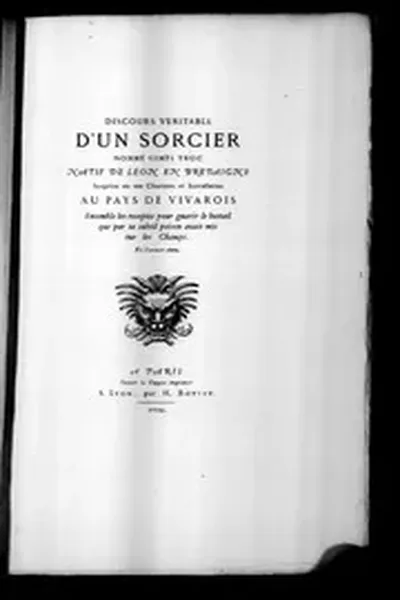
Tractatvs de confessionibvs maleficorvm et sagarvm recognitus & auctus. An, et quanta fides ijs adhibenda sit. ... 1591: Iss 114

 82
82

Tractatvs de confessionibvs maleficorvm et sagarvm recognitus & auctus. An, et quanta fides ijs adhibenda sit. ... 1591: Iss 114


Lorelei Sage, Contemplative Literature Editor — Pierre Binsfeld's 'Tractatus de confessionibus maleficorum et sagarum' is a cornerstone for understanding the historical discourse surrounding witchcraft and demonic influence. This expanded edition offers profound insights into the methods of investigation and the theological justifications prevalent in the late 16th century. Binsfeld's rigorous, albeit biased, approach to analyzing confessions reveals the intricate belief systems that fueled witch trials. Its strength lies in its comprehensive compilation of perceived evidence and the author's attempt to reconcile these with established dogma. Essential reading for scholars of esotericism, religious history, and the darker currents of European thought, this work illuminates a critical period of societal and spiritual upheaval.
📝 Description
82
Pierre Binsfeld's 1591 'Tractatus de confessionibus maleficorum et sagarum' examines witchcraft confessions.
Published in 1591, Pierre Binsfeld's Tractatus de confessionibus maleficorum et sagarum recognitus & auctus scrutinizes confessions made by individuals accused of witchcraft and sorcery. Binsfeld investigates the credibility of these testimonies, questioning the extent to which they should be trusted in matters of faith and truth. The work details the perceived pacts and practices attributed to those labeled as malevolent.
This text functions as a historical document showing the anxieties of its time regarding supernatural threats. It also reveals the philosophical basis for judicial and theological responses to these perceived dangers. For those interested, the treatise offers insight into how 'witchcraft' was historically understood, the power dynamics within confession processes, and the persistent human interest in concealed knowledge and proscribed practices. It reflects the complex mixture of fear, belief, and the disruption of perceived natural order that characterized late Renaissance Europe, prompting reflection on the trustworthiness of evidence when confronting the unknown.
This treatise belongs to the tradition of early modern demonology and legal inquiry into witchcraft. It engages with theological debates on the nature of demonic influence and the validity of confessions obtained under duress or persuasion. Binsfeld's work reflects a scholarly attempt to categorize and understand malevolent magic, drawing on legal precedent, theological arguments, and accounts of supposed malefactors. It sits within a broader intellectual current concerned with the perceived supernatural threats to social and religious order during the Renaissance.
💡 Why Read This Book?
Explore the historical construction of 'witchcraft' through the lens of confessional accounts. Understand the theological and societal anxieties of the late Renaissance. This book is ideal for seekers of hidden historical truths, scholars of occultism, and practitioners interested in the roots of demonology and early modern legal practices.
⭐ Reader Reviews
Honest opinions from readers who have explored this book.
❓ Frequently Asked Questions
What is the primary focus of this tractate?
The primary focus is the analysis and evaluation of confessions obtained from individuals accused of witchcraft and sorcery, questioning the credibility and weight to be given to such testimonies within the context of the late 16th century.
Who was Pierre Binsfeld?
Pierre Binsfeld was a jurist and writer active in the late 16th century, known for his contributions to the legal and theological discourse surrounding witchcraft during a period of intense persecution.
What historical period does this book cover?
The book directly addresses events and beliefs from the late 16th century, a peak period for witch trials and the dissemination of literature on maleficium and sorcery across Europe.
Is this book a primary source for understanding witch trials?
Yes, it is considered a significant primary source, offering insight into the legal reasoning, theological arguments, and societal perceptions that informed the prosecution of alleged witches during its time.
Does this book advocate for or against the accused?
Binsfeld's work is complex; while it critically examines confessions, it operates within the prevailing framework that believed in the reality of witchcraft, aiming to refine the understanding and prosecution of such cases.
🔮 Key Themes & Symbolism
The Nature of Confession and Truth
This treatise delves deeply into the psychological and spiritual implications of confessions extracted from those accused of witchcraft. It questions the veracity of statements made under duress, influenced by fear, or potentially manipulated by external forces, exploring the fine line between genuine remorse or confession and coerced testimony. Binsfeld grapples with how to discern truth when the accused themselves might be under the influence of 'maleficium' or have undergone profound spiritual distress. The text examines the evidentiary value of these confessions, a critical aspect in historical legal proceedings, and implicitly touches upon the philosophical problem of subjective experience versus objective reality when dealing with alleged supernatural involvement.
Theological Frameworks of Sorcery
Binsfeld's work is steeped in the theological doctrines of his time, attempting to reconcile the perceived reality of witchcraft with Christian dogma. He explores the concept of the pact with the Devil, the nature of demonic influence, and the perceived mechanisms by which sorcerers could inflict harm. The text reflects a worldview where the supernatural was an active force, and individuals could enter into alliances with malevolent spiritual entities. Understanding these theological underpinnings is crucial for grasping the societal fear and the justification for severe punishment meted out to those accused of such crimes. It highlights the era's struggle to categorize and combat perceived threats to spiritual order.
Judicial and Investigative Practices
The 'Tractatus' offers a window into the legal and investigative methods employed during the height of the witch hunt era. Binsfeld, as a jurist, analyzes the procedures for questioning suspects, the types of evidence considered valid, and the legal precedents or principles guiding the trials. The book implicitly critiques certain practices while advocating for a more 'rational' or doctrinally sound approach to identifying and prosecuting witches. It reveals the anxieties surrounding false accusations, the challenges of discerning guilt, and the immense power wielded by authorities in shaping narratives of guilt and innocence based on confessions and other forms of 'evidence'.
💬 Memorable Quotes
Direct passages from the work, attributed to the author.
“An, et quanta fides ijs adhibenda sit.”
— A key question: 'And how much faith should be given to them?' This expresses the core inquiry into the reliability of confessions.
“Maleficorum et sagarum confessiones, vel verae, vel falsae, semper suspectae.”
— 'The confessions of sorcerers and witches, whether true or false, are always suspect.' This highlights Binsfeld's cautious approach to such testimonies.
“Diabolus veritatem suam interdum per mendacium pervertit.”
— 'The Devil sometimes perverts his truth through lies.' This reflects the theological belief in demonic deception influencing confessions.
“Scientia mali non semper est voluntas mali.”
— 'Knowledge of evil is not always the will for evil.' This suggests a nuanced view on the intent behind alleged malevolent acts.
“Magia et veneficia, crimina gravissima.”
— 'Magic and witchcraft are the most serious crimes.' This underscores the perceived gravity of offenses discussed.
🌙 Esoteric Significance
Tradition
This work falls within the broader tradition of demonology and early modern occult studies, specifically focusing on the legal and theological interrogation of perceived magical practices. While not a grimoire or a manual for practitioners, it is a critical text for understanding the historical construction of 'witchcraft' as an esoteric and forbidden art within a Christian framework. It informs the historical context of how occult beliefs were perceived, investigated, and condemned by established authorities, offering insight into the societal fear of hidden knowledge and forbidden powers.
Symbolism
The symbolism here is deeply embedded within the religious and legal discourse of the era. 'Confessions' themselves become symbolic of the struggle between divine order and infernal chaos. The 'maleficus' (sorcerer) and 'sagae' (witches) symbolize societal fears of subversion, betrayal, and the corruption of the natural world. The 'pact with the Devil' is a potent symbol of ultimate heresy and the abandonment of God. Binsfeld's analysis of these symbols aims to deconstruct their perceived manifestations and their implications for justice and spiritual salvation.
Modern Relevance
In contemporary times, Binsfeld's 'Tractatus' serves as a vital historical document for understanding the psychology of fear, mass hysteria, and the dangers of unchecked authority. It offers crucial insights into how deeply ingrained beliefs, when combined with legal power, can lead to persecution and injustice. For scholars of esotericism, it provides context for the historical perception and condemnation of folk magic and occult practices. For practitioners, it offers a critical historical perspective on the societal forces that shaped and often demonized their traditions, encouraging a deeper understanding of the historical roots of prejudice against the esoteric.
👥 Who Should Read This Book
This profound work is essential for academics and students specializing in Renaissance history, the history of religion, and the study of witchcraft and demonology. Seekers of esoteric knowledge will find it important for understanding the historical context of occult beliefs and their persecution. Practitioners interested in the historical evolution of magical practices and the societal forces that have historically opposed them will gain critical insights. Even the general reader with an interest in the darker aspects of human history and the nature of belief will find this a compelling and thought-provoking exploration of a key era.
📜 Historical Context
Published in 1591, Pierre Binsfeld's 'Tractatus de confessionibus maleficorum et sagarum' emerged during the latter, intense phase of the European witch hunts. This era was marked by widespread societal fear of witchcraft, fueled by religious upheaval, social anxieties, and the dissemination of demonological literature. Jurists, theologians, and inquisitors grappled with how to identify, prosecute, and punish individuals perceived as agents of the Devil. Binsfeld's work reflects the intellectual climate of the late Renaissance, where attempts were made to systematize knowledge about witchcraft, often relying on confessions obtained through brutal interrogation methods. The text is a evidence of the prevalent belief in the reality of diabolical pacts and the perceived threat posed by malevolent magic to both individuals and the divine order. Its influence extended to legal practices and theological debates concerning the evidence and nature of witchcraft accusations.
📔 Journal Prompts
Reflect on the power of confession: how can it be both a tool for truth and a weapon of oppression?
Consider the role of fear in shaping societal beliefs and actions, particularly in relation to the unknown or the 'other.'
Analyze the intersection of religious dogma, legal practice, and the construction of 'evidence' in historical witch trials.
How do the 'confessions' described by Binsfeld reflect the anxieties and worldview of the late 16th century?
Explore the enduring fascination with the occult and the supernatural across different historical periods and cultures.
🗂️ Glossary
Maleficorum
Latin for 'of sorcerers' or 'of evildoers.' Refers to individuals practicing harmful magic or malevolent arts.
Sagarum
Latin for 'of witches' or 'of sorceresses.' Refers specifically to female practitioners of witchcraft.
Maleficium
Latin for 'evil deed' or 'harmful act.' In the context of witchcraft, it refers to the magical infliction of harm on people, animals, or property.
Diabolus
Latin for 'Devil' or 'Satan.' The primary antagonist in Christian theology, believed to be the source of evil and temptation.
Veneficia
Latin for 'witchcraft' or 'poisoning.' Often used interchangeably with 'maleficium' to denote the practice of harmful magic, particularly by women.
This book appears in 2 collections
🔮 Readers Also Liked
Browse all →







![Disputatio physica qua magiam doemoniacam [sic] ceu illicitam, & naturalem ceu licitam, ... 1667: Iss 181](/img/thumb/disputatio-physica-qua-magiam-doemoniacam-sic-ceu-illicitam-naturalem-ceu-licitam-1667-iss-181-bugges-laurentius.webp)

More by BINSFELD, Pierre.
All books →


From the “Witchcraft” Collection
View all →




More Free Witchcraft & Paganism Books
View all →