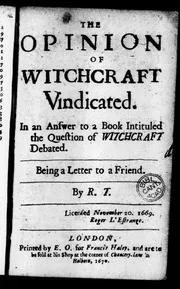
The opinion of witchcraft vindicated. ... 1670
 81
81

The opinion of witchcraft vindicated. ... 1670


Sophia Crane (Associate Editor) — "The Opinion of Witchcraft Vindicated" is a crucial artifact for understanding the historical discourse surrounding occult practices. R. T.'s defense moves beyond simple exoneration, probing the philosophical and spiritual arguments that underpinned accusations of witchcraft. Its strength lies in its introspective approach, urging a re-evaluation of what constituted 'witchcraft' in the 17th century, hinting at forgotten wisdom and misunderstood natural philosophies. This work is indispensable for scholars of early modern occultism, historical paganism, and anyone interested in the evolution of esoteric thought. It offers a nuanced perspective, challenging modern readers to consider the complexities of belief and persecution.
📝 Description
81
Published in 1670, 'The Opinion of Witchcraft Vindicated' argued for the reality of witchcraft.
This 1670 text, attributed to R. T., defends the practice of witchcraft. It moves beyond simply protecting accused individuals to examine the underlying beliefs about unseen forces and the anxieties of its time. The author questions common understandings and encourages a deeper look past the persecution of alleged witches.
The book connects the human mind, the natural world, and spiritual dimensions. It is written for those interested in older magical traditions, secretive knowledge, and the strength of inner knowing when faced with rigid, rational thought. It provides insight into how people in the past considered complex metaphysical issues and their continued interest in the unknown. The defense of witchcraft presented here prompts reflection on authority, understanding, and the often-mistrusted feminine aspects of divinity.
This work emerges from a period where the boundaries between folk magic, religious belief, and demonology were intensely debated. It engages with concepts of unseen influences and spiritual forces that were common in various esoteric traditions of the early modern era. The author's attempt to 'vindicate' witchcraft suggests a perspective that sought to understand or even legitimize practices often condemned by mainstream religious and secular authorities, placing it within a broader discourse on occult philosophy and early modern demonology.
💡 Why Read This Book?
Embark on a journey into the heart of 17th-century occult thought. "The Opinion of Witchcraft Vindicated" offers a rare defense of practices often demonized, revealing hidden philosophical arguments. Ideal for seekers of esoteric knowledge, scholars of witchcraft history, and practitioners intrigued by the roots of modern paganism and occultism.
⭐ Reader Reviews
Honest opinions from readers who have explored this book.
❓ Frequently Asked Questions
What is the main argument of the book?
The book argues for a vindication of witchcraft, challenging the prevailing negative perceptions and suggesting a deeper, perhaps misunderstood, spiritual or natural basis for what was then condemned.
Who was the author, R. T.?
The author is identified only by the initials R. T. Their true identity remains a subject of scholarly speculation, adding to the text's mystique and enigmatic allure.
What historical period does this book represent?
The book represents the late 17th century, a period of intense societal and religious upheaval, where beliefs about witchcraft were deeply ingrained and often violently enforced.
Is this book a practical guide to witchcraft?
No, it is primarily a philosophical and argumentative text defending the concept of witchcraft, rather than a manual of magical practices or spells.
What is the significance of this book for modern occult studies?
It provides invaluable insight into the intellectual currents and defenses of occult belief during a time of significant persecution, offering a counter-narrative to mainstream historical accounts.
🔮 Key Themes & Symbolism
The Nature of Accusation and Defense
This theme studies the societal mechanisms of accusation and the intellectual strategies employed to counter them. It examines how 'witchcraft' was perceived and how R. T. constructs a reasoned, albeit controversial, defense. The text interrogates the power dynamics at play, where fear and dogma often overshadowed reason, and explores the courage required to challenge deeply entrenched beliefs, even if only through reasoned argument and subtle suggestion. It is a study in rhetoric and the art of persuasion in the face of overwhelming condemnation, highlighting the vulnerabilities of both the accused and the accusers.
Perception vs. Reality in the Occult
Fundamentally, the book grapples with the chasm between perceived malevolence and potential hidden truths within the area of the occult. R. T. suggests that what is feared and condemned might possess a different nature entirely, perhaps one aligned with misunderstood natural laws or spiritual insights. This theme invites contemplation on how societal lenses distort our understanding of the unknown, leading to persecution rather than exploration. It questions whether 'witchcraft' was a genuine force of evil or a misinterpretation of natural phenomena, spiritual practices, or even psychological states, urging a re-evaluation of our own biases towards the esoteric.
The Enduring Power of Unseen Forces
This theme explores the persistent human fascination with and belief in unseen forces, even in the face of societal pressure to conform. R. T. implicitly argues for the existence and influence of these forces, suggesting that they are an integral part of the cosmic order, whether understood or not. The text hints at a worldview where the veil between the physical and spiritual is thin, and where certain individuals possess a heightened sensitivity or connection to these energies. It speaks to the timeless quest for knowledge that transcends the mundane, recognizing the lasting impact of the invisible on the visible world and the human experience.
💬 Memorable Quotes
Direct passages from the work, attributed to the author.
“Fear often breeds delusion.”
— This poignant observation speaks to the psychological underpinnings of persecution. It suggests that irrational fears can lead individuals to perceive threats where none exist, creating a distorted reality.
“The wise man seeks understanding, not condemnation.”
— This highlights a philosophical ideal, contrasting a pursuit of knowledge with a tendency towards judgment. It implies that true wisdom lies in open-minded inquiry rather than pre-emptive denunciation.
“Nature holds secrets for those who observe.”
— This suggests a belief in natural magic and hidden knowledge within the environment. It encourages a deeper, more attentive relationship with the world around us to uncover its mysteries.
“Truth, though veiled, will eventually emerge.”
— This optimistic assertion speaks to the author's faith in the eventual triumph of truth, even when obscured by ignorance or malice. It implies a cyclical or unfolding understanding of reality.
💡 Key Ideas
Editorial paraphrase of the work's core concepts — not direct quotes.
To vindicate a cause is to bring it to light.
This quote emphasizes the act of revelation and justification. It suggests that the author's intent is to expose the truth about witchcraft, clearing its name and presenting it in a new, more favorable light.
🌙 Esoteric Significance
Tradition
This work is deeply rooted in the historical context of early modern occultism and demonology, acting as a counterpoint to the prevailing narratives of diabolical pacts and malevolent forces. It engages with the philosophical underpinnings of what was then considered 'witchcraft,' hinting at a potential understanding of natural magic, psychic phenomena, or misunderstood spiritual practices. While not explicitly aligning with a specific formalized esoteric tradition like Hermeticism or Kabbalah, it participates in the broader intellectual milieu that explored hidden knowledge and the interconnectedness of the cosmos, subtly challenging the monolithic view of witchcraft as purely evil.
Symbolism
While the text itself may not be overtly symbolic in its prose, its very subject matter—witchcraft—is laden with potent symbolism. The 'witch' often symbolized the untamed feminine, repressed natural instincts, or forbidden knowledge. The act of 'vindicating' witchcraft can be interpreted as an attempt to reclaim or reinterpret these symbols, suggesting that what was feared might hold a different, perhaps even beneficial, significance. The book's existence in 1670 symbolizes a moment of intellectual resistance against ingrained societal fears and a nascent attempt to look beyond the surface-level condemnation of perceived 'otherness.'
Modern Relevance
In contemporary times, "The Opinion of Witchcraft Vindicated" holds significant relevance for practitioners of modern paganism and witchcraft, offering a historical perspective on the roots of their traditions and the struggles faced by those who practiced similar arts centuries ago. For scholars, it remains a vital primary source for understanding the discourse surrounding occultism and persecution. Its themes of questioning societal norms, the power of belief, and the potential for misunderstood knowledge resonate with modern discussions on critical thinking, the nature of evidence, and the importance of historical empathy when examining marginalized beliefs and practices.
👥 Who Should Read This Book
This key work is essential for several distinct groups. **Scholars of occult history, religious studies, and early modern England** will find it an invaluable primary source for understanding the intellectual debates surrounding witchcraft. **Practitioners of modern witchcraft and pagan traditions** will gain a profound historical context for their path, understanding the lineage of persecution and defense. **Seekers of esoteric wisdom** who are drawn to challenging established narratives and exploring the philosophical underpinnings of belief will find much to contemplate. **Individuals interested in the psychology of fear and societal control** will appreciate its analysis of accusation and defense. Ultimately, anyone curious about the enduring human fascination with the 'other' and the quest for hidden knowledge will find this book useful.
📜 Historical Context
Published in 1670, "The Opinion of Witchcraft Vindicated" emerged during a period of significant intellectual and social transition in England. The fervor of the witch trials, which had peaked in the late 17th century, was beginning to wane, giving way to more rationalist and scientific thought influenced by figures like Isaac Newton. However, deep-seated beliefs and anxieties surrounding witchcraft persisted. This era saw a complex interplay between traditional folk beliefs, religious dogma, and the nascent Enlightenment ideals. The book's attempt to vindicate witchcraft can be seen as a reaction against the excesses of persecution, a philosophical defense of practices that were increasingly misunderstood or demonized. It reflects a society grappling with the shadows of superstition while simultaneously reaching for the light of reason, making it a fascinating window into the evolving consciousness of the time.
📔 Journal Prompts
How has the perception of 'witchcraft' evolved from the 17th century to today, and what does this evolution reveal about societal anxieties?
Reflect on a time when fear or societal pressure influenced your perception of a particular belief or practice. How did you navigate this?
Consider the concept of 'vindication.' What does it mean to vindicate a misunderstood or condemned idea or practice in your own life or in society?
Explore the relationship between natural phenomena and perceived supernatural events. How might R. T. have viewed this connection?
If you were to 'vindicate' a contemporary belief or practice that is often misunderstood or demonized, what would it be and how would you approach it?
🗂️ Glossary
Vindicated
To be cleared of blame or suspicion; to be shown to be right, reasonable, or justified.
Occult
Relating to supernatural, mystical, or magical powers, practices, or phenomena that are hidden or secret.
Dogma
A principle or set of principles laid down by an authority as incontrovertibly true.
Metaphysical
Relating to or based on philosophical reasoning; concerned with the fundamental nature of reality.
Esoteric
Intended for or likely to be understood by only a small number of people with a specialized knowledge or interest.
This book appears in 2 collections
🔮 Readers Also Liked
Browse all →


![Disputatio physica qua magiam doemoniacam [sic] ceu illicitam, & naturalem ceu licitam, ... 1667: Iss 181](/img/thumb/disputatio-physica-qua-magiam-doemoniacam-sic-ceu-illicitam-naturalem-ceu-licitam-1667-iss-181-bugges-laurentius.webp)



From the “Witchcraft” Collection
View all →
![John Todd [Illuminati And Witchcraft Exposed].pdf (PDFy mirror)](/img/thumb/john-todd-illuminati-and-witchcraft-exposed-pdf-pdfy-mirror.webp)




More Free Witchcraft & Paganism Books
View all →




![Aloysii Charitini [pseud.] Discurs von trüglichen Kennzeichen der Zauberey, worinnen viel abergläubische Meinungen vernunfftmässig untersucht und verworffen; wie auch ... 1708: Iss 174](/img/thumb/aloysii-charitini-pseud-discurs-von-tr-glichen-kennzeichen-der-zauberey-worinnen-viel-abergl-ubische-meinungen-vernunfftm-ssig-untersucht-und-verworffen-wie-auch-1708-iss-174-brunneman-jacob-d-1735.webp)