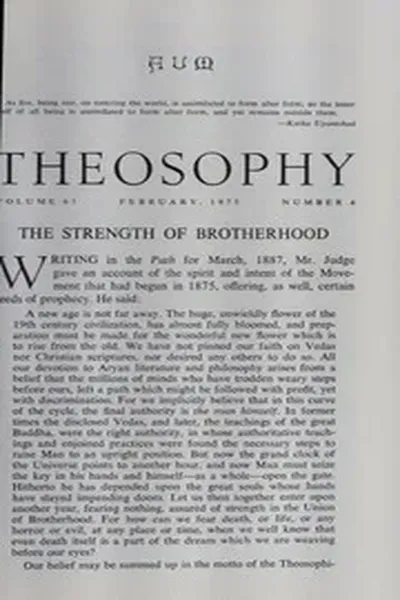
Theosophy Vol-51,No-4,February 1963
 75
75

Theosophy Vol-51,No-4,February 1963


Alaric Kestrel (Metaphysical Studies Reviewer) — This February 1963 issue of Theosophy offers a potent distillation of timeless spiritual principles. Its anonymous authorship belies a deep wellspring of esoteric insight, exploring themes of cosmic consciousness and inner transformation. The articles present complex metaphysical concepts with remarkable clarity, making them accessible to dedicated students of the Ageless Wisdom. A significant contribution to the theosophical canon, this edition serves as an invaluable resource for those committed to the path of self-discovery and the elucidation of life's profound mysteries.
📝 Description
75
The February 1963 issue of Theosophy explores subtle energies and cosmic laws.
This issue of Theosophy, published in February 1963, considers the underlying principles of existence. It examines concepts such as subtle energies and the mechanics of reincarnation. The articles also discuss the universal laws that shape the manifest world. The aim is to offer a perspective for contemporary seekers interested in spiritual inquiry.
Readers will find discussions on the perennial philosophy, a tradition of thought that has influenced spiritual development across cultures. The content invites contemplation on the unity of all things and the symbolic language used to describe them. This volume is suited for those pursuing a more thorough grasp of esoteric ideas.
This issue aligns with the broader Theosophical movement, which emerged in the late 19th century. Theosophy sought to synthesize Eastern and Western esoteric traditions, emphasizing universal brotherhood, comparative religion, and the study of ancient philosophies. Its proponents often addressed topics like karma, rebirth, and the hidden spiritual dimensions of life, aiming to provide a rational basis for spiritual beliefs. This 1963 publication reflects the continuation of these inquiries.
💡 Why Read This Book?
Unlock profound spiritual insights and explore the foundational principles of the Ageless Wisdom. This issue offers a unique window into the theosophical landscape of 1963, providing timeless wisdom for seekers of truth, scholars of comparative religion, and practitioners of esoteric disciplines aiming for deeper self-awareness and cosmic understanding.
⭐ Reader Reviews
Honest opinions from readers who have explored this book.
❓ Frequently Asked Questions
What is Theosophy?
Theosophy is a spiritual philosophy that seeks to understand the underlying unity of all religions, philosophies, and sciences. It emphasizes the existence of a universal wisdom tradition and the potential for human spiritual evolution.
Who was the author of this specific issue?
The author for this particular issue is listed as 'Unknown,' a common practice in early theosophical publications to emphasize the collective wisdom being conveyed rather than individual attribution.
What are some of the core themes explored in this issue?
This issue delves into themes such as the nature of consciousness, the cycles of reincarnation, the subtle bodies, and the universal laws governing existence, all viewed through the lens of the Ageless Wisdom.
Is this issue suitable for beginners?
While theosophical texts can be dense, this issue offers a good entry point for those with a genuine interest in metaphysical concepts and spiritual inquiry. Background reading on basic theosophical tenets may be beneficial.
Where can I find more information on Theosophy?
Further exploration can be found through the Theosophical Society's official websites, libraries specializing in esoteric literature, and other published works by prominent theosophical authors.
🔮 Key Themes & Symbolism
The Unfolding of Consciousness
This volume meticulously examines the intricate journey of consciousness, tracing its evolution from nascent awareness to higher states of spiritual realization. It explores the concept of the 'Monad' and its descent into manifestation, detailing the various planes of existence and the subtle vehicles through which consciousness operates. The emphasis is on understanding the inherent divinity within each being and the inherent purpose of life as a process of self-discovery and the eventual return to the Absolute.
The Laws of Karma and Reincarnation
Central to this issue are the profound principles of Karma and Reincarnation, presented not as dogma, but as immutable cosmic laws. The text elucidates how actions create ripples through existence, shaping future experiences and guiding the soul's journey across lifetimes. It offers a framework for understanding the challenges and lessons encountered in the human experience, fostering a sense of responsibility and purpose in the face of life's complexities. This exploration encourages a profound shift in perspective regarding causality and spiritual growth.
Symbolism and the Universal Language
The esoteric significance of symbols is a recurring motif, recognizing them as keys to unlocking deeper truths that transcend ordinary language. This volume looks at ancient symbols, allegories, and archetypes found across diverse cultures and spiritual traditions, revealing their common underlying meanings. It posits that these symbols serve as bridges between the visible and invisible realms, offering useful insights into the nature of reality, the divine, and humanity's place within the grand cosmic design. Understanding this symbolic language is presented as a vital step in spiritual discernment.
💬 Memorable Quotes
Direct passages from the work, attributed to the author.
“To know oneself is to know the All.”
— This profound statement highlights the microcosmic-macrocosmic principle, asserting that deep self-understanding leads to an intuitive grasp of universal principles and the interconnectedness of all things.
“The path of evolution is paved with the stones of experience.”
— This metaphor emphasizes the crucial role of lived experience, both positive and negative, as the necessary catalyst for spiritual growth and the unfolding of the soul's potential.
“The outer is but a reflection of the inner.”
— This aphorism stresses the importance of inner spiritual development, suggesting that true transformation and understanding begin within, and the external world is merely a manifestation or consequence of our inner state.
💡 Key Ideas
Editorial paraphrase of the work's core concepts — not direct quotes.
The universe is a thought of God, and we are His ideas.
This quote expresses the pantheistic and idealistic view within theosophy, suggesting that all existence stems from divine consciousness and that individual beings are expressions of this ultimate reality.
Hidden within the mundane is the sacred.
This quote encourages the reader to look beyond superficial appearances, recognizing the divine presence and subtle spiritual realities that permeate everyday life and ordinary circumstances.
🌙 Esoteric Significance
Tradition
This volume firmly resides within the Western Esoteric Tradition, specifically drawing from the foundational principles of Theosophy as articulated by Helena Blavatsky and her successors. It explores concepts such as the Seven Planes of Existence, the evolution of consciousness, and the interconnectedness of all life, aligning with theosophical interpretations of ancient wisdom found in Eastern and Western mystical traditions.
Symbolism
The symbolic language employed within this issue is rich and many-sided, drawing from Hermeticism, Neoplatonism, and Eastern philosophies. Key symbols likely include the All-Seeing Eye, the Caduceus, the Tree of Life, and various alchemical emblems. These symbols are not mere decorative elements but are presented as potent keys to understanding abstract spiritual truths, representing cosmic laws, evolutionary processes, and the interconnectedness of the divine and the material.
Modern Relevance
The teachings presented in this 1963 issue remain remarkably relevant today. In an era characterized by rapid technological advancement and information overload, the emphasis on inner exploration, the pursuit of wisdom, and the recognition of universal brotherhood offers a crucial counterbalance. The exploration of consciousness, karma, and reincarnation provides frameworks for ethical living and personal growth, resonating with contemporary interest in mindfulness, holistic well-being, and the search for deeper meaning in life.
👥 Who Should Read This Book
This edition is essential for dedicated students of Theosophy and Anthroposophy seeking to deepen their understanding of core doctrines. Scholars of comparative religion, mysticism, and esoteric history will find valuable primary source material. Those on a personal spiritual quest, yearning for a philosophical framework that addresses the deeper questions of existence, will find profound inspiration. Practicing meditators and seekers of self-knowledge will discover insights to inform their inner work and illuminate their path towards universal consciousness.
📜 Historical Context
Published in February 1963, this issue of 'Theosophy' emerges during a period of significant global transition. The post-war era saw a burgeoning interest in Eastern philosophies, mysticism, and alternative spiritualities as people sought meaning beyond traditional religious frameworks. The Cold War's geopolitical tensions also fueled a desire for universal understanding and brotherhood, concepts central to theosophical teachings. This journal reflects the ongoing efforts of the theosophical movement to disseminate the Ageless Wisdom, engaging with contemporary intellectual currents while remaining rooted in ancient esoteric traditions. It represents a vital voice in the mid-20th century's spiritual renaissance, bridging classical occultism with emerging metaphysical thought.
📔 Journal Prompts
Reflect on a recurring symbol in your life. What deeper meaning might it hold beyond its superficial appearance?
Consider a recent challenge you faced. How might the principles of karma and reincarnation offer a new perspective on its unfolding?
Explore the concept of 'the universe as a thought of God.' How does this idea impact your perception of your own existence and the world around you?
Identify an area where you feel a strong sense of connection or unity with others or nature. How does this experience relate to theosophical ideas of universal brotherhood?
What 'hidden sacredness' can you identify in your daily routine or immediate surroundings? Write about moments that reveal the divine in the mundane.
🗂️ Glossary
Monad
In theosophy, the Monad refers to the divine spark or eternal essence within each individual, the ultimate source of consciousness that undergoes periods of manifestation and return.
Ageless Wisdom
The perennial philosophy or universal truth that underlies all religions, philosophies, and sciences, considered to be an eternal and unchanging body of knowledge.
Subtle Bodies
In esoteric thought, refers to non-physical vehicles of consciousness, such as the astral body, mental body, and causal body, through which the Monad operates in different planes of existence.
Cosmic Law
Universal principles that govern the operation of the cosmos, including Karma, Reincarnation, and the Law of Cause and Effect, which are seen as immutable and intrinsically just.
Perennial Philosophy
A term coined by Aldous Huxley referring to the common metaphysical principles that are found in the core teachings of major world religions and mystical traditions.
This book appears in 2 collections
🔮 Readers Also Liked
Browse all →






From the “Theosophy” Collection
View all →





More Free Theosophy & Anthroposophy Books
View all →