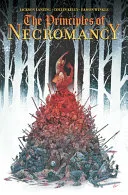
The Principles of Necromancy, Volume 1
 84
84

The Principles of Necromancy, Volume 1
Collin Kelly and Jackson Lanzing's "The Principles of Necromancy, Volume 1" presents a starkly grim vision of ambition. The conceit of a "medical miracle" intended to overcome death itself, driven by a figure like Doctor Jakob Eyes, is immediately striking. The authors excel at establishing a palpable atmosphere where civilization's reason is juxtaposed against the primal, untamed forces operating beyond its borders. A particular strength lies in the unflinching depiction of Eyes's methods, which are as unsettling as they are ambitious. However, the narrative occasionally leans too heavily on its grim premise, sometimes sacrificing character nuance for the sake of thematic consistency. The initial chapters, detailing the clash between the 'City King's' rationalism and the 'last pagans,' effectively set the stage but could benefit from more direct engagement with the philosophical underpinnings of Eyes's quest. The work's effectiveness hinges on its willingness to explore the grotesque in pursuit of the sublime.
This volume offers a potent, if dark, meditation on humanity's oldest fear.
📝 Description
84
### What It Is
The Principles of Necromancy, Volume 1, by Collin Kelly and Jackson Lanzing, is a fictional exploration of forbidden arts set against the backdrop of an age of reason. It chronicles the ambitious work of Doctor Jakob Eyes, a man driven to defy mortality in the perceived 'dark woods' beyond the reach of a rationalist society. The narrative posits a world where death itself is the ultimate frontier for scientific and arcane endeavor.
### Who It's For
This volume is intended for readers fascinated by the fringes of speculative fiction, particularly those who appreciate narratives that blend scientific ambition with occult themes. It will appeal to individuals interested in explorations of forbidden knowledge, the ethics of overcoming natural laws, and characters who operate outside societal norms to achieve seemingly impossible goals. Fans of dark fantasy and philosophical horror may find this work compelling.
### Historical Context
Set in a fictional era reminiscent of the Enlightenment's push towards empiricism and the suppression of older beliefs, the book contrasts a dominant 'age of reason and medicine' with lingering pagan traditions. This dichotomy reflects historical periods where scientific advancement often clashed with, or sought to explain away, older mystical practices. The pursuit of defying death is a perennial theme in human history, appearing in alchemical texts and ancient mythologies.
### Key Concepts
The central concept is necromancy, not merely as the raising of the dead, but as a radical medical and philosophical endeavor to conquer mortality. Doctor Jakob Eyes represents a figure who seeks to achieve this through applied, albeit highly unconventional, means. The narrative explores the tension between established scientific progress and ancient, nature-defying arts, questioning the definition of 'miracle' and 'healing' when pushed to extreme limits.
💡 Why Read This Book?
• Understand the philosophical implications of "medical miracles" as presented in Doctor Jakob Eyes's pursuit of overcoming death, a concept central to the book's initial chapters. • Explore the conflict between a technologically advanced 'age of reason' and older, persistent 'pagan' traditions, a recurring theme that shapes the narrative's setting. • Witness a unique portrayal of necromancy as a scientific endeavor rather than purely supernatural, challenging conventional interpretations of the practice.
⭐ Reader Reviews
Honest opinions from readers who have explored this book.
❓ Frequently Asked Questions
What is the core premise of 'The Principles of Necromancy, Volume 1'?
The book centers on Doctor Jakob Eyes, a proponent of advanced medical science who seeks to conquer death itself, operating outside the established 'age of reason' and clashing with traditional beliefs.
Who are the main authors of this work?
The book is authored by Collin Kelly and Jackson Lanzing, with its first publication date in 2024.
What is the historical setting suggested by the blurb?
The setting appears to be an era where a dominant 'age of reason and medicine' is challenged by 'pagan' traditions in secluded areas, evoking historical periods of intellectual and spiritual conflict.
What makes Doctor Jakob Eyes's work unique within the book's narrative?
Doctor Eyes aims to achieve a 'medical miracle' by overcoming death, framing necromancy as a scientific pursuit rather than solely a magical one.
What kind of themes does the book explore?
It explores themes of ambition, the ethics of defying natural laws, the conflict between science and ancient practices, and the ultimate conquest of mortality.
Is 'The Principles of Necromancy, Volume 1' part of a series?
The title indicates it is Volume 1, suggesting it is the first part of a larger work or series.
🔮 Key Themes & Symbolism
Mortality as Frontier
The work frames death not as an inevitable end, but as the ultimate frontier for human endeavor, particularly through Doctor Jakob Eyes's advanced 'medical' practices. This challenges the established order of the 'age of reason and medicine' by positing that mortality itself can be overcome through applied, albeit forbidden, knowledge. The narrative questions what constitutes a 'miracle' when achieved through such means, setting up a conflict between natural law and human ambition.
Reason vs. Ancient Ways
A central tension exists between the rational, empirical 'City King' and the 'pagan' traditions persisting in the 'dark woods'. This dichotomy highlights the historical friction between emerging scientific thought and deeply entrenched, often nature-based, belief systems. The book positions Doctor Eyes's work as an extreme manifestation of ambition that transcends both, operating in the liminal spaces where these forces collide.
The Ethics of Forbidden Knowledge
The pursuit of necromancy, framed as overcoming death, inherently involves forbidden knowledge and practices. The narrative implicitly questions the ethical boundaries of such pursuits. Doctor Eyes's goal, while framed as a medical marvel, likely carries significant moral and societal costs, exploring the consequences of wielding power that fundamentally alters the human condition.
Defining 'Miracle'
The blurb specifically references a 'medical miracle' in the context of defying death. This invites readers to consider how definitions of miracles shift when confronted with extreme scientific or arcane achievement. Is it a miracle when achieved through meticulous, if dark, practice, or only when attributed to divine intervention? The book probes this ambiguity.
💬 Memorable Quotes
“There is no such thing as magic.”
— This opening statement sets a provocative tone, suggesting the book will redefine or re-contextualize what is perceived as magical through a lens of extreme science or applied principle, challenging conventional understanding.
“The City King has driven the barbarian hordes to the edge of the world - ushering in an age of reason and medicine.”
— This establishes the societal backdrop: a dominant, rationalist regime that has suppressed older ways, creating a fertile ground for conflict with those who still practice ancient arts.
“In the dark woods beyond his reach, where the last pagans still keep their ancient ways, a single man of civilization is about to show the true meaning of 'medical miracle.'”
— This highlights the narrative's core conflict: a civilization's rationalism versus ancient practices, and introduces the central figure whose work will redefine the boundaries of possibility.
“His goal: to overcome death itself.”
— This concisely states the ultimate, audacious ambition driving the narrative, positioning death as the final obstacle to be conquered by the protagonist's methods.
“And god help the man or king who stands in his way.”
— This conveys the dangerous, uncompromising nature of Doctor Jakob Eyes's quest, warning of the formidable opposition he represents to any who would uphold the status quo.
🌙 Esoteric Significance
Tradition
While not explicitly tied to a single lineage, 'The Principles of Necromancy' engages with themes resonant in Hermeticism and certain branches of Western Esotericism, particularly the ambition to transcend natural limitations through gnosis and applied will. The pursuit of overcoming death aligns with alchemical goals and the Gnostic concept of liberating the spirit from material constraints. It departs by framing these aims through a starkly 'medical' and rationalist lens, suggesting a scientific approach to what is traditionally considered mystical.
Symbolism
The 'dark woods' likely symbolize the unconscious, the unknown, or the untamed forces beyond societal control, a traditional motif for hidden knowledge. Doctor Jakob Eyes himself can be seen as a symbol of transgressive ambition, a Promethean figure pushing the boundaries of human capability. The 'age of reason and medicine' represents a dominant paradigm of empirical knowledge, against which the protagonist's work is starkly contrasted, highlighting the limitations of purely rational understanding when facing existential questions.
Modern Relevance
Contemporary occult and esoteric circles often explore the intersection of science and spirituality. Works like this, which re-contextualize traditional forbidden arts within a pseudo-scientific framework, appeal to modern practitioners interested in the 'how' and 'why' of ancient practices, seeking to demystify or scientifically analyze phenomena. Thinkers in transhumanism and radical life extension might find thematic parallels in the book's ambition to conquer death, albeit through vastly different means.
👥 Who Should Read This Book
• Students of speculative fiction interested in narratives that blend scientific ambition with dark fantasy elements. • Readers drawn to philosophical explorations of mortality, ethics, and the boundaries of human achievement. • Individuals intrigued by reimagined occult themes that challenge traditional interpretations of forbidden arts.
📜 Historical Context
Published in 2024, "The Principles of Necromancy, Volume 1" emerges within a contemporary literary landscape that often revisits themes of occultism and forbidden knowledge, a trend that saw resurgence in the late 20th and early 21st centuries. The book’s premise, contrasting an 'age of reason and medicine' with enduring 'pagan' traditions, echoes historical periods like the Enlightenment (roughly 1685-1815), when scientific rationalism gained prominence, often challenging or seeking to explain away older mystical beliefs. This era saw figures like Isaac Newton engage with alchemy, demonstrating a complex relationship between emerging science and esoteric practices. The narrative's focus on defying death through applied, perhaps 'medical,' means can be seen as a modern interpretation of alchemical pursuits for immortality or the resurrection myths found across ancient cultures. The book's engagement with necromancy as a principle rather than mere sorcery taps into a long-standing occult fascination that also influenced figures like Aleister Crowley in the early 20th century, who sought to synthesize various esoteric traditions.
📔 Journal Prompts
Doctor Jakob Eyes's quest to overcome death: analyze the ethical implications of his 'medical miracle'.
The 'age of reason and medicine' versus 'pagan' traditions: how does this dichotomy shape the narrative's conflict?
Consider the definition of 'magic' as presented in the book's opening assertion.
Reflect on the symbolism of the 'dark woods' as a setting for forbidden knowledge.
Explore the concept of necromancy as a scientific endeavor rather than purely supernatural.
🗂️ Glossary
Age of Reason and Medicine
A fictional societal era characterized by a dominant belief in empirical science, rational thought, and advanced medical practices, often dismissive of older, non-scientific traditions.
Pagan traditions
Refers to the ancient, often nature-based, belief systems and practices that persist in secluded areas, existing in contrast to the dominant rationalist culture.
Medical Miracle
In the context of the book, this term is used provocatively to describe Doctor Jakob Eyes's attempts to achieve the seemingly impossible feat of overcoming death through his methods.
City King
The ruler or governing authority representing the established 'age of reason and medicine,' whose influence extends over the civilized world but not the wilder outskirts.
Barbarian Hordes
A metaphorical or literal term used to describe groups or forces pushed to the periphery by the dominant civilization, often associated with older ways of life.
Necromancy
In this work, necromancy is presented not just as the practice of communicating with the dead, but as a principle applied to achieve the ultimate 'medical miracle' of conquering death itself.
Dark Woods
A symbolic location representing the untamed, uncivilized, and perhaps mystical or forbidden territories beyond the reach of the 'City King's' rationalist domain.






![Secret Enemies of True Republicanism: Most important developments regarding the inner life of man and the spirit world, in order to abolish revolutions and wars and to establish permanent peace on earth, also: the plan for redemption of nations from monarchical and other oppresive [sic] speculations and for the introduction of the promised new era of harmony, truth and righteousness on the whole globe](/img/thumb/secret-enemies-of-true-republicanism-most-important-developments-regarding-the-inner-life-of-man-and-the-spirit-world-in-order-to-abolish-revolutions-and-wars-and-to-establish-permanent-peace-on-earth.webp)