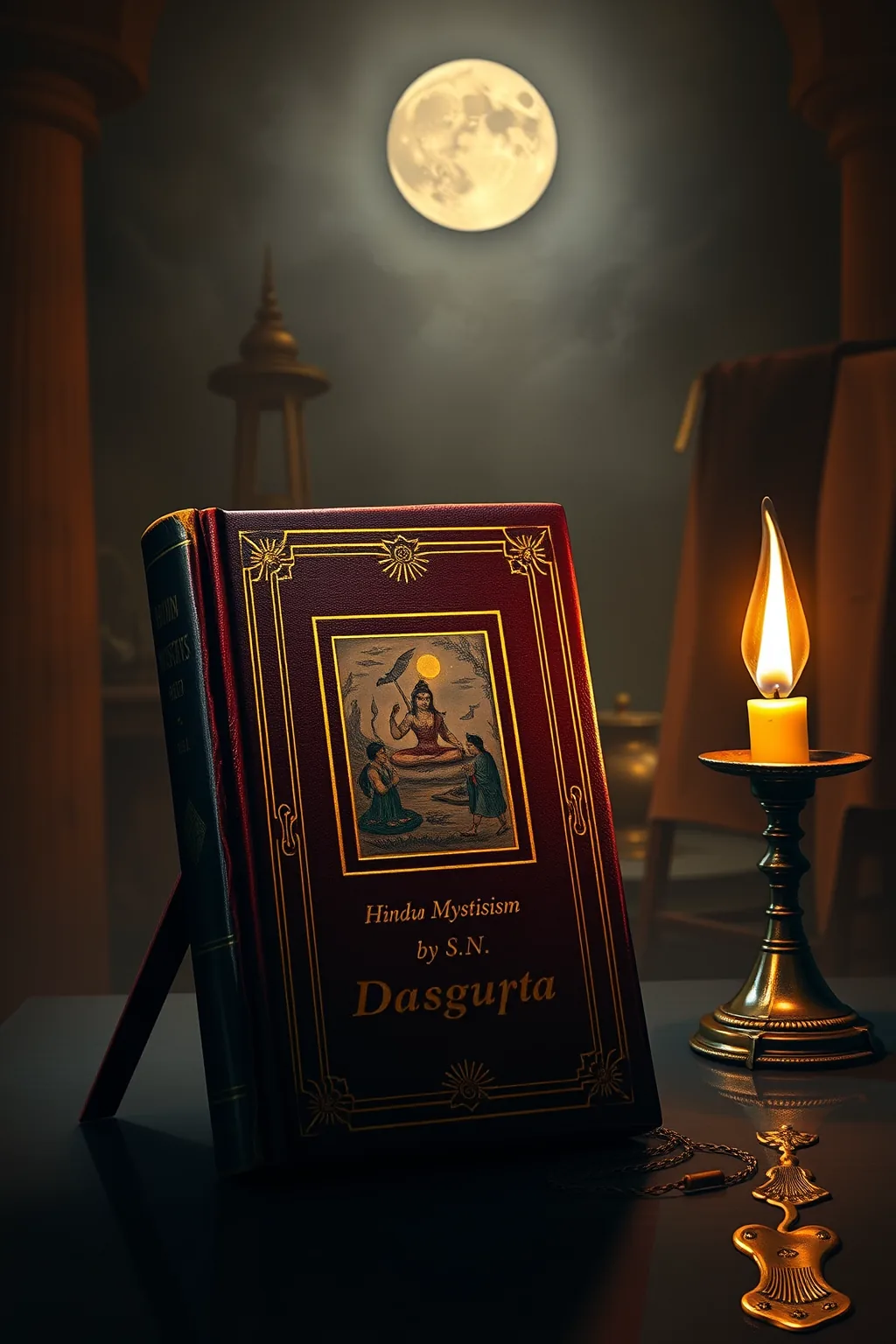
Hindu Mysticism
 74
74

Hindu Mysticism



Silas Hawthorne, Hermetic Studies Editor: S. N. Dasgupta's 'Hindu Mysticism' remains an indispensable cornerstone for understanding India's rich spiritual landscape. Published nearly a century ago, its clarity and depth are remarkable. Dasgupta masterfully dissects various mystical currents, presenting a systematic overview that eschews simplistic categorization. His definition of mysticism as direct spiritual apprehension is particularly potent, offering a framework for understanding practices beyond mere intellectualization. This work is a treasure trove for scholars and earnest seekers alike, providing foundational knowledge for anyone delving into the esoteric traditions of the East. Its enduring power lies in its ability to illuminate the profound connection between the individual soul and the cosmic consciousness.
📝 Description
74
S. N. Dasgupta published 'Hindu Mysticism' in 1927, detailing India's spiritual traditions.
Dasgupta's 1927 work presents Hindu mysticism not as abstract thought, but as a direct experience of life's fundamental questions. He traces the evolution of these ideas through centuries of Indian philosophy. The book examines esoteric knowledge, potent symbolism, and the pursuit of transcendental states. It aims to help contemplative readers understand the soul's desire for divine union and the core of existence. This volume serves as a guide for those seeking to move beyond the mundane toward the sacred.
This book situates Hindu mystical practices within the broader spectrum of Indian philosophical schools. It examines how concepts like Brahman, Atman, and Maya are understood through a mystical lens, moving beyond purely academic exposition. Dasgupta connects these ideas to specific yogic and meditative techniques that aim for direct spiritual realization. The work reflects a period when Western scholars were beginning to systematically study and present Indian spiritual thought, making these traditions accessible to a wider audience.
✍️ Author

S N Dasgupta
Surendranath Dasgupta (18 October 1887 – 18 December 1952) was an Indian scholar of Sanskrit and Indian philosophy..
💡 Why Read This Book?
This book is essential for anyone seeking to understand the profound spiritual heritage of India. It provides a clear, systematic introduction to diverse mystical traditions and their philosophical underpinnings. Ideal for seekers of inner truth, scholars of comparative religion, and practitioners interested in the roots of Eastern contemplative practices. It offers a gateway to a deeper understanding of consciousness, the divine, and the human quest for meaning.
⭐ Reader Reviews
Honest opinions from readers who have explored this book.
❓ Frequently Asked Questions
What is the central definition of mysticism presented in this book?
Dasgupta defines mysticism as a direct, immediate spiritual apprehension of life's aims and problems, experienced more profoundly than through abstract reasoning alone. It's about a felt, intuitive understanding of existence.
What historical periods of Hindu mysticism are covered?
The book traces the evolution of Hindu mysticism over many centuries, outlining its development and the emergence of various major forms within the Indian subcontinent.
Is this book suitable for beginners in Eastern spirituality?
Yes, while offering depth, the book provides a systematic introduction, making it accessible to sincere beginners eager to learn about Hindu mystical thought.
What is the philosophical significance of Dasgupta's approach?
Dasgupta emphasizes the experiential and intuitive aspects of spiritual knowledge, grounding mysticism in a direct relationship with the divine, rather than solely in intellectual dogma.
Does the book discuss specific practices or philosophies?
The book outlines several major forms of mysticism and introduces the systematic development of Hindu mysticism, touching upon its philosophical underpinnings and aims.
🔮 Key Themes & Symbolism
The Nature of Mystical Experience
This theme explores Dasgupta's core assertion that mysticism is not solely intellectual but a direct, intuitive apprehension of reality. It explores how this direct spiritual insight transcends rational thought, offering a more profound understanding of existence, the soul, and the divine. The book illuminates the subjective experience of the mystic, emphasizing the immediate and visceral connection to ultimate truths, thereby explaining the concept and grounding it in lived experience.
Evolution of Hindu Spiritual Thought
The work meticulously traces the historical and philosophical development of Hindu mysticism across centuries. It highlights the emergence and interplay of various schools of thought and devotional practices that constitute the body of India's spiritual heritage. By showcasing this evolutionary process, Dasgupta provides context for understanding the diversity and depth of Hindu mystical traditions, revealing how ancient wisdom has adapted and transformed through time.
The Quest for Ultimate Reality
Central to this theme is the exploration of the Hindu mystic's journey towards understanding and union with the ultimate reality. Dasgupta examines the philosophical frameworks and spiritual aspirations that drive this quest, whether through knowledge (Jnana), devotion (Bhakti), or action (Karma). The book reveals the diverse paths Hindus have trod in their pursuit of liberation (Moksha) and spiritual enlightenment, underscoring the perennial human desire to connect with the divine.
💬 Memorable Quotes
Direct passages from the work, attributed to the author.
“We must grasp in a more immediate and profound manner than through abstract reasoning alone.”
— This highlights the book's emphasis on intuitive knowledge and direct spiritual insight as superior to purely logical or philosophical deduction in understanding ultimate truths.
“The evolution of Hindu mysticism is a long and complex journey.”
— This points to the book's historical and systematic approach, underscoring the rich, complex development of spiritual thought within India over many centuries.
“The soul's yearning for union with the divine is a universal theme.”
— This suggests the book connects the specific traditions of Hindu mysticism to broader, universal spiritual aspirations shared by humanity across cultures and time.
“Hidden knowledge reveals the true nature of reality.”
— This implies the presence of esoteric teachings and secret wisdom within Hindu mysticism, which, when unveiled, offer useful insights into the fundamental essence of existence.
💡 Key Ideas
Editorial paraphrase of the work's core concepts — not direct quotes.
Mysticism is a direct apprehension of the aims and problems of life.
This quote expresses Dasgupta's view of mysticism as an immediate, felt understanding of existence, moving beyond mere intellectualization to a profound experiential grasp of life's purpose.
🌙 Esoteric Significance
Tradition
This work is deeply rooted in the Advaita Vedanta tradition, while also encompassing elements of Tantra, Yoga, and Bhakti movements. It explores the esoteric understanding of Brahman (Ultimate Reality), Atman (the Self), and the paths to realizing their non-duality. The emphasis on direct spiritual apprehension aligns with the core tenets of yogic and Vedantic paths seeking liberation through inner knowledge and experience.
Symbolism
Hindu mysticism is rich with potent symbolism, and Dasgupta's work implicitly or explicitly touches upon key elements such as the Om symbol representing the primordial sound, the lotus flower signifying spiritual purity and unfolding consciousness, and the serpent (Kundalini) as dormant spiritual energy. These symbols serve as visual and conceptual keys to understanding the subtle energies and cosmic principles within the tradition.
Modern Relevance
In an age often characterized by materialism and existential uncertainty, 'Hindu Mysticism' offers profound relevance. Its exploration of direct spiritual apprehension provides a framework for seeking meaning beyond the superficial. The ancient paths to self-realization and inner peace are timeless, offering practical guidance for working through the complexities of modern life and fostering a deeper connection to oneself and the universe.
👥 Who Should Read This Book
This foundational text is important for a diverse readership. **Beginners** seeking an accessible yet comprehensive introduction to the spiritual range of India will find its systematic approach useful. **Scholars** of comparative religion and philosophy will appreciate its rigorous historical and philosophical analysis. **Spiritual seekers** yearning for a deeper understanding of consciousness, the divine, and the human quest for transcendence will find profound inspiration. **Practitioners** of meditation, yoga, or other contemplative disciplines can gain valuable context and a richer appreciation for the traditions that underpin their practices.
📜 Historical Context
Published in 1927, S. N. Dasgupta's 'Hindu Mysticism' emerged during a period of significant intellectual and spiritual awakening in India. The early 20th century saw a burgeoning interest in Indian philosophy and spirituality globally, fueled by scholars and yogis who began to bridge Eastern and Western thought. This era was marked by a desire to both preserve and reinterpret ancient traditions in the face of modernity. Dasgupta's work contributed to this movement by presenting a systematic, academic, yet deeply appreciative overview of Hindu mystical traditions, making them accessible to a wider audience and establishing their philosophical legitimacy within academic discourse. It served as a vital bridge, useful the profound depths of Indian spirituality for both Indian intellectuals and Western scholars.
📔 Journal Prompts
Reflect on Dasgupta's definition of mysticism. How does 'direct spiritual apprehension' differ from intellectual understanding for you?
Identify a core concept from Hindu mysticism discussed in the book that appeals to your personal spiritual journey. Explore its meaning.
Consider the 'evolution' of spiritual thought. How do ancient ideas about consciousness and reality still manifest in modern life?
What does the quest for 'ultimate reality' mean in your own life? What paths are you exploring?
Analyze a symbol from Hindu mysticism (e.g., Om, lotus). What deeper esoteric meanings can be gleaned from its form and context?
🗂️ Glossary
Brahman
The ultimate, unchanging reality or cosmic spirit in Hinduism, the supreme cosmic spirit that is the source and sustainer of all existence, often described as infinite, eternal, and formless.
Atman
The individual soul or self, which in many Hindu traditions, particularly Advaita Vedanta, is considered identical to Brahman. It is the eternal essence of a living being.
Moksha
Liberation or release from the cycle of birth, death, and rebirth (samsara). It represents the ultimate spiritual goal in many Hindu philosophies, achieved through self-realization and union with the divine.
Jnana Yoga
The path of knowledge and wisdom. It involves intellectual inquiry, discrimination between the real and unreal, and the cultivation of wisdom to achieve spiritual liberation. It emphasizes understanding the true nature of reality.
Samsara
The cycle of birth, death, and rebirth, governed by karma. It is often viewed as a state of suffering and illusion from which liberation (Moksha) is sought.
This book appears in 2 collections
🔮 Readers Also Liked
Browse all →









From the “Transcendental Meditation” Collection
View all →









More Free Spiritual Development Books
View all →