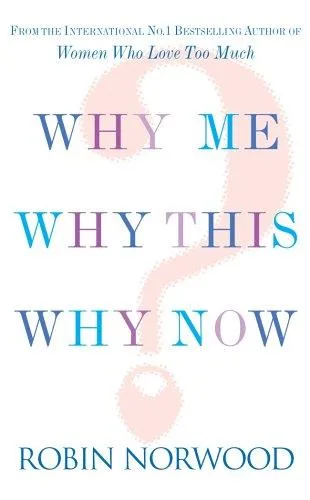
Why Me, Why This, Why Now?
 75
75

Why Me, Why This, Why Now?
Norwood’s 1994 work, "Why Me, Why This, Why Now?", attempts to reframe personal hardship not as a curse but as a complex, often obscured, message. The strength lies in its persistent invitation to view suffering as a potential teacher, moving beyond simple victimhood. A particularly resonant passage discusses how patterns of relational difficulty often echo early family dynamics, suggesting a path to breaking these cycles through conscious awareness rather than mere willpower. However, the limitation is its occasional descent into a somewhat deterministic view, where life events can feel pre-ordained rather than influenced by agency. The book's reliance on a unified theory of personal crisis might feel overly neat for some readers accustomed to more chaotic interpretations of life's adversities. Still, it offers a unique perspective for those seeking to extract meaning from adversity.
📝 Description
75
### What It Is Robin Norwood's "Why Me, Why This, Why Now?", first published in 1994, is not a manual for self-help in the conventional sense. Instead, it offers a framework for understanding personal crises and life transitions not as random misfortunes, but as potential catalysts for profound personal evolution. The work encourages readers to examine the underlying patterns and lessons embedded within difficult experiences.
### Who It's For This book is intended for individuals grappling with significant life challenges, whether personal, relational, or existential. It appeals to those who feel stuck, bewildered by their circumstances, and are seeking a deeper meaning or a new perspective on their struggles. It is for the reader who suspects their difficulties hold a hidden purpose.
### Historical Context Published in the mid-1990s, "Why Me, Why This, Why Now?" emerged during a period of growing interest in transpersonal psychology and spiritual inquiry outside of traditional religious structures. The self-help and New Age movements were gaining momentum, but Norwood's approach distinguished itself by emphasizing a more introspective, pattern-seeking methodology rather than prescriptive advice. It paralleled explorations in depth psychology and narrative therapy that were also gaining traction.
### Key Concepts The central thesis revolves around the idea of 'life scripts' and the recognition that recurring patterns in our lives often point to unhealed wounds or unresolved issues. Norwood posits that significant life events, even painful ones, can be understood as invitations to break these cycles and to access a more authentic self. The book explores how our personal histories and unconscious beliefs shape our present reality.
💡 Why Read This Book?
• You will learn to identify recurring personal challenges as potential 'life scripts' originating from unexamined early experiences, moving beyond a feeling of random misfortune. This offers a concrete method for pattern recognition introduced by Norwood in 1994. • You will gain a new perspective on suffering, viewing difficult life events not as punishments but as opportunities for growth and self-discovery, a core tenet of the book's philosophy. • You will understand how to actively engage with personal crises by seeking the underlying lessons, transforming passive victimhood into active participation in your own evolution, as explored throughout the text.
⭐ Reader Reviews
Honest opinions from readers who have explored this book.
❓ Frequently Asked Questions
What is the central premise of Robin Norwood's 'Why Me, Why This, Why Now?' published in 1994?
The book's central premise is that personal crises and difficult life experiences are not random occurrences but often serve as potent catalysts for profound personal growth and the unveiling of deeper life patterns. It suggests these events carry inherent lessons.
How does 'Why Me, Why This, Why Now?' differ from typical self-help books from the 1990s?
Unlike many prescriptive self-help books of the 1990s, Norwood's work focuses on introspective analysis and pattern recognition rather than offering direct solutions. It encourages readers to find meaning within their struggles.
Who would benefit most from reading 'Why Me, Why This, Why Now?'?
Individuals experiencing significant life challenges, feeling bewildered by their circumstances, or seeking a deeper understanding of recurring personal patterns will find this book particularly beneficial. It's for those questioning the 'why' behind their difficulties.
Does the book offer practical exercises for readers?
While not a manual of direct exercises, the book implicitly guides readers toward self-reflection and analytical thinking. It encourages readers to examine their life narratives and identify repeating themes and their potential origins.
What kind of 'patterns' does Robin Norwood discuss in the book?
Norwood discusses recurring patterns in relationships, career, health, and emotional responses. These are often linked to early life experiences and unconscious beliefs, suggesting they act as 'life scripts' that can be understood and potentially altered.
Is 'Why Me, Why This, Why Now?' considered an esoteric text?
While not strictly fitting into traditional esoteric lineages, its focus on inner meaning, symbolic interpretation of life events, and the potential for transformation through understanding personal narratives aligns with broader esoteric and transpersonal psychological themes.
🔮 Key Themes & Symbolism
Life Scripts and Patterns
The core of "Why Me, Why This, Why Now?" lies in identifying and understanding 'life scripts' – recurring patterns of behavior, thought, and relationship that often originate from early experiences. Norwood posits that these scripts, while unconscious, heavily influence our present reality and can lead to predictable difficulties. Recognizing these patterns, such as repeating relationship failures or career frustrations, is the first step toward consciously choosing a different path, moving away from a sense of being trapped by fate and towards agency.
Crisis as Catalyst
This work reframes personal crises – illness, loss, relational breakdowns – not as mere misfortune but as critical junctures designed to prompt significant personal evolution. The book suggests that these difficult moments act as a powerful, albeit often painful, impetus for change, forcing individuals to confront aspects of themselves or their lives they might otherwise ignore. The emphasis is on the potential for profound transformation that lies dormant within periods of intense struggle.
Meaning-Making in Suffering
Norwood encourages a deep dive into the meaning behind one's suffering. Instead of seeking to merely escape pain, the book advocates for an exploration of what the pain might be communicating. This involves looking at the narrative of one's life and discerning the underlying messages or lessons embedded within challenging circumstances. The goal is to move from a victim mentality to one of empowered understanding, finding purpose even in adversity.
The Unconscious Influence
A significant theme is the pervasive influence of the unconscious mind on our lives. The book explores how unresolved emotional issues, childhood imprints, and deeply ingrained beliefs shape our perceptions and choices, often in ways we are not aware of. Understanding this unconscious dynamic is presented as key to unlocking personal freedom and making conscious, deliberate shifts in one's life trajectory, moving beyond automatic reactions.
💬 Memorable Quotes
“Our lives are not random events; they are patterns of experience that repeat until we learn the lesson they hold.”
— This statement encapsulates the book's central thesis: difficulties are not arbitrary but are part of a larger learning process. It suggests that persistent challenges serve as indicators of underlying issues that require our attention and understanding for personal growth.
“The crisis itself is not the problem; the problem is our failure to understand what the crisis is trying to teach us.”
— This highlights the book's re-framing of adversity. It posits that the true difficulty lies not in the event itself, but in our interpretation and our ability (or inability) to extract wisdom from it. This perspective shifts focus from external circumstances to internal response.
“We are often drawn to situations and people that mirror our own unresolved inner conflicts, seeking unconsciously to heal them.”
— This interpretation points to the concept of projection and the unconscious drive for wholeness. It suggests that our relationships and life circumstances can act as a mirror, reflecting back to us parts of ourselves that need acknowledgment and integration.
“The moment of deepest despair can paradoxically be the moment of greatest potential for breakthrough.”
— This highlights the transformative power of hitting rock bottom. It suggests that when all other avenues seem closed, and one is at their lowest point, there is often an opening for profound change and a radical shift in perspective.
“Understanding the 'why' behind our experiences is the first step toward changing the 'what' of our future.”
— This emphasizes the power of insight and self-awareness. It argues that gaining clarity on the root causes and meanings of our past and present situations is fundamental to creating a different and more empowered future.
🌙 Esoteric Significance
Tradition
While not explicitly rooted in a single ancient tradition like Kabbalah or Hermeticism, "Why Me, Why This, Why Now?" draws heavily from the psychological and philosophical currents that inform modern esoteric thought. Its emphasis on symbolic interpretation of life events, the unconscious, and the pursuit of inner meaning aligns with archetypal psychology (influenced by Jung) and broader Gnostic or Neoplatonic ideas about hidden knowledge and personal liberation through understanding. It fits within the tradition of psychological esotericism that seeks spiritual or ultimate truth through the examination of the human psyche.
Symbolism
The book frequently employs the symbolism of 'patterns' and 'scripts' as metaphors for the unconscious forces shaping our lives. These function similarly to archetypal symbols in that they represent recurring, fundamental human experiences. Another implicit symbol is the 'crisis' itself, which can be seen as a symbolic threshold or rite of passage, a universal motif in mythology and spiritual traditions, representing a point of potential transformation and rebirth.
Modern Relevance
Norwood's work continues to be relevant for contemporary practitioners of depth psychology, narrative coaching, and trauma-informed care. Its insights into how early life experiences shape adult behavior and relationships are foundational to many modern therapeutic modalities. Thinkers and practitioners exploring concepts like attachment theory, adverse childhood experiences (ACEs), and somatic experiencing can find echoes of these ideas in Norwood's earlier explorations of life patterns and their origins.
👥 Who Should Read This Book
• Individuals experiencing significant life transitions or crises (e.g., job loss, divorce, illness) who are seeking to understand the deeper meaning and potential lessons within their struggles. • Students of psychology and personal development who are interested in how early life experiences and unconscious patterns influence adult behavior and relationship dynamics. • Anyone feeling 'stuck' in recurring negative patterns and seeking a framework for self-reflection that moves beyond superficial solutions towards profound personal insight.
📜 Historical Context
Published in 1994, "Why Me, Why This, Why Now?" arrived during a period when the self-help industry was booming, yet it sought a more introspective and less prescriptive approach than many contemporaries. The mid-90s saw a growing public interest in transpersonal psychology, narrative therapy, and Jungian concepts of individuation, themes that resonate within Norwood's work. While figures like Stephen Covey were popularizing habit-based self-improvement, Norwood focused on excavating the deeper psychological and existential 'why' behind personal struggles. The book emerged in an era less saturated with digital distractions, where long-form introspection was more common. Its reception was generally positive among those seeking deeper meaning, though some critics of the self-help genre might have found its framework too generalized. It didn't face major censorship but contributed to the broader discourse on personal responsibility and psychological exploration.
📔 Journal Prompts
The recurring patterns identified in the text: what specific life scripts are most evident in your personal history?
Your most significant life crises: what potential lessons or messages do they hold, according to the book's framework?
The concept of the unconscious influence: how might your early experiences be shaping your present-day perceptions and choices?
Reflecting on personal transformation: what does the journey from crisis to breakthrough look like conceptually, based on Norwood's ideas?
The 'meaning of suffering': explore a personal hardship through the lens of seeking its underlying message or purpose.
🗂️ Glossary
Life Script
A set of unconscious beliefs, assumptions, and patterns of behavior and relationship, often formed in early childhood, that dictate how an individual experiences and navigates their life.
Pattern Recognition
The process of identifying recurring themes, behaviors, or events in one's life that suggest underlying psychological dynamics or unresolved issues.
Crisis as Catalyst
The idea that significant life challenges, while painful, serve as crucial turning points that can precipitate profound personal growth and transformation.
Unconscious Influence
The impact of thoughts, feelings, and memories that exist outside of conscious awareness but significantly shape behavior, choices, and life experiences.
Meaning-Making
The psychological process of interpreting and finding significance or purpose in life events, particularly those that are challenging or traumatic.
Personal Evolution
The ongoing process of growth, change, and development of the self, often spurred by life experiences and the integration of new understanding.
Inner Conflicts
Psychological struggles within an individual, often between opposing desires, beliefs, or impulses, which can manifest in external life situations.