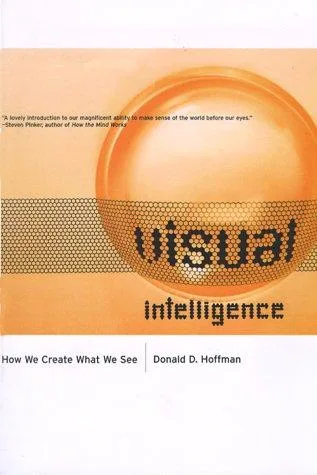
Visual intelligence
 79
79

Visual intelligence
Donald D. Hoffman’s *Visual Intelligence* (2000) offers a compelling, albeit sometimes dense, exploration of perception as an evolutionary interface. Hoffman’s central argument—that our visual system is less about objective truth and more about actionable guidance for survival—is a powerful reframing. He adeptly dissects how evolutionary pressures would favor a system that prioritizes utility over fidelity, a point illustrated through discussions on perceptual shortcuts and illusions. The book’s strength lies in its systematic dismantling of naive realism, presenting a coherent, science-based alternative. However, for readers less steeped in cognitive science terminology, the extensive technical explanations can present a barrier. The detailed mathematical and computational models, while crucial to his argument, might alienate those seeking a more philosophical or intuitive grasp of the concepts. Despite this, the work’s ambition to connect visual processing with evolutionary imperatives is considerable. *Visual Intelligence* provides a robust, scientifically grounded challenge to how we perceive reality.
📝 Description
79
Donald Hoffman's 2000 book, Visual Intelligence, proposes that our perception is a user interface, not a window onto objective reality.
Published in 2000, Donald Hoffman's Visual Intelligence challenges the common assumption that our senses deliver an accurate representation of the external world. Instead, Hoffman argues that perception functions as a "user interface," a system of icons and symbols designed by evolution to guide our actions and ensure survival and reproduction. This cognitive science perspective suggests that the accuracy of our visual system is secondary to its utility in decision-making and interaction with the environment.
The book appeals to readers interested in cognitive psychology, evolutionary biology, and the philosophy of mind. It is particularly relevant for those who question the direct correspondence between sensory experience and objective reality, and who wish to understand the adaptive purpose of perception. Hoffman's work invites a deconstruction of the mechanisms underlying sight and thought, reframing our engagement with the world.
While grounded in cognitive science, Visual Intelligence resonates with esoteric traditions that question the primacy of material reality. Philosophies that posit a constructed or illusory external world, such as certain forms of idealism or Gnosticism, share a common ground with Hoffman's idea that our sensory experience is an adaptive interface rather than a direct apprehension of truth. The book's focus on subjective experience as a functional system, rather than an objective mirror, aligns with traditions that prioritize inner knowledge and the nature of consciousness over external observation.
💡 Why Read This Book?
• Gain a novel perspective on perception, understanding it not as a window to objective reality but as an adaptive interface, a concept rooted in evolutionary pressures by the year 2000. • Grasp the 'interface theory of perception,' a core concept that reframes sensory input as icons guiding action, a framework distinct from earlier representational theories. • Explore how evolutionary goals, not just accuracy, shape our visual experience, a perspective highlighted through specific examples of perceptual illusions discussed in the text.
⭐ Reader Reviews
Honest opinions from readers who have explored this book.
❓ Frequently Asked Questions
What is the primary argument of Donald D. Hoffman's Visual Intelligence?
The book argues that our visual system functions as an evolutionary interface, not a direct window to objective reality. It prioritizes guiding actions for survival and reproduction over presenting an accurate representation of the world, a concept first published in 2000.
What is the 'interface theory of perception'?
This theory, central to Visual Intelligence, likens perception to a computer's graphical user interface. It suggests that our senses present simplified icons and symbols that guide our behavior, hiding the complex underlying reality, much like a desktop hides the computer's code.
Does Visual Intelligence suggest that what we see is false?
Not precisely false, but rather a useful simplification. The book posits that our perception is 'true' in the sense that it is adaptive and guides us effectively in our environment, even if it doesn't mirror objective reality. This is a key takeaway from its 2000 publication.
What is the role of evolution in Hoffman's theory of vision?
Evolution is paramount. Hoffman argues that natural selection favors perceptual systems that enhance fitness (survival and reproduction). Therefore, our visual system evolved to create a functional interface, not necessarily to perceive objective truth, as detailed in the work from 2000.
Who would benefit most from reading Visual Intelligence?
Individuals interested in cognitive science, philosophy of mind, evolutionary psychology, and anyone questioning the nature of reality and perception will find this book valuable. It's particularly suited for those who enjoy rigorous, scientific arguments.
What are some common misconceptions about perception that the book addresses?
The book challenges the idea of naive realism – the belief that we perceive the world exactly as it is. It also re-examines visual illusions, presenting them not as errors but as features of an adaptive, icon-based perceptual system as explored in the 2000 text.
🔮 Key Themes & Symbolism
Perception as Interface
The core of Hoffman's argument in *Visual Intelligence* is the reframing of perception not as a mirror reflecting external reality, but as a user interface. Published in 2000, this concept draws parallels to computer interfaces, where icons and visual cues simplify complex underlying data to facilitate interaction. For instance, the perception of 'redness' is not an objective property of an object but a symbolic representation generated by our visual system to signify danger or ripeness, guiding our actions effectively within our evolutionary context. This interface theory fundamentally alters how we consider the veracity of our sensory experiences.
Evolutionary Fitness Over Truth
A crucial theme is that evolutionary pressures have shaped our perceptual systems not for accuracy, but for fitness. Hoffman contends that a system that accurately depicts reality might not be the most advantageous for survival. Instead, our senses evolved to create a functional, albeit simplified, representation that helps us navigate the world, make decisions, and reproduce. The book posits that 'truth' in a representational sense is secondary to adaptive utility. This perspective, presented in the 2000 publication, suggests that what we perceive is tailored to what helps us thrive, not necessarily what 'is'.
The Nature of Consciousness
While primarily focused on visual perception, *Visual Intelligence* touches upon the broader implications for consciousness. If our perception is an constructed interface, then our subjective experience of reality is also a product of this system. This leads to questions about the nature of consciousness itself and its relationship to the physical world. The work implicitly suggests that consciousness may be intrinsically tied to this adaptive interface, prompting deeper philosophical inquiries into mind-body problems and the subjective construction of reality, a topic relevant since the book's 2000 release.
Illusions as Features
Rather than viewing optical illusions as glitches or errors in perception, Hoffman's framework interprets them as inherent features of the adaptive interface. These phenomena, such as the Müller-Lyer illusion where lines appear different lengths due to surrounding arrows, demonstrate how the system prioritizes contextual cues and learned responses to guide action. The book argues that these 'illusions' are evidence of the interface's design, optimized for typical environmental interactions rather than for abstract geometric accuracy, a viewpoint elaborated upon since its 2000 publication.
💬 Memorable Quotes
“Perception is not about finding truth, but about guiding action.”
— This encapsulates Hoffman's central thesis that our visual system evolved for pragmatic purposes. It prioritizes providing information that leads to successful behaviors (like acquiring food or avoiding predators) over presenting a perfectly accurate, objective picture of the world.
“Our perceptual system creates a 'user interface' for reality.”
— This metaphor highlights how our senses present information in a simplified, symbolic form. Just as a computer's desktop hides complex code, our perception uses icons and representations that are easy for our brain to process and act upon.
“Evolution favors organisms that are 'fit', not necessarily those that are 'true'.”
— This statement underscores the evolutionary basis of Hoffman's theory. Fitness, in this context, means having traits that increase the likelihood of survival and reproduction. The perceptual system is thus shaped by what works, not by what objectively corresponds to reality.
“Illusions are not errors, but features of our perceptual design.”
— This challenges the common view of optical illusions as mistakes. Instead, Hoffman suggests they reveal the underlying principles and adaptive strategies of our visual system, demonstrating how it processes information based on context and learned patterns.
“We don't see the world as it is, but as it is useful for us to see.”
— This paraphrased concept summarizes the core idea of the interface theory. Our subjective experience of reality is a constructed representation, optimized by evolution to serve our needs and goals, rather than a faithful depiction of external objective conditions.
🌙 Esoteric Significance
Tradition
While not overtly occult, *Visual Intelligence* resonates with Gnostic and Hermetic traditions that question the reliability of sensory perception and posit a constructed or illusory nature of the phenomenal world. Like Gnosticism, which views the material world as a flawed creation (the 'demiurge'), Hoffman's interface theory suggests our perceived reality is a 'user-friendly' illusion designed for survival, not ultimate truth. It echoes Hermetic principles of "As Above, So Below" by implying a deep connection between our internal mental architecture and the 'reality' we experience, albeit framed through evolutionary biology rather than metaphysical correspondence.
Symbolism
The central 'symbol' is the 'user interface' itself, representing the mind's constructed reality. Within this, specific visual icons (like the perception of 'red' for danger) function as potent symbols, mediating between the organism and its environment. These icons are not arbitrary but are evolved, adaptive symbols that carry functional meaning for survival. The 'hidden complexity' of reality beneath the interface can be seen as a symbolic representation of the unmanifest or the true nature of things, obscured by the phenomenal world, a concept found in many mystical traditions.
Modern Relevance
Hoffman's work remains highly relevant in contemporary discussions on consciousness, artificial intelligence, and virtual reality. Thinkers exploring embodied cognition and predictive processing often draw upon his ideas about perception as an active, constructive process. His interface theory provides a compelling framework for understanding simulated realities and the philosophical implications of AI, questioning whether an AI's 'perception' of a virtual world is fundamentally different from human perception of the physical world. His ongoing research and public engagement continue to influence fields seeking to understand the subjective nature of experience.
👥 Who Should Read This Book
• Cognitive scientists and psychologists seeking to understand alternative models of perception grounded in evolutionary theory. • Philosophers of mind interested in the nature of consciousness, reality, and the problem of perception. • Individuals fascinated by evolutionary biology and its implications for human cognition and behavior, particularly those questioning naive realism.
📜 Historical Context
Published in 2000, Donald D. Hoffman's *Visual Intelligence* arrived at a time when cognitive science was increasingly embracing computational and evolutionary frameworks. The work engaged with, and sought to advance, theories of perception that moved beyond simple stimulus-response models. It built upon foundational ideas from figures like James J. Gibson, who emphasized the ecological approach to visual perception, and the computational theories of mind that gained traction in the late 20th century. Hoffman's unique contribution was to rigorously apply evolutionary game theory and principles of adaptive systems to argue that perception's primary function is not to represent objective reality but to guide adaptive behavior. This perspective contrasted sharply with philosophical traditions, such as direct realism, which assume a more transparent access to the external world through the senses. The book's reception within the scientific community was notable for its strong, empirically-grounded challenge to conventional assumptions about vision and cognition.
📔 Journal Prompts
The concept of perception as an evolutionary interface.
An example of how an optical illusion might serve an adaptive function.
The implications of the 'user interface' model for understanding subjective experience.
How might the goal of 'fitness' over 'truth' influence our understanding of knowledge?
Reflecting on the difference between the 'objective world' and our 'perceived world'.
🗂️ Glossary
Interface Theory of Perception
The theory that perception functions like a computer's graphical user interface, presenting simplified icons and symbols to guide actions rather than accurately representing objective reality.
Adaptive Utility
The degree to which a trait or characteristic increases an organism's chances of survival and reproduction in its environment.
Naive Realism
The common-sense view that the world is pretty much as we perceive it through our senses; that we have direct, unmediated access to reality.
Fitness
In evolutionary biology, fitness refers to an organism's ability to survive and reproduce successfully in its environment.
Iconic Representation
A symbolic representation in perception that stands for something in the external world, analogous to icons on a computer screen.
Phenomenal World
The world as it appears to our consciousness; our subjective experience of reality.
Objective Reality
The state of things as they exist independently of our perception or consciousness.