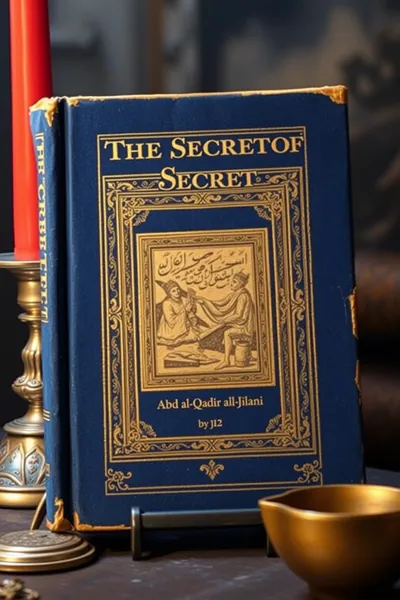
The Secret of Secrets
 77
77

The Secret of Secrets
The enduring appeal of ʻAbd al-Qādir al-Jīlānī’s teachings, as presented in 'The Secret of Secrets,' lies in their direct confrontation with the inner life. Unlike many spiritual texts that offer abstract philosophy, this work, particularly in its discussions on the nature of the heart as a mirror to divine truths, feels intensely personal. A notable strength is its unwavering focus on the practical application of spiritual principles, urging the reader towards constant self-awareness and purification. However, a significant limitation for the modern, non-specialist reader is the dense reliance on Islamic terminology and scriptural references, which can create a steep barrier to entry. Without substantial scholarly annotation or prior familiarity with the Qadiri tradition, certain passages, especially those detailing the spiritual stations, can remain opaque. Nevertheless, the core message concerning the transformative power of inner focus and devotion offers a stark, almost ascetic, path to spiritual clarity that remains potent.
📝 Description
77
The Secret of Secrets, attributed to ʻAbd al-Qādir al-Jīlānī, compiles 12th-century Sufi teachings on the inner life.
This compilation, attributed to the 12th-century Hanbali scholar and Sufi saint ʻAbd al-Qādir al-Jīlānī, presents spiritual guidance for the inner life, the nature of prophecy, and the esoteric dimensions of Islamic practice. While not a direct writing by al-Jīlānī in the usual sense, it represents teachings and interpretations gathered over centuries, with its first known print publication in 1992. The work addresses serious students of Sufism and Islamic esotericism, particularly those interested in the Qadiri order. It is intended for readers seeking a deeper understanding of the spiritual path, soul purification (tazkiyah), and divine presence, rather than casual readers unfamiliar with Islamic mysticism.
The teachings emerged from the intellectual and spiritual environment of 12th-century Baghdad, a time of significant growth in Islamic jurisprudence, theology, and mysticism. Al-Jīlānī was a notable figure, known for his sermons and legal judgments. The collection of 'The Secret of Secrets' aligns with a broader practice of gathering the sayings and spiritual insights of revered Sufi masters to preserve their wisdom. Its focus on the inner aspects of faith reflects the development of Sufi orders and their structured approach to spiritual training, often in contrast to more literal interpretations of scripture that became more prominent later.
Emerging from 12th-century Baghdad, a fertile ground for Islamic scholarship and mysticism, 'The Secret of Secrets' reflects the systematic approach to spiritual training characteristic of Sufi orders. It aligns with the tradition of collecting and preserving the teachings of revered masters like ʻAbd al-Qādir al-Jīlānī. The text emphasizes the inner life and esoteric interpretations of Islamic practice, a current within a broader intellectual milieu that also saw developments in jurisprudence and theology.
💡 Why Read This Book?
• Gain insight into the Qadiri Sufi tradition's approach to spiritual development, as exemplified by the teachings attributed to ʻAbd al-Qādir al-Jīlānī in the 12th century. • Understand the Sufi concept of the 'heart' (qalb) as the primary locus of divine perception, a core theme explored within the text. • Discover the practical methods for spiritual purification (tazkiyah) outlined in the book, focusing on cultivating virtues and shedding ego.
⭐ Reader Reviews
Honest opinions from readers who have explored this book.
❓ Frequently Asked Questions
Is 'The Secret of Secrets' a direct work of ʻAbd al-Qādir al-Jīlānī?
While attributed to him, 'The Secret of Secrets' is a compilation of teachings and interpretations associated with ʻAbd al-Qādir al-Jīlānī. The first known print publication appeared in 1992, suggesting it was compiled and disseminated over time rather than being a single authored manuscript from the 12th century.
What is the primary focus of 'The Secret of Secrets'?
The book focuses on esoteric Islamic teachings, particularly within the Sufi tradition. It emphasizes the inner spiritual life, the purification of the soul, the nature of divine presence, and the esoteric understanding of prophecy and spiritual states.
Who was ʻAbd al-Qādir al-Jīlānī?
ʻAbd al-Qādir al-Jīlānī (1077/1078–1166 CE) was a renowned Hanbali jurist, preacher, and Sufi mystic in 12th-century Baghdad. He is a pivotal figure in Islamic spirituality and the founder of the Qadiri Sufi order.
What are some key concepts discussed in the book?
Key concepts include the 'heart' (qalb) as the seat of spiritual insight, 'witnessing' (mushahada) divine presence, the importance of spiritual purification (tazkiyah), and the esoteric significance of prophetic figures.
What is the historical significance of the teachings attributed to al-Jīlānī?
These teachings emerged from 12th-century Baghdad, a center of Islamic scholarship and mysticism. They represent the systematic development of Sufi thought and practice, emphasizing the inner dimensions of faith and the direct experience of the divine.
Is 'The Secret of Secrets' suitable for beginners in Sufism?
It can be challenging for absolute beginners due to its specialized terminology and deep immersion in Islamic esoteric concepts. Readers with some background in Sufism or Islamic mysticism will likely find it more accessible and rewarding.
🔮 Key Themes & Symbolism
The Spiritual Heart
The work posits the 'heart' (qalb) not merely as a physical organ but as the supreme spiritual faculty, capable of discerning divine truths and experiencing direct apprehension of God. It's presented as a mirror that, when polished through spiritual discipline and purification, reflects the divine light. This concept is central to understanding the inner journey, positioning the heart as the true seat of gnosis and the gateway to spiritual proximity.
Divine Presence and Witnessing
A core theme is the pursuit of 'witnessing' (mushahada) – the profound and direct experience of God's presence. This is not mere intellectual belief but a state of being where the spiritual aspirant perceives the divine reality pervading all existence. The text outlines the arduous path required to attain this state, involving detachment from the material world and intense focus on the divine essence.
Prophecy and Spiritual Stations
The book explores the esoteric dimensions of prophecy, viewing prophets not just as messengers but as paragons of spiritual perfection. It explores the concept of 'spiritual stations' (maqamat) that a seeker must traverse, each representing a stage of inner transformation and increasing proximity to the Divine. These stations are depicted as challenging but essential steps on the path to spiritual realization.
Purification of the Soul
Central to achieving spiritual insight is the rigorous process of soul purification (tazkiyah). The text details the vices that afflict the soul – pride, envy, greed – and outlines methods for their eradication through repentance, remembrance of God (dhikr), and the cultivation of virtues like humility, patience, and gratitude. This inner cleansing is presented as the indispensable foundation for all higher spiritual attainments.
💬 Memorable Quotes
Direct passages from the work, attributed to the author.
“The heart is the place where the Divine manifests.”
— This captures the Sufi understanding of the heart (qalb) as the primary organ of spiritual perception, capable of receiving divine knowledge and experiencing God's presence directly, far beyond its physical function.
“Purify yourself to witness the Unseen.”
— This aphorism highlights the essential link between inner purification (tazkiyah) and the attainment of spiritual vision or direct knowledge of divine realities (mushahada).
“The path requires constant remembrance and vigilance.”
— This speaks to the continuous effort required in Sufism, emphasizing the practice of dhikr (remembrance of God) and a state of spiritual awareness (haqiqah) to stay on the path.
“Ego is the greatest veil between the servant and the Lord.”
— This statement addresses the fundamental obstacle in the spiritual journey: the ego (nafs), which obscures the perception of God and must be overcome for spiritual progress.
💡 Key Ideas
Editorial paraphrase of the work's core concepts — not direct quotes.
The true prophet is a manifestation of divine wisdom.
This paraphrased concept points to the esoteric view of prophets not just as law-givers but as embodiments of divine truth and spiritual perfection, serving as models for seekers.
🌙 Esoteric Significance
Tradition
This work is deeply rooted in the Sunni Islamic mystical tradition, specifically Sufism, and is closely associated with the Qadiri order founded by ʻAbd al-Qādir al-Jīlānī. It represents a significant articulation of esoteric Islamic thought, focusing on the inner dimensions of faith and practice, the purification of the soul, and the direct experience of the Divine Presence.
Symbolism
The 'heart' (qalb) is a paramount symbol, representing the spiritual core of a human being, the locus of divine knowledge and perception. The concept of 'light' (nur) symbolizes divine illumination and the unveiling of spiritual truths. The 'veil' (hijab) symbolizes the barriers created by the ego, worldly distractions, and ignorance that obscure the perception of reality.
Modern Relevance
Contemporary Sufi practitioners, particularly within the Qadiri and related orders, continue to draw on these teachings for spiritual guidance. Scholars of Islamic mysticism and comparative religion find it an invaluable primary source for understanding historical Sufi thought and practice. Its emphasis on inner purification and direct spiritual experience also finds echoes in modern mindfulness and contemplative practices, albeit often secularized.
👥 Who Should Read This Book
• Students of Islamic Sufism: Those seeking to understand the core tenets and practices of Sufi traditions, particularly the Qadiri lineage, will find foundational teachings. • Seekers of inner transformation: Individuals interested in practical guidance on spiritual purification, self-discipline, and cultivating a deeper connection with the Divine. • Scholars of comparative mysticism: Researchers and academics studying esoteric traditions will benefit from this text's insights into a major stream of Islamic esoteric thought.
📜 Historical Context
The teachings attributed to ʻAbd al-Qādir al-Jīlānī emerged from the rich intellectual and spiritual field of 12th-century Baghdad. This era saw the flourishing of various Islamic sciences, including jurisprudence, theology, and the nascent forms of organized Sufism. Al-Jīlānī himself was a towering figure, renowned for his erudition and spiritual authority. His sermons and teachings were widely attended, and the compilation of works attributed to him, like 'The Secret of Secrets,' reflects a broader movement to systematize and disseminate Sufi wisdom. This period also witnessed debates between ascetics and legal scholars, and the development of distinct Sufi orders. Al-Jīlānī's approach, emphasizing both adherence to Sharia and the pursuit of inner states, sought to integrate these dimensions. His influence was profound, shaping the trajectory of Sufism for centuries, with the Qadiri order becoming one of the most widespread.
📔 Journal Prompts
Reflect on the concept of the spiritual heart as a locus of divine manifestation.
Consider the obstacles presented by the ego (nafs) on the spiritual path.
Explore the meaning of 'witnessing' (mushahada) in your own spiritual practice.
How can the principles of purification (tazkiyah) be applied to daily life?
Examine the role of prophetic exemplars in spiritual development.
🗂️ Glossary
Qalb
Arabic term for 'heart'. In Sufism, it refers to the spiritual heart, the seat of divine knowledge, intuition, and the locus of direct experience of God.
Tazkiyah
Arabic for 'purification'. It refers to the process of purifying the soul from negative traits and vices, and cultivating virtues, essential for spiritual progress in Islam.
Mushahada
Arabic for 'witnessing' or 'contemplation'. It signifies the direct, experiential apprehension of Divine Presence or reality, a high spiritual state in Sufism.
Nafs
The self, ego, or psyche. In Sufism, it often refers to the lower self, driven by desires and egoistic tendencies, which must be disciplined and purified.
Dhikr
Arabic for 'remembrance'. It is the practice of remembering God, often through the repetition of divine names or phrases, a central Sufi devotional practice.
Maqamat
Plural of 'Maqam', meaning 'station'. These are the spiritual stages or states a Sufi seeker progresses through on the path to God, involving specific spiritual disciplines and transformations.
Nur
Arabic for 'light'. In esoteric contexts, it often symbolizes divine illumination, spiritual knowledge, and the manifestation of God's presence.