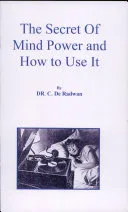
The Secret of Mind Power and How to Use It
 72
72

The Secret of Mind Power and How to Use It
C. De Radwan’s 1996 treatise, "The Secret of Mind Power and How to Use It," offers a dense, almost academic, approach to subjects often relegated to popular psychology. The author, founder of London's Radwan Institute, eschews breezy platitudes for a methodical examination of consciousness. Its strength lies in the detailed exposition of "Psychophony," a concept that promises a disciplined path to mental control, distinct from mere positive thinking. However, the prose can be dense, occasionally bordering on the impenetrable for readers unfamiliar with esoteric terminology. A notable passage discussing the 'return to spiritual harmony' highlights the book's core tenet: that external power stems from internal equilibrium, a point well-articulated. Despite its occasional opacity, the work provides a robust framework for those serious about understanding the deeper mechanisms of the mind. It is a demanding but rewarding text for the dedicated student.
📝 Description
72
### What it Is
C. De Radwan's "The Secret of Mind Power and How to Use It" is not merely a self-help manual but a structured exploration into the mechanics of consciousness. Published in 1996, it presents a unique synthesis of psychological principles and esoteric understanding. The work functions as a guide to harnessing internal mental faculties, moving beyond superficial affirmations to a deeper engagement with one's own psyche. It aims to equip readers with practical methods for mental discipline and spiritual alignment.
### Who It's For
This book is intended for individuals seeking a more rigorous approach to mind-power concepts, particularly those disillusioned with simplistic motivational rhetoric. It will appeal to serious students of esoteric psychology, individuals interested in the historical development of mind-control theories, and practitioners looking to integrate their spiritual beliefs with practical mental techniques. Those who appreciate academic rigor within metaphysical inquiry will find its approach especially valuable.
### Historical Context
Emerging in the mid-1990s, "The Secret of Mind Power" arrived during a resurgence of interest in consciousness studies and New Age philosophies, yet it retained a distinct, more formal tone. Its publication by C. De Radwan, founder of the Radwan Institute of Psychology & Psychophony in London, places it within a lineage of Western esoteric thought that sought to bridge empirical observation with spiritual laws. The book's foreword by Dr. Alexander Cannon, a figure known for his work in parapsychology and unconventional medicine, signals its intent to engage with a scientifically-minded, albeit open-minded, audience.
### Key Concepts
The core of De Radwan's thesis revolves around the concept of "Psychophony," a term coined to describe a sophisticated method of mental projection and reception. This involves detailed instruction on achieving states of deep concentration, understanding the energetic and psychological components of thought, and utilizing them for personal development and perhaps even external influence. The book emphasizes the necessity of returning to spiritual harmony as a prerequisite for effective mind power, suggesting that true control originates from inner balance and alignment with higher principles.
💡 Why Read This Book?
• You will learn the specific techniques of 'Psychophony' as detailed by C. De Radwan, moving beyond generic affirmations to a structured method for mental discipline, as presented in the book's dedicated sections. • You will gain an understanding of the necessity for 'spiritual harmony' as a foundation for mind power, a concept elaborated upon in the chapter discussing the return to balance. • You will explore the integrated approach of the Radwan Institute of Psychology & Psychophony, London, understanding how its founder, C. De Radwan, combined psychological theory with esoteric practice in the 1990s.
⭐ Reader Reviews
Honest opinions from readers who have explored this book.
❓ Frequently Asked Questions
What is 'Psychophony' as described by C. De Radwan?
Psychophony, according to C. De Radwan in his 1996 book, is a specialized technique for mental projection and reception. It involves disciplined concentration and an understanding of consciousness to harness mind power effectively, aiming for a level of control beyond simple affirmation.
Who was Dr. Alexander Cannon and why is his foreword significant?
Dr. Alexander Cannon, who wrote the foreword for 'The Secret of Mind Power,' was known for his work in parapsychology and unconventional medicine. His endorsement lends a degree of scientific credibility and historical context to C. De Radwan's esoteric teachings from the 1990s.
What is the 'Radwan Institute of Psychology & Psychophony'?
Founded by C. De Radwan, this London-based institute was the nexus for his research and teachings on mind power and consciousness, as presented in his 1996 publication. It represented a formal structure for exploring and applying his unique psychological and esoteric theories.
Does the book offer practical exercises for developing mind power?
Yes, 'The Secret of Mind Power and How to Use It' provides practical methods and exercises. It guides readers through achieving deep concentration and understanding the energetic components of thought, aiming for tangible results in mental discipline.
When was 'The Secret of Mind Power and How to Use It' first published?
The book was first published in September 1996. This places its emergence within the broader landscape of late 20th-century interest in consciousness studies and esoteric psychology.
What is the relationship between spiritual harmony and mind power in De Radwan's work?
C. De Radwan posits that true mind power is contingent upon achieving spiritual harmony. The book explores this concept by suggesting that inner balance and alignment are foundational prerequisites for effectively utilizing one's mental faculties.
🔮 Key Themes & Symbolism
Psychophony Techniques
This theme focuses on the core methodology presented by C. De Radwan, termed 'Psychophony.' The book details specific processes for mental projection and reception, emphasizing disciplined concentration and the energetic aspects of thought. It moves beyond simplistic affirmations to offer a structured system for individuals to actively engage with and direct their mental faculties, aiming for a more profound level of self-mastery. The intent is to provide actionable steps for readers to cultivate and utilize their inherent mind power.
Spiritual Harmony as Foundation
A central tenet of De Radwan's work is the indispensable link between spiritual harmony and effective mind power. The book argues that true control and influence over one's mental landscape are not achievable without a preceding state of inner balance and alignment. This theme explores the concept of returning to a state of equilibrium, suggesting that external manifestations of power are direct reflections of internal order and integration, a key philosophical underpinning of the Radwan Institute's teachings.
Integration of Psychology and Esotericism
The book represents an effort to bridge the fields of academic psychology and esoteric studies. C. De Radwan, drawing from his position as founder of the Radwan Institute of Psychology & Psychophony in London, presents concepts that are both psychologically informed and metaphysically oriented. It examines the mind not just as a biological organ but as a conduit for deeper energies and potentials, seeking to offer a more holistic understanding of human consciousness and its capabilities.
Personal Development Through Mental Discipline
Ultimately, 'The Secret of Mind Power' is a treatise on personal transformation through rigorous mental discipline. It outlines a path for readers to cultivate self-awareness, enhance their cognitive abilities, and achieve personal goals by understanding and applying the principles of mind power. The emphasis is on internal work—disciplining thoughts, understanding emotions, and aligning one's will—as the primary driver for external change and achievement.
💬 Memorable Quotes
“The return to spiritual harmony is a prerequisite for the effective use of mind power.”
— This statement encapsulates De Radwan's core philosophy: that true mental control and influence stem from an internal state of balance. It suggests that external power is not achieved through force or manipulation, but through a cultivated inner order and alignment.
“What is Psychophony? It is a method of conscious mental projection and reception.”
— This defines the central concept of the book, 'Psychophony.' It highlights its active nature, involving both sending and receiving with conscious intent, positioning it as a sophisticated psychological tool for engaging with one's own mind and potentially external influences.
“Academic knowledge must be balanced with practical experience.”
— This principle, likely drawn from the Radwan Institute's approach, emphasizes the book's intent to bridge theory and practice. It suggests that true understanding and mastery come from applying intellectual concepts in real-world situations, particularly within the realm of mind power.
“The mind possesses latent powers waiting to be awakened.”
— This interpretation points to the book's foundational premise: that individuals possess untapped potential within their consciousness. The work serves as a guide to unlocking these latent abilities through specific techniques and understanding.
“Foreword by Dr. Alexander Cannon.”
— This factual inclusion signifies the book's attempt to ground its esoteric claims within a framework that might appeal to a scientifically curious audience of the 1990s, given Cannon's background in parapsychology.
🌙 Esoteric Significance
Tradition
This work aligns with the Western Esoteric Tradition, particularly its branches focused on mind sciences and psychological manipulation, often termed 'occult psychology.' It shares lineage with Hermeticism's emphasis on correspondence ('as above, so below,' applied to the mental plane) and later Theosophical explorations of consciousness. De Radwan's 'Psychophony' can be viewed as a modern, formalized attempt to articulate and systematize techniques for mental discipline and projection, akin to practices found in some Rosicrucian or mental science movements that flourished in the late 19th and early 20th centuries.
Symbolism
While the book is less reliant on overt symbolic imagery and more on conceptual frameworks, the concept of 'Psychophony' itself acts as a symbolic representation of the mind's active, two-way communicative potential. The implied 'return to spiritual harmony' suggests a symbolic journey back to an original, balanced state of consciousness, a common motif in many esoteric traditions. The structure of the Radwan Institute, combining 'Psychology' and 'Psychophony,' symbolically represents the integration of the empirical and the esoteric.
Modern Relevance
De Radwan's work finds echoes in contemporary fields such as neuro-linguistic programming (NLP), manifestation coaching, and advanced meditation techniques that emphasize focused intention and visualization. Thinkers and practitioners exploring consciousness hacking, the power of belief in shaping reality (as popularized by books like 'The Secret,' though De Radwan predates its widespread fame), and sophisticated mental training regimes can find foundational concepts here. The emphasis on disciplined thought and internal states as drivers of external reality remains a potent idea in modern self-development and esoteric circles.
👥 Who Should Read This Book
• Serious students of esoteric psychology and mind sciences seeking a structured, systematic approach beyond popular self-help literature. • Individuals interested in the historical development of consciousness theories in the late 20th century, particularly those who appreciate the integration of psychological principles with metaphysical concepts. • Practitioners looking to refine their mental discipline and explore advanced techniques for concentration, projection, and self-mastery, as outlined by C. De Radwan.
📜 Historical Context
The mid-1990s saw a confluence of New Age spirituality, burgeoning internet culture, and a continued interest in consciousness studies. C. De Radwan's "The Secret of Mind Power and How to Use It," published in September 1996, emerged from this milieu, yet it distinguished itself with a more structured, almost academic, presentation. As founder of the Radwan Institute of Psychology & Psychophony in London, De Radwan positioned his work within a tradition of Western esoteric psychology, attempting to synthesize empirical observation with metaphysical principles. This was a departure from the more overtly mystical or purely self-help oriented texts prevalent at the time. While figures like Deepak Chopra were popularizing accessible spirituality, De Radwan's approach, endorsed by Dr. Alexander Cannon, a noted parapsychologist, aimed for a deeper, more systematic exploration of mental faculties. The book's meticulous exposition of 'Psychophony' can be seen as an attempt to formalize esoteric practices in a way that might engage a post-rationalist yet still scientifically-minded readership, contrasting with the more philosophical explorations of thinkers like Carlos Castaneda whose influence was also felt during this period.
📔 Journal Prompts
The concept of Psychophony: initial impressions and potential applications.
Reflecting on the prerequisite of spiritual harmony for mind power.
Mapping academic knowledge to practical experience in mental discipline.
Personal definition of 'latent powers of the mind.'
How does the Radwan Institute's approach differ from contemporary self-help methods?
🗂️ Glossary
Psychophony
A term coined by C. De Radwan, referring to a sophisticated method of conscious mental projection and reception. It involves disciplined concentration and an understanding of consciousness to harness mind power effectively.
Mind Power
The inherent capacity of the human mind to influence internal states and external circumstances through focused thought, will, and intention. De Radwan explores its disciplined application.
Spiritual Harmony
A state of inner balance, alignment, and integration of one's mental, emotional, and potentially metaphysical aspects. De Radwan posits this as essential for true mind power.
Radwan Institute of Psychology & Psychophony
The London-based institution founded by C. De Radwan, dedicated to the study and application of his theories on consciousness, mind power, and psychophony.
Mental Discipline
The practice of controlling and directing one's thoughts, emotions, and focus with precision and consistency, a core component of De Radwan's teachings.
Latent Powers
Untapped or undeveloped abilities of the mind that are believed to exist within individuals, which can be awakened and utilized through specific techniques and understanding.
Conscious Mental Projection
The act of directing one's thoughts or mental energy towards a specific outcome, person, or idea with deliberate intent, a key element of Psychophony.