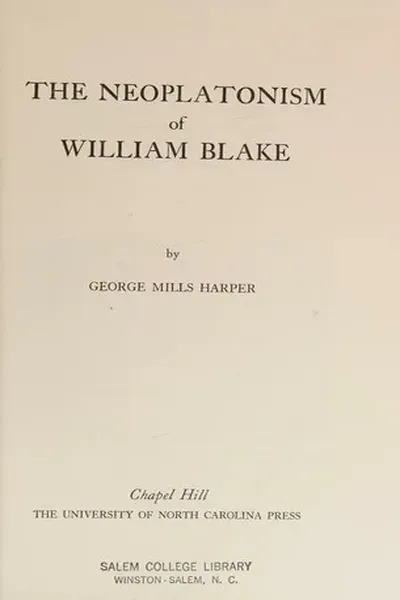
The neoplatonism of William Blake

 81
81

The neoplatonism of William Blake
Harper's "The Neoplatonism of William Blake" provides a rigorously argued case for the philosophical underpinnings of Blake's creative output. The strength of the work lies in its detailed mapping of specific Neoplatonic doctrines onto Blake's "prophetic books." For instance, the discussion of the concept of divine illumination as mirrored in Blake's "eternal ideas" is particularly illuminating. However, the prose, while scholarly, can at times feel dense, occasionally obscuring the very visionary power it seeks to explain. The analysis of Blake's "marriage of heaven and hell" through the lens of Neoplatonic dualities offers a compelling, though perhaps overly systematized, perspective. Ultimately, Harper's study is a foundational text for understanding the philosophical architecture supporting Blake's unique universe.
📝 Description
81
### The Blakean Cosmos Interpreted George Mills Harper's "The Neoplatonism of William Blake," first published in 1962, offers a meticulous examination of the profound influence of Neoplatonic philosophy on the visionary works of William Blake. This scholarly study traces the intricate threads connecting Blake's poetry and visual art to the philosophical systems of Plotinus, Porphyry, and Iamblichus.
### Who Will Benefit from This Study This work is essential for scholars of Romantic literature, comparative philosophy, and art history. It is particularly valuable for those interested in tracing the lineage of esoteric thought within Western intellectual traditions. Students and researchers seeking to understand the underlying metaphysical frameworks that informed Blake's unique artistic output will find this an indispensable resource.
### Intellectual Currents of the Mid-20th Century Published during a period of renewed interest in both Blake and classical philosophy, Harper's book arrived as scholars were beginning to reassess Blake beyond purely literary or biographical interpretations. It contributed to a burgeoning academic conversation that sought to contextualize Blake's radical visions within established philosophical and mystical lineages, moving away from earlier, more impressionistic readings.
### Core Philosophical Tenets Explored The book systematically unpacks how Blake adopted and adapted Neoplatonic concepts such as the One, the Intellect (Nous), and the Soul (Psyche). It demonstrates how Blake's intricate mythologies, populated by figures like Urizen, Los, and Enitharmon, can be understood as allegorical representations of these metaphysical hierarchies and emanations, offering a key to deciphering his complex symbolic language.
💡 Why Read This Book?
• Gain a structured understanding of how Plotinus's concept of "The One" might inform Blake's depiction of the infinite and divine. • Trace the influence of Iamblichus's ideas on theurgy within Blake's symbolic system, particularly concerning the role of the imagination. • Appreciate the 1962 scholarly context that began to systematically link Blake's visual and poetic works to specific classical philosophical schools.
⭐ Reader Reviews
Honest opinions from readers who have explored this book.
❓ Frequently Asked Questions
What is the primary philosophical tradition analyzed in relation to William Blake's work?
The primary tradition is Neoplatonism, a school of thought that flourished in the Roman Empire, particularly associated with figures like Plotinus, Porphyry, and Iamblichus. Harper's work meticulously details how their metaphysical concepts influenced Blake.
When was George Mills Harper's "The Neoplatonism of William Blake" first published?
The book was first published in 1962, a period when scholarly interest in Blake's philosophical and esoteric dimensions was gaining momentum.
Does the book connect Blake's visual art to Neoplatonism?
Yes, Harper's study explicitly links Blake's intricate mythologies and symbolic imagery in both his poetry and visual art to Neoplatonic metaphysical structures and concepts.
Which specific Neoplatonic concepts are explored in relation to Blake?
The work explores concepts such as "The One," the emanations (Nous and Psyche), the divine intellect, and the soul's descent and ascent, drawing parallels with Blake's own symbolic language and cosmology.
Is this book suitable for beginners in Blake studies?
While comprehensive, the book's scholarly depth might be best appreciated by those with some familiarity with Blake or classical philosophy. It serves as a deep dive rather than an introductory overview.
What is the significance of "The Emanation" in the context of this book?
Harper uses the Neoplatonic concept of "Emanation" to explain how Blake's divine principles, like "The One," unfold into the multiplicity of the created universe, mirroring the structure of Blake's pantheon.
🔮 Key Themes & Symbolism
Blake's Emanation Theory
Harper elucidates how Blake's cosmology mirrors the Neoplatonic concept of emanation, where the divine "One" cascades into a multiplicity of being. Figures like Urizen are presented not merely as characters, but as embodiments of these metaphysical outflows, reflecting the hierarchy from the ineffable Godhead down to the material world. This framework helps decode the intricate relationships and separations within Blake's pantheon, such as the fall of the Soul and its subsequent journey towards reintegration.
The Role of Imagination
Central to both Blake and Neoplatonism is the power of the human imagination, which Harper argues Blake elevates to a divine faculty. Drawing parallels with Plotinus's concept of the Intellect (Nous) and the soul's intuitive apprehension of higher realities, the book posits that Blake's imaginative visions are not mere fantasy but a means of perceiving ultimate truth. This faculty serves as the bridge between the material and the spiritual, enabling the soul's ascent.
Neoplatonic 'Theurgy' in Blake
The concept of theurgy, the practice of rituals designed to invoke divine presence and facilitate spiritual ascent, finds resonance in Harper's interpretation of Blake's art. The book suggests that Blake's meticulous creation of his symbolic universe, through engraving and poetry, can be seen as a form of personal theurgy. By externalizing his internal visions, Blake sought to enact a spiritual discipline, aligning his creative act with the Neoplatonic pursuit of divine union.
Blake's 'Fall' and Reintegration
Harper analyzes Blake's complex narratives of 'fall' and redemption through the lens of Neoplatonic soul-psychology. The descent of the soul into matter, a common theme in Neoplatonism, is presented as a core element in Blake's mythology. The book explores how Blake's characters and symbolic events represent the soul's entanglement with material existence and its arduous journey back towards its divine source, echoing the Neoplatonic path of purification and return.
💬 Memorable Quotes
“Blake's mythology is a symbolic representation of the Neoplatonic metaphysical system.”
— This core assertion suggests that Blake's seemingly unique and wild visions are not arbitrary but are structured by the philosophical architecture of Neoplatonism, offering a key to their interpretation.
“The imagination, for Blake, functions as the divine Intellect (Nous).”
— This interpretation highlights the elevated status of imagination in Blake's thought, aligning it with the Neoplatonic concept of Nous, the second hypostasis after "The One," responsible for the generation of all reality.
“Urizen embodies the Neoplatonic principle of limitation and division.”
— This paraphrased concept explains how the character Urizen, often depicted as a stern lawgiver, can be understood as representing the Neoplatonic tendency for the Intellect to differentiate and, in doing so, create boundaries and separations within the divine unity.
“Blake's 'Marriage of Heaven and Hell' reflects Neoplatonic dualities and their potential integration.”
— This interpretation suggests that Blake's exploration of opposing forces in this work can be viewed through the Neoplatonic framework of understanding how divine unity manifests through apparent dualities, and the soul's journey toward reconciling them.
“The soul's journey in Blake mirrors the Neoplatonic ascent back to "The One."”
— This paraphrased concept frames Blake's narratives of spiritual struggle and enlightenment as analogous to the Neoplatonic goal of the soul returning to its divine source through purification and contemplation.
🌙 Esoteric Significance
Tradition
This work firmly situates William Blake within the broad stream of Western Esotericism, specifically connecting him to the Neoplatonic tradition that flourished in late antiquity. Harper argues that Blake did not merely read Neoplatonic texts but internalized their metaphysical structures, adapting them to his unique visionary cosmology. This study highlights how Blake transformed abstract philosophical concepts into dynamic, symbolic narratives, contributing to the lineage of thinkers who sought direct experience of the divine through intellectual and imaginative means.
Symbolism
Key symbols in Blake, such as the "Eternal Eye" and the figure of "Urizen," are interpreted through a Neoplatonic lens. The "Eternal Eye" can be seen as representing the divine Intellect (Nous) or the ultimate source of all perception and being, akin to Plotinus's "The One." Urizen, often depicted as a creator god imposing limits, is analyzed as embodying the Neoplatonic principle of differentiation and limitation that arises in the process of emanation, a necessary step in the manifestation of multiplicity from unity.
Modern Relevance
Contemporary scholars and practitioners of Western Esotericism continue to draw upon Harper's foundational work. His systematic approach informs modern analyses of Blake's relationship to Hermeticism, Gnosticism, and Theosophy. Thinkers exploring the intersection of consciousness studies, art, and metaphysics find Blake's Neoplatonic-inspired system a rich source for understanding the creative process as a spiritual endeavor, relevant to contemporary explorations of consciousness and symbolic interpretation.
👥 Who Should Read This Book
• Scholars of Romanticism and comparative literature seeking to understand the philosophical foundations of Blake's "prophetic books." • Students of Western Esotericism interested in tracing the influence of Neoplatonism on later mystical and artistic movements. • Art historians and critics aiming to decipher the complex symbolic language and metaphysical underpinnings of Blake's visual art.
📜 Historical Context
Published in 1962, George Mills Harper's "The Neoplatonism of William Blake" emerged during a significant period of scholarly reassessment of William Blake. The mid-20th century saw a move beyond purely Romantic or biographical readings towards a deeper engagement with Blake's philosophical and theological underpinnings. Contemporaries like Northrop Frye were also exploring complex symbolic systems, though often with a different theoretical framework. Harper's work was part of a growing trend to contextualize Blake's radical visions within established Western esoteric and philosophical traditions, particularly Neoplatonism, which had been a subject of intense study since the Renaissance but was being applied with new rigor to Blake's oeuvre. The book offered a systematic counterpoint to more impressionistic interpretations, grounding Blake's mysticism in a specific, albeit interpreted, philosophical lineage.
📔 Journal Prompts
The emanation of 'The One' into multiplicity, as explored by Plotinus and Blake.
Blake's interpretation of the Soul's descent and ascent through the Neoplatonic framework.
The role of Imagination as a divine faculty in Blake's system.
Urizen's function as a limiting principle within Blake's cosmology.
The practice of 'theurgy' as potentially reflected in Blake's creative process.
🗂️ Glossary
Neoplatonism
A school of philosophy founded by Plotinus in the 3rd century CE, which synthesized the teachings of Plato with other mystical and philosophical traditions, emphasizing a hierarchical structure of reality emanating from an ineffable "One."
The One
The supreme, ineffable principle in Neoplatonism, the ultimate source of all existence from which reality emanates. It is beyond being and thought.
Nous (Intellect)
In Neoplatonism, the second hypostasis, emanating from "The One." It is the realm of Forms or Ideas and the seat of divine intelligence and consciousness.
Psyche (Soul)
The third hypostasis in Neoplatonism, emanating from Nous. It bridges the intelligible and sensible worlds, and is often seen as the vehicle for individual consciousness and spiritual aspiration.
Emanation
The Neoplatonic concept describing the outflow or radiation of reality from "The One" in a descending hierarchy, without diminishing the source.
Theurgy
A set of religious-magical practices associated with later Neoplatonism (particularly Iamblichus), aimed at invoking divine beings or facilitating the soul's ascent through ritual and symbolic action.
Urizen
A key figure in William Blake's mythology, often representing reason, law, and limitation. Harper interprets him through the lens of Neoplatonic principles of differentiation and division.