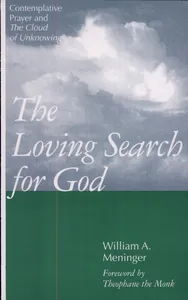
The loving search for God

 76
76

The loving search for God
William Meninger’s 1994 text, *The Loving Search for God*, offers a refreshingly counter-intuitive perspective on spiritual seeking. Rather than guide the reader toward a goal, Meninger subtly redirects the entire enterprise. He argues, with the gentle persistence of a seasoned contemplative, that the very act of 'searching' can obscure the divine presence we supposedly seek. His critique of the ego’s acquisitive spiritual desires is particularly incisive, especially when he discusses how our attempts to 'possess' God prevent us from receiving God. The limitation, however, lies in its singular focus; while powerful, the text offers little practical guidance beyond the implicit suggestion of surrender, leaving some readers perhaps wanting more concrete steps for cultivating receptivity. The passage discussing how the desire for spiritual 'experiences' becomes a form of spiritual materialism is a standout, highlighting the book's core argument with clarity. It’s a valuable, if narrowly focused, meditation on the nature of spiritual attainment.
📝 Description
76
### What It Is
The Loving Search for God, penned by William Meninger and first published in 1994, is not a devotional manual in the conventional sense. Instead, it functions as a deeply personal exploration of the spiritual quest, drawing heavily on the teachings of the Trappist monk Thomas Keating and the contemplative prayer movement. Meninger interrogates the nature of seeking, suggesting that the very act of searching is often a barrier to experiencing the divine presence. The book advocates for a shift from active striving to passive receptivity.
### Who It's For
This work is intended for individuals wrestling with the inherent paradoxes of faith and spirituality. It speaks to those who have found traditional religious frameworks insufficient or overly intellectualized, particularly those drawn to contemplative practices. Readers seeking a more direct, experiential encounter with the sacred, rather than a set of doctrines or rituals, will find resonance here. It is for the sincere seeker who questions the efficacy of their own efforts in approaching God.
### Historical Context
Published in 1994, The Loving Search for God emerged during a period of renewed interest in contemplative spirituality within Western Christianity. This was significantly influenced by figures like Thomas Keating, whose work on Centering Prayer gained traction throughout the 1980s and early 1990s. Meninger’s book engages with this milieu, offering a personal reflection on the principles underlying Keating’s approach. It arrived at a time when many were seeking alternatives to the perceived dogmatism of established religious institutions and the New Age movement's more eclectic offerings.
### Key Concepts
Meninger's central thesis revolves around the idea that the 'loving search' itself is a misdirection. He posits that God, or the divine presence, is not a distant object to be found through arduous effort, but an immanent reality that is already present. The book critiques the ego's tendency to make God an object of possession or achievement. Concepts such as divine indwelling, the surrender of the will, and the practice of interior silence are explored as pathways to recognizing this ever-present reality.
💡 Why Read This Book?
• Learn how the desire for spiritual 'experiences' can function as a barrier, a concept central to Meninger's critique of ego-driven seeking, as detailed in his 1994 publication. • Understand the contemplative principle of divine indwelling, a core theme explored through the lens of Thomas Keating's teachings, offering a path beyond active striving. • Discover the potential for passive receptivity as a spiritual practice, moving away from the 'loving search' towards an acceptance of the already-present divine.
⭐ Reader Reviews
Honest opinions from readers who have explored this book.
❓ Frequently Asked Questions
What is the central paradox William Meninger addresses in 'The Loving Search for God'?
Meninger highlights the paradox that the very act of 'lovingly searching' for God can become an obstacle, preventing the seeker from recognizing the divine presence that is already here.
What spiritual tradition heavily influences William Meninger's 1994 book?
The book is deeply influenced by the contemplative prayer movement, particularly the teachings of Thomas Keating, a prominent Trappist monk known for Centering Prayer.
How does Meninger suggest one can find God?
Instead of active seeking, Meninger suggests a path of passive receptivity and surrender, emphasizing the divine's immanence rather than transcendence.
Is 'The Loving Search for God' a practical guide to meditation?
While it touches on contemplative practices implicitly, it's more of a philosophical and theological exploration of the nature of seeking, rather than a step-by-step meditation manual.
Who was Thomas Keating and why is he relevant to this book?
Thomas Keating (1928-2018) was a key figure in the modern contemplative movement. Meninger draws upon Keating's ideas, particularly Centering Prayer, to frame his discussion on spiritual seeking.
What does Meninger mean by the ego's 'acquisitive' spiritual desires?
He refers to the ego's tendency to want to possess, control, or achieve spiritual states or a relationship with God as if it were a commodity, thus missing the gift of divine presence.
🔮 Key Themes & Symbolism
The Ego's Role in Seeking
Meninger critically examines how the ego, with its inherent desire for control and possession, often misdirects the spiritual quest. He argues that the ego tends to turn God into an object to be acquired or an achievement to be attained, thereby creating a fundamental misunderstanding of divine presence. This theme is central to his argument that the 'search' itself, when driven by egoic ambition, becomes counterproductive. The work suggests that recognizing and transcending these egoic patterns is crucial for genuine spiritual progress, moving beyond the desire for spiritual 'highs' or validation.
Divine Immanence vs. Transcendence
A core concept explored is the pervasive immanence of God – the idea that the divine is not solely a distant entity but is present within all creation and within the individual seeker. Meninger contrasts this with a more conventional view of God as purely transcendent, existing only outside the human experience. By emphasizing immanence, the book encourages a shift in perception, where the goal is not to reach God, but to awaken to the reality of God's already-present indwelling. This perspective underpins the move towards passive receptivity over active pursuit.
Passive Receptivity Over Active Striving
The Loving Search for God advocates for a radical reorientation of spiritual effort. Instead of engaging in constant striving, prayer, or practices aimed at 'getting somewhere,' Meninger proposes the path of passive receptivity. This involves a letting go, a surrender of the will, and an openness to receive the divine presence that is already available. This theme is deeply rooted in contemplative traditions, suggesting that true spiritual growth occurs not through forceful effort but through a quiet yielding to the divine mystery.
The Paradox of the Search
Meninger’s central thesis revolves around the inherent paradox of the spiritual search. He posits that the very energy and intention directed towards 'finding' God can create a conceptual barrier, making God seem like something external and separate that needs to be discovered. The book suggests that the 'loving search' becomes most effective when it transforms into a loving surrender, an acceptance of what is already given. This challenges the seeker to question their assumptions about the nature of spiritual attainment and the methods employed.
💬 Memorable Quotes
“The desire for God is God working in us.”
— This statement encapsulates Meninger's view that the very impulse to seek the divine is not a human effort alone, but a divine stirring within the individual, indicating that the search originates from the source it seeks.
“We are not seeking God; we are being sought by God.”
— This challenges the traditional notion of the seeker actively pursuing a distant deity, reframing the relationship as one where the divine is the initiator, drawing the individual towards itself through grace.
“The ego makes God an object.”
— Meninger points out the ego's tendency to conceptualize God as something to be possessed, controlled, or achieved, thereby turning a dynamic, living presence into a static concept or possession.
“Stillness is the prerequisite for divine encounter.”
— This highlights the importance of interior silence and quietude, suggesting that by quieting the mental noise and egoic chatter, one creates the space for the divine presence to be recognized.
“The search ends when we stop searching.”
— This paradoxical statement suggests that the cessation of active, ego-driven seeking is the very condition through which the object of the search (God) is finally perceived.
🌙 Esoteric Significance
Tradition
This work aligns closely with the Christian contemplative tradition, particularly the lineage of mystical theology that emphasizes direct, experiential knowledge of God over purely intellectual assent. It draws implicitly from figures like Meister Eckhart and John of the Cross, but its immediate context is the 20th-century revival of contemplative prayer, notably through Thomas Keating. While not strictly 'esoteric' in the Hermetic or Kabbalistic sense, its focus on interiority, divine indwelling, and the paradoxical nature of spiritual attainment places it within the broader spectrum of Western mystical thought, often categorized alongside esoteric currents due to its emphasis on non-rational apprehension.
Symbolism
The central 'symbol' is arguably the concept of the 'search' itself, which Meninger deconstructs. It represents the ego's striving and the illusion of separation. Contrasted with this is the implied symbolism of 'stillness' or 'receptivity,' which stands for the open, unconditioned space wherein the divine presence (often symbolized by light, presence, or love in mystical traditions) is recognized. The book doesn't rely on overt, codified symbols but uses the very act of seeking and the proposed alternative of surrender as symbolic representations of spiritual states.
Modern Relevance
Meninger's work remains relevant for contemporary practitioners of contemplative prayer, Centering Prayer, and other forms of Christian meditation. It speaks to modern spiritual seekers who grapple with the efficacy of their practices and the role of the ego in their spiritual lives. Its critique of spiritual materialism and the tendency to 'collect' experiences is particularly pertinent in an age saturated with self-help spirituality and online spiritual influencers. Thinkers and groups focused on embodied spirituality or non-dual awareness within Christian frameworks might also find conceptual bridges in Meninger's emphasis on presence over process.
👥 Who Should Read This Book
• Individuals questioning the effectiveness of their active spiritual practices, particularly those drawn to contemplative prayer traditions like Centering Prayer. • Seekers who feel their efforts to find God are yielding little result and are open to a paradigm shift towards surrender and receptivity. • Students of Christian mysticism and Western esotericism interested in how contemplative figures like Thomas Keating influenced later spiritual writing in the late 20th century.
📜 Historical Context
William Meninger’s *The Loving Search for God*, published in 1994, emerged within a landscape significantly shaped by the resurgence of Christian contemplative practices. The preceding decades had seen a growing interest in forms of prayer that emphasized interior silence and direct experience, partly as a response to the perceived intellectualism of mainline theology and the cultural shifts following the 1960s. Figures like Thomas Keating, whose work on Centering Prayer gained widespread acceptance from the 1980s onward, provided a framework for this renewed emphasis on mystical experience within a Catholic context. Meninger’s book engages directly with this milieu, offering a personal reflection on the principles articulated by Keating and others. While the New Age movement offered its own spiritual alternatives, Meninger’s work remained rooted in a Christian contemplative tradition, distinguishing it from the more syncretic or eclectic spiritualities prevalent at the time. The book resonated with individuals seeking a path beyond dogma, aligning with a broader cultural current of spiritual seeking that valued personal experience.
📔 Journal Prompts
The ego’s tendency to make God an object; what forms does this take in your spiritual practice?
Reflect on the paradox: When has your 'search' for something created a barrier to finding it?
Consider the practice of passive receptivity: What does it mean to 'let go' of the desire for spiritual progress?
Analyze the statement: 'The desire for God is God working in us.' How does this reframe your understanding of spiritual longing?
Explore the concept of divine immanence: Where have you experienced the divine as already present, rather than something to be sought?
🗂️ Glossary
Centering Prayer
A formal prayer practice developed by Trappist monks Thomas Keating, Basil Pennington, and William Menninger, designed to facilitate the development of a contemplative dimension of prayer through fostering receptivity to the divine presence.
Divine Indwelling
The theological concept that God resides within creation and, more specifically, within the individual human soul, not as an external entity but as an intimate presence.
Ego
In this context, the part of the self that is characterized by self-centeredness, the desire for control, and the tendency to view reality, including the divine, as objects to be possessed or mastered.
Immanence
The philosophical and theological concept of God's presence within the universe and the human experience, as opposed to transcendence, which suggests God exists wholly outside of it.
Passive Receptivity
A spiritual attitude or practice involving openness and surrender, allowing divine grace or presence to act without forceful human effort or striving.
Spiritual Materialism
The tendency to treat spiritual attainments, experiences, or knowledge as commodities to be acquired, possessed, or displayed, often driven by egoic desire for validation.
Surrender of the Will
The act of relinquishing one's personal desires, plans, and sense of control to a higher power or divine will, seen as a key step in spiritual growth.