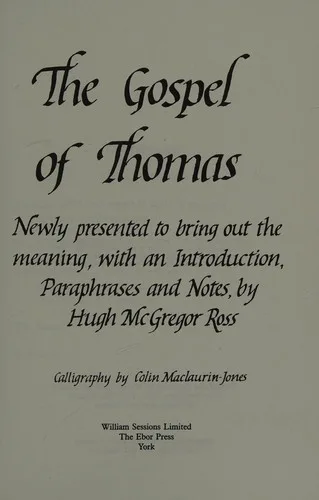
The Gospel of Thomas
 73
73

The Gospel of Thomas
Hugh McGregor Ross's edition of The Gospel of Thomas offers a straightforward presentation of this enigmatic text. The strength lies in its unadorned accessibility, allowing the sayings to speak for themselves without excessive scholarly overlay, which is a relief for readers weary of over-interpretation. However, the lack of extensive commentary on the historical development of specific sayings, beyond the 1997 publication date, leaves some of the deeper textual lineages less explored. The insistence on the "living Jesus" in Ross's introduction, while understandable, sometimes overshadows the text's more abstract, philosophical pronouncements. The passage concerning the "kingdom of heaven" being a "mathematical calculation" (Saying 118) is particularly striking for its intellectual rigor, diverging from common mystical interpretations. Ross's edition serves as a solid, if somewhat brief, introduction to a foundational text in Gnostic studies.
📝 Description
73
### What It Is The Gospel of Thomas is a collection of sayings attributed to Jesus of Nazareth, presented as direct teachings rather than narrative accounts. Unlike the canonical Gospels, it focuses on the inner spiritual life and the discovery of the divine within oneself. This text offers a unique window into early Christian thought, predating or existing alongside the New Testament writings.
### Who It Is For This work is for seekers interested in the mystical and philosophical dimensions of early Christianity, particularly those exploring Gnostic traditions or alternative interpretations of Jesus' teachings. It appeals to scholars of ancient religions and anyone questioning the established dogma, seeking a more personal and experiential approach to spirituality.
### Historical Context Discovered in 1945 among the Nag Hammadi library in Egypt, the Gospel of Thomas dates back to approximately the 2nd century CE. Its existence challenges the traditional view of a single, unified early Christian doctrine. The text’s survival and subsequent scholarly attention highlight the diversity of early Christian movements and the suppression of non-canonical texts.
### Key Concepts The central tenets revolve around the "Kingdom of God" being present within individuals, accessible through profound self-knowledge and understanding of Jesus' esoteric sayings. It emphasizes dualism (light/darkness, male/female) and the attainment of a higher spiritual state through gnosis, or direct spiritual knowing.
💡 Why Read This Book?
• Gain direct access to Jesus' sayings as preserved outside the canonical Bible, offering a unique perspective on early Christian spirituality and the concept of the 'Kingdom of God' as an internal state, as exemplified in Saying 3. • Understand the historical context of the Nag Hammadi discovery in 1945, which unearthed this text and challenged established notions of early Christian diversity and textual transmission. • Explore the concept of gnosis, or direct spiritual knowledge, as the path to enlightenment, a central theme in the Gospel of Thomas that distinguishes it from exoteric religious doctrines.
⭐ Reader Reviews
Honest opinions from readers who have explored this book.
❓ Frequently Asked Questions
What is the origin of the Gospel of Thomas and when was it discovered?
The Gospel of Thomas was discovered in 1945 as part of the Nag Hammadi library in Egypt. Scholarly consensus places its composition in the 2nd century CE, making it a significant early Christian document.
How does the Gospel of Thomas differ from the canonical Gospels?
Unlike the canonical Gospels, it contains only sayings attributed to Jesus, without narrative or biographical details. It emphasizes inner spiritual realization and the 'Kingdom of God' within, rather than external events.
Who is Hugh McGregor Ross and what is his contribution?
Hugh McGregor Ross is the translator and editor of this specific edition, first published in 1997. His work aims to present the text clearly for modern readers interested in its esoteric and philosophical dimensions.
What is the significance of the Nag Hammadi discovery?
The Nag Hammadi discovery provided crucial evidence for the diversity of early Christian thought, including Gnostic texts like the Gospel of Thomas, which were previously known only through the writings of their critics.
What does 'gnosis' mean in the context of the Gospel of Thomas?
Gnosis refers to direct, intuitive spiritual knowledge or insight. The Gospel of Thomas suggests that achieving this inner knowing is the key to understanding Jesus' teachings and attaining spiritual liberation.
Is the Gospel of Thomas considered part of the Christian Bible?
No, the Gospel of Thomas is not included in the Christian biblical canon. It is considered an apocryphal or extra-canonical text, significant for its historical and theological insights into early Christianity.
🔮 Key Themes & Symbolism
The Inner Kingdom
The Gospel of Thomas radically redefines the 'Kingdom of God' not as a future event or a geographical place, but as an immediate, internal reality accessible through the sayings of Jesus. This concept challenges traditional eschatological views, focusing instead on the present moment and the individual's capacity for spiritual awakening. The text suggests that the divine is not external but resides within, and the sayings are keys to unlocking this inner awareness. This perspective aligns with mystical traditions emphasizing immanence over transcendence.
Gnosis and Spiritual Sight
Central to the Gospel of Thomas is the idea of gnosis, or direct spiritual knowledge, which surpasses mere intellectual understanding. The sayings are presented as tools to awaken this inner sight, enabling the seeker to perceive the true nature of reality and their own divine essence. This emphasis on experiential knowing over dogma is a hallmark of Gnostic thought. Attaining gnosis is depicted as the path to overcoming ignorance and achieving spiritual liberation, moving beyond the material world.
Dualism and Transformation
The text frequently employs dualistic imagery, contrasting light and darkness, male and female, spirit and flesh. However, this dualism is not presented as an insurmountable cosmic conflict but as a framework for understanding the human condition and the process of spiritual transformation. The ultimate goal is to transcend these apparent oppositions by recognizing the unity underlying them, often through a reintegration of perceived opposites, as suggested in the pursuit of becoming 'male and female'.
The Way of the Ascetic Seeker
The Gospel of Thomas outlines a path for the dedicated seeker, often characterized by detachment from worldly concerns and a focus on the immediate transmission of Jesus' wisdom. It implies a select group who can truly understand and implement these teachings, setting them apart from the masses. This focus on rigorous self-inquiry and the abandonment of conventional societal roles is a recurring motif, prioritizing spiritual pursuit above all else.
💬 Memorable Quotes
“Jesus said, 'Recognize what is in front of your eyes, and what is hidden from you will be revealed to you.'”
— This saying underscores the importance of present awareness and direct perception. It suggests that the answers to profound spiritual questions are often readily available in our immediate experience, if only we learn to truly see and understand.
“His disciples said to him, 'When will the kingdom of heaven come?' He said, 'It will not come by waiting for it. It will not be a matter of saying, 'Here it is' or 'There it is'. Rather, the kingdom of the Father is spread out upon the earth, and people do not see it.'”
— This quote directly challenges the notion of an external, future kingdom. It posits that the divine presence is immanent, woven into the fabric of existence, yet unseen by those who do not possess the spiritual insight to perceive it.
“Jesus said, 'I am the light that is over all things; I am the all; from me all has come, and to me all returns.'”
— This statement expresses a pantheistic or panentheistic view, presenting Jesus as the ultimate source and destination of all existence. It highlights a profound unity underlying creation, where the divine permeates and is identical with all that is.
“Simon Peter said to him, 'Let Mary leave them, for women are not worthy of life.' Jesus said, 'I myself shall lead her in order to make her male, so that she too may become a living spirit like the male. For every woman who makes herself male will enter the kingdom of heaven.'”
— This challenging saying is often interpreted as a metaphor for transcending gendered limitations and societal roles, which are seen as hindrances to spiritual equality and entry into the divine realm. It speaks to a spiritual androgyny or a state beyond conventional human distinctions.
“He who seeks shall find, and to him who knocks it shall be opened.'”
— This is a classic expression of the efficacy of sincere spiritual seeking. It assures the earnest seeker that their efforts in searching for truth and knocking on the doors of understanding will be met with divine response and revelation.
🌙 Esoteric Significance
Tradition
The Gospel of Thomas is a cornerstone text for understanding Gnostic traditions within early Christianity. It aligns with the Gnostic emphasis on gnosis, a direct, intuitive apprehension of divine truth, as the primary means of salvation. Unlike mainstream Christianity, which developed a hierarchical structure and relied on external sacraments and historical narratives, Gnosticism, as exemplified here, prioritizes individual spiritual insight and the recognition of the divine spark within. It represents a significant departure from Pauline Christianity and the developing proto-orthodox church.
Symbolism
Key symbols include 'light' representing divine consciousness or true knowledge, contrasted with 'darkness' as ignorance or the material world. The 'kingdom of heaven' is not a celestial realm but an inner state of being, accessible through the sayings. The concept of 'becoming male' is often interpreted esoterically as transcending duality and societal constructs, achieving a state of spiritual androgyny or wholeness, free from the limitations of the physical form and its social roles.
Modern Relevance
Contemporary spiritual seekers, particularly those interested in Gnosticism, contemplative prayer, and comparative religion, draw heavily on the Gospel of Thomas. Thinkers and practitioners exploring the 'Jesus myth' or seeking non-dogmatic spiritual paths find its emphasis on personal revelation and inner transformation highly relevant. Its teachings continue to inspire individuals seeking a direct, experiential connection to the divine, often influencing modern esoteric movements and psychological interpretations of spiritual texts.
👥 Who Should Read This Book
• Students of early Christianity and Gnosticism: Gain direct exposure to a foundational Gnostic text, offering a counterpoint to canonical Gospels and understanding the diversity of 2nd-century religious thought. • Esoteric practitioners and mystics: Explore Jesus' sayings through the lens of inner gnosis, self-realization, and the immanence of the divine, applicable to contemporary contemplative practices. • Comparative religion scholars: Analyze the unique theological and philosophical propositions of the Gospel of Thomas, comparing its teachings on the 'Kingdom of God' and spiritual awakening with other wisdom traditions.
📜 Historical Context
The Gospel of Thomas emerged during a period of intense spiritual and intellectual ferment in the 2nd century CE. The discovery of this text in 1945 at Nag Hammadi, Egypt, alongside other Gnostic writings, revolutionized the understanding of early Christianity. This era saw a proliferation of diverse theological interpretations, with various groups developing distinct understandings of Jesus' teachings and the nature of salvation. While orthodox Christianity, as later codified, emphasized creedal faith and historical events, movements like the one that produced the Gospel of Thomas focused on mystical experience and direct spiritual knowledge (gnosis). The text's survival, hidden for centuries, speaks to the suppression of non-canonical Christian literature by emerging orthodox authorities. Its content directly engages with and offers an alternative to the developing biblical canon, highlighting the vibrant, multifaceted landscape of early religious thought.
📔 Journal Prompts
The saying, 'Recognize what is in front of your eyes...' prompts reflection on immediate perception versus hidden truths.
Consider the implications of Jesus stating the 'kingdom of the Father is spread out upon the earth' for your understanding of divine presence.
Reflect on the dualistic imagery in the text and how it relates to your own perceived inner conflicts.
What does the concept of 'gnosis' mean to you in the context of your spiritual journey?
How does the Gospel of Thomas's emphasis on inner knowing challenge conventional religious authority for you?
🗂️ Glossary
Gnosis
Greek for 'knowledge'. In esoteric and Gnostic contexts, it refers to intuitive, direct spiritual knowledge or insight, distinct from intellectual understanding, leading to enlightenment and salvation.
Nag Hammadi Library
A collection of thirteen ancient Coptic and Greek texts discovered near the town of Nag Hammadi in Upper Egypt in 1945, containing important Gnostic writings, including the Gospel of Thomas.
Apocryphal
Texts or writings that are not part of the established canon of scripture but are often considered to have religious significance or to be of similar origin. The Gospel of Thomas is an apocryphal gospel.
Immanence
The belief that the divine is present within the material universe and human existence, as opposed to transcendence, which posits the divine as existing beyond or outside of it.
Dualism
A philosophical or religious concept that posits two fundamental, often opposing, principles or substances (e.g., good and evil, spirit and matter, light and darkness) that shape reality.
Saying
In the context of the Gospel of Thomas, a 'saying' refers to an individual, often brief, utterance attributed to Jesus, forming the core content of the text, as opposed to narrative passages found in canonical gospels.
Esoteric
Intended for or likely to be understood by only a small number of people with a specialized knowledge or interest. In religion and spirituality, it refers to inner teachings or doctrines accessible to initiates.