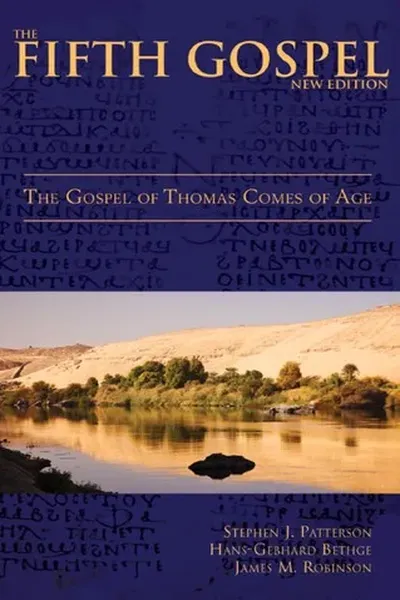
The fifth Gospel
 82
82

The fifth Gospel
Stephen J. Patterson's "The Fifth Gospel" moves beyond devotional readings to scrutinize the Gospels as products of their time. Patterson's strength lies in his rigorous historical-critical method, which treats the biblical texts as artifacts to be excavated. He compellingly argues that the communities that birthed these narratives are as crucial to understanding them as the events they purport to describe. A particular passage that stands out is his discussion of how the Gospel of Mark, often considered the earliest, might have been shaped by the social upheaval in Judea during the Roman occupation. However, the book can sometimes feel dense for the uninitiated, requiring a certain familiarity with biblical scholarship. Patterson's focus on literary and social construction, while insightful, might leave some readers desiring a more direct engagement with the theological implications. Despite this, "The Fifth Gospel" offers a valuable, critical lens for anyone seeking to understand the Gospels beyond their surface meaning.
📝 Description
82
### What It Is The Fifth Gospel by Stephen J. Patterson, first published in 1998, offers a unique perspective on early Christian narratives. It is not a theological treatise in the conventional sense, but rather an examination of the historical and cultural forces that shaped the Gospels. Patterson approaches the texts as literary and historical documents, seeking to understand their origins and the communities that produced them. The work questions traditional authorship and dating, suggesting a more complex evolution of the Gospel accounts than commonly accepted.
### Who It's For This book is intended for readers interested in the historical Jesus movement, early Christian literature, and critical biblical studies. It will appeal to those who approach religious texts with a scholarly mindset, seeking to understand their development within their original historical contexts. Scholars of ancient history, religious studies, and literature will find Patterson's arguments engaging, particularly his focus on the social and political pressures influencing the Gospel writers.
### Historical Context Patterson's work emerged in an era of robust scholarly debate surrounding the Synoptic Problem and the historical reliability of the Gospels. The late 20th century saw continued engagement with form criticism and redaction criticism, as well as burgeoning interest in social-scientific approaches to the New Testament. While scholars like John Dominic Crossan were exploring the historical Jesus and E.P. Sanders was analyzing the context of the earliest Christianity, Patterson's contribution focused on the literary construction of the Gospel narratives themselves, positioning it within the broader academic discourse of its time.
### Key Concepts The central concept explored is the 'Fifth Gospel' itself – a metaphor for the living tradition and community that experienced Jesus, which then informed the written Gospels. Patterson examines the oral traditions, the social needs of early Christian communities, and the literary conventions of the period. He critically analyzes the textual evidence, suggesting that the Gospels are not simple transcriptions of events but carefully crafted narratives designed to convey specific theological and social messages to particular audiences.
💡 Why Read This Book?
• Gain a nuanced understanding of the Gospel narratives as evolving literary and social constructs, moving beyond literal interpretation. Patterson's analysis of the community context behind Mark's Gospel provides unique insight. • Appreciate the historical forces and scholarly debates surrounding early Christian texts, particularly the critical approaches prevalent in the late 20th century, as highlighted by Patterson's engagement with form and redaction criticism. • Re-evaluate the concept of "truth" in religious texts by exploring Patterson's "Fifth Gospel" metaphor, which emphasizes the lived experience and oral traditions that preceded and informed the written accounts.
⭐ Reader Reviews
Honest opinions from readers who have explored this book.
❓ Frequently Asked Questions
What is the core argument of Stephen J. Patterson's "The Fifth Gospel"?
Patterson argues that the Gospels are not just historical records but were shaped by the living communities and oral traditions that experienced Jesus. He calls this dynamic, community-informed understanding the "Fifth Gospel."
When was "The Fifth Gospel" first published?
Stephen J. Patterson's "The Fifth Gospel" was first published in 1998, placing it within a period of significant scholarly re-evaluation of early Christian texts.
What is the "Synoptic Problem" mentioned in relation to this book?
The Synoptic Problem refers to the scholarly challenge of explaining the similarities and differences among the Gospels of Matthew, Mark, and Luke. Patterson's work engages with this by examining how these texts were composed.
Does "The Fifth Gospel" present a new religious doctrine?
No, the book does not present a new religious doctrine. Instead, it offers a critical, historical-literary analysis of the existing Gospel texts and their formation.
Who would benefit most from reading "The Fifth Gospel"?
Students of religious studies, New Testament scholars, and readers interested in the historical Jesus movement and the literary development of early Christian writings would find this book particularly beneficial.
How does Patterson's "Fifth Gospel" differ from traditional understandings of scripture?
Traditional views often see scripture as divinely dictated or a direct historical account. Patterson emphasizes the human, communal, and historical factors in Gospel creation, viewing the "Fifth Gospel" as the vibrant, living tradition that produced the texts.
🔮 Key Themes & Symbolism
Community as Author
Patterson posits that the true "Fifth Gospel" resides not in parchment but in the lived experience and collective memory of the early Jesus communities. This theme emphasizes that the written Gospels are not objective records but are deeply embedded within, and shaped by, the social, political, and spiritual needs of their originating audiences. The work explores how the interpretation and transmission of Jesus's story evolved through oral tradition before being codified, highlighting the collective nature of early Christian witness.
Literary Construction of Narrative
This theme focuses on the deliberate ways in which the Gospel writers crafted their accounts. Patterson examines the literary conventions, rhetorical strategies, and theological agendas that influenced the composition of texts like Mark and John. The book delves into how narrative choices served to convey specific messages about Jesus's identity, mission, and the burgeoning Christian movement, treating the Gospels as sophisticated literary works rather than simple historical reports.
Historical Context and Influence
The work underscores the impact of the historical milieu on the Gospels. Patterson considers the political climate of Roman Judea, the social dynamics within early Christian groups, and the broader intellectual currents of the 1st century CE. Understanding these external pressures and internal community needs is presented as crucial for a comprehensive grasp of why the Gospels were written the way they were, and what they meant to their first hearers.
Orality and Textuality
Patterson explores the dynamic relationship between oral tradition and written text in the formation of the Gospels. He suggests that the fluidity of oral transmission played a significant role in shaping the narratives before they were committed to writing. This theme highlights the transition from a primarily oral culture to one where written documents became authoritative, examining how memory, performance, and communal affirmation influenced the final Gospel texts.
💬 Memorable Quotes
“The living experience of Jesus was the first gospel.”
— This quote captures the essence of Patterson's "Fifth Gospel" concept, suggesting that the initial, dynamic encounter with Jesus and his message within the community formed the foundational "gospel" before any scripture was written.
“The Gospels are not dictated by divine authority alone, but are products of human hands responding to specific needs.”
— This interpretation highlights Patterson's critical stance, emphasizing the human element and socio-historical context in the creation of the Gospels, moving away from a purely supernatural or inerrant view of scripture.
“To understand the text, one must understand the community that produced it.”
— This paraphrased concept underscores the importance of sociological and historical context. Patterson insists that the social realities, beliefs, and needs of the early Christian communities are inseparable from the meaning and form of the Gospel narratives.
“The written word emerged from a vibrant oral tradition.”
— This interpretation points to the book's focus on the transition from oral storytelling and communal memory to the fixed, written form of the Gospels, acknowledging the significance of the pre-literary phase.
“Mark's Gospel reflects the anxieties of a community under siege.”
— This interpretation suggests a specific reading of the Gospel of Mark, linking its narrative elements and theological emphases to the socio-political pressures faced by its intended audience, likely during a time of Roman conflict.
🌙 Esoteric Significance
Tradition
While not strictly an esoteric text in the vein of Hermeticism or Kabbalah, "The Fifth Gospel" engages with a form of critical, historical Gnosticism by emphasizing hidden knowledge and alternative interpretations of foundational texts. It aligns with scholarly approaches that seek deeper, often non-literal, meanings embedded within religious narratives, challenging orthodox or singular interpretations. It resonates with traditions that value subjective experience and community revelation as sources of spiritual truth, akin to how Gnostic traditions viewed direct spiritual insight.
Symbolism
The central 'symbol' is the "Fifth Gospel" itself – representing the living, unwritten tradition of Jesus's impact and interpretation within the community. This concept functions symbolically to elevate the importance of lived experience and communal wisdom over static, written dogma. Another motif is the evolution of narrative, symbolizing the dynamic nature of truth and the way foundational stories are continually reinterpreted to meet the needs of each generation.
Modern Relevance
Patterson's work remains relevant for contemporary scholars and practitioners interested in historical Jesus studies and the sociology of religion. Thinkers exploring the fluidity of religious traditions, the impact of community on belief, and the literary analysis of sacred texts draw upon his method. His emphasis on the "living tradition" finds echoes in modern discussions about the re-contextualization of ancient wisdom for contemporary spiritual seekers and in the ongoing academic project of understanding the diverse origins of Christianity.
👥 Who Should Read This Book
• Students of New Testament studies and early Christianity seeking a critical, historical-literary analysis of Gospel formation. • Comparative religion scholars interested in how foundational narratives are shaped by cultural and social contexts. • Readers questioning traditional interpretations of scripture and desiring a deeper understanding of the historical forces behind the Gospels.
📜 Historical Context
Stephen J. Patterson's "The Fifth Gospel" emerged in 1998, a period marked by intense scholarly inquiry into the historical Jesus and the formation of early Christian literature. The late 20th century saw continued engagement with historical-critical methods, including form criticism and redaction criticism, which Patterson adeptly employs. While scholars like Bart D. Ehrman were meticulously examining textual variations and historical reliability, and John Dominic Crossan was presenting bold reconstructions of the historical Jesus, Patterson focused on the literary and social construction of the Gospels themselves. His work contributed to a broader academic conversation that viewed the Gospels not merely as theological documents but as complex literary artifacts shaped by specific historical circumstances and community needs. The reception of such works often involved robust debate within academic circles regarding the balance between historical reconstruction and theological interpretation.
📔 Journal Prompts
The concept of the "Fifth Gospel" as lived experience.
How might the social needs of the Markan community have influenced its narrative choices?
Analyze the transition from oral tradition to written Gospel texts.
Reflect on the author's perspective on Gospel construction.
Consider the community's role in shaping the "Fifth Gospel."
🗂️ Glossary
Synoptic Problem
The scholarly puzzle concerning the literary relationship between the Gospels of Matthew, Mark, and Luke, explaining their similarities and differences in content, order, and wording.
Form Criticism
A method of biblical analysis that seeks to identify the different 'forms' or literary genres within scripture (e.g., parables, miracle stories) and understand their original setting and function in the life of the early church.
Redaction Criticism
A critical approach that examines how editors ('redactors') shaped and modified existing source materials to produce the final form of biblical books, revealing the theological or ideological aims of the editor.
Oral Tradition
The process by which stories, teachings, and traditions are passed down verbally from person to person and generation to generation within a community before being written.
Historical Jesus
The figure of Jesus of Nazareth as reconstructed by historical and critical methods, distinct from the Christ of faith or theological interpretations.
Literary Criticism
An approach that analyzes biblical texts as literary works, focusing on narrative structure, characterization, plot, style, and rhetorical devices.
The "Fifth Gospel"
Patterson's term for the living experience, communal interpretation, and oral tradition surrounding Jesus, which he argues preceded and informed the written Gospels.