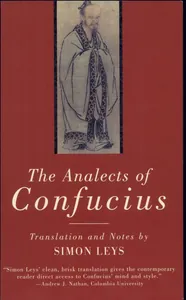
The ethics of Confucius

 75
75

The ethics of Confucius
Reading The Ethics of Confucius is akin to sifting through ancient wisdom, often presented in terse, aphoristic fragments. The strength lies in its directness; the absence of elaborate argumentation forces the reader to confront the core principles of Confucian thought without intermediary interpretation. A particularly striking passage concerns the cultivation of virtue, where Confucius suggests that learning is like a journey that never ends, emphasizing continuous self-improvement. However, the compilation's lack of a clear narrative arc can make it feel disjointed at times, requiring the reader to actively synthesize the ideas. The pervasive emphasis on social hierarchy, while historically significant, may also feel alienating to a modern Western audience accustomed to different social structures. Nonetheless, the work offers a clear, unvarnished glimpse into a philosophy that has profoundly shaped East Asian civilization.
📝 Description
75
### What It Is
The Ethics of Confucius, first published in 2005, presents the foundational moral and social philosophy of the ancient Chinese thinker. It is not a narrative or a treatise in the Western sense, but a collection of aphorisms, dialogues, and sayings attributed to Confucius and his disciples. These texts articulate a vision of a well-ordered society built upon personal virtue, ritual propriety, and cultivated relationships.
### Who It's For
This work is essential for students of Eastern philosophy, comparative ethics, and political thought. It offers a direct encounter with the source material that shaped millennia of Chinese culture and governance. Scholars seeking to understand the roots of Confucianism, as well as individuals interested in practical wisdom for personal conduct and societal harmony, will find considerable value here.
### Historical Context
Confucius lived during the Spring and Autumn period (771–476 BCE), a time of significant political fragmentation and intellectual ferment in China. His teachings emerged as a response to the perceived moral decline and social chaos of his era. He sought to revive the values of an earlier, idealized past, emphasizing the importance of the 'Junzi' (noble person) as a model for rulers and citizens alike. His ideas would later be codified and profoundly influence imperial China.
### Key Concepts
Central to the text is the concept of 'Ren' (仁), often translated as benevolence or humaneness, representing the ideal inner moral character. 'Li' (禮), ritual propriety or etiquette, provides the outward expression of Ren and governs social interactions. The cultivation of virtue through education and self-reflection is paramount, leading to the ideal of the 'Junzi' (君子), the gentleman or superior person, who embodies these principles and contributes to social order.
💡 Why Read This Book?
• You will learn about the concept of 'Ren' (仁) and its practical application in daily life, understanding how this core virtue aims to foster genuine human connection, a facet often overlooked in modern ethics. • You will gain insight into the role of 'Li' (禮), ritual propriety, as Confucius envisioned it, recognizing its function not as mere ceremony but as a framework for social harmony and respect, specifically as detailed in sections discussing ceremonial conduct. • You will encounter the ideal of the 'Junzi' (君子) and understand its significance within the Spring and Autumn period (771–476 BCE), grasping how this model of personal virtue was intended to rectify societal ills.
⭐ Reader Reviews
Honest opinions from readers who have explored this book.
❓ Frequently Asked Questions
What is the central philosophy presented in The Ethics of Confucius?
The central philosophy revolves around cultivating personal virtue, particularly 'Ren' (benevolence) and 'Li' (ritual propriety), to achieve social harmony and good governance, a vision deeply rooted in the historical context of the Spring and Autumn period.
Who was Confucius and when did he live?
Confucius was an ancient Chinese philosopher and teacher whose teachings, compiled in works like this, originated during the Spring and Autumn period (771–476 BCE), a time of considerable social and political upheaval.
What does 'Ren' mean in the context of Confucian ethics?
'Ren' (仁) is a core concept, often translated as benevolence, humaneness, or goodness. It represents the ideal inner moral character and the fundamental virtue of empathy that should guide all human interactions.
How does 'Li' relate to 'Ren' in Confucian thought?
'Li' (禮), meaning ritual propriety or etiquette, is seen as the outward expression and cultivation of 'Ren'. It provides the social norms and ceremonies through which inner virtue is manifested and social order is maintained.
What is the significance of the 'Junzi' in this work?
The 'Junzi' (君子), or noble person/gentleman, is the ideal individual who embodies 'Ren' and 'Li'. The text presents the cultivation of the Junzi as crucial for ethical leadership and the creation of a stable, moral society.
Is this book a primary source for Confucius's teachings?
Yes, The Ethics of Confucius is a compilation of sayings and dialogues attributed to Confucius and his disciples, serving as a primary source for understanding his philosophical system, though it was compiled by his followers.
🔮 Key Themes & Symbolism
Cultivating 'Ren' (Benevolence)
The core virtue of 'Ren' (仁) is presented as the foundation of ethical living. It signifies a deep sense of humaneness, empathy, and care for others. The text explores how 'Ren' is not an abstract ideal but a practical quality to be actively developed through self-reflection and mindful interaction. This concept contrasts with purely legalistic or utilitarian ethical systems, emphasizing internal moral cultivation as the primary driver for good conduct and societal well-being. Its pursuit aims to transform individuals from within, fostering genuine connection rather than mere adherence to rules.
The Role of 'Li' (Ritual Propriety)
'Li' (禮), encompassing ritual, etiquette, and propriety, functions as the outward manifestation and practical training ground for 'Ren'. The work details how structured social interactions, ceremonies, and even seemingly minor courtesies are essential for cultivating respect, order, and harmony. Far from being superficial, 'Li' is depicted as a vital mechanism for teaching individuals their social roles and responsibilities, thereby preventing chaos and fostering a cohesive society. It provides the framework through which inner virtue can be effectively expressed and recognized.
The Ideal of the 'Junzi'
The 'Junzi' (君子), or noble person, serves as the aspirational model within Confucian ethics. This individual embodies 'Ren' and adheres to 'Li', demonstrating exemplary moral character and leadership. The text outlines the qualities and practices necessary for aspiring to be a Junzi, emphasizing continuous learning, self-discipline, and a commitment to righteousness. The presence and pursuit of the Junzi ideal were seen as crucial for effective governance and the moral upliftment of society, providing a tangible standard for ethical behavior.
Governance and Social Order
Beyond individual ethics, the work profoundly addresses principles of governance and the maintenance of social order. Confucius's philosophy posits that a ruler's moral example is the most potent tool for governing. By cultivating virtue in leadership, society naturally tends towards order and prosperity. This perspective challenges autocratic or purely coercive models of rule, suggesting that ethical leadership, rooted in the ruler's own character and adherence to principles like 'Ren' and 'Li', is paramount for creating a stable and flourishing state.
💬 Memorable Quotes
“To learn and not to think is a waste. To think and not to learn is a danger.”
— This aphorism highlights the essential balance between theoretical knowledge and practical application, or between study and critical reflection. It suggests that true understanding requires both the intake of information and the active processing and integration of that information into one's own thought processes.
“The superior man understands righteousness; the small man understands profit.”
— This statement draws a clear distinction between the motivations of an ethical individual and a self-serving one. It posits that the 'superior man' (Junzi) prioritizes moral principles and justice, while the 'small man' is primarily concerned with personal gain and material advantage.
“Do not do to others what you do not want done to yourself.”
— This is a fundamental principle of reciprocity, often referred to as the Golden Rule. It emphasizes empathy and consideration for others by advising individuals to act as they would wish to be treated, forming a cornerstone of interpersonal ethics.
“When you have faults, do not fear to abandon them.”
— This emphasizes the importance of continuous self-improvement and moral correction. It suggests that acknowledging one's errors and actively working to rectify them is a sign of strength and a necessary component of personal growth and ethical development.
“The man of virtue is not sad when he is not understood by men.”
— This highlights the internal locus of virtue. A truly virtuous individual, according to this saying, derives satisfaction from their own moral conduct and principles, rather than seeking external validation or approval from others.
🌙 Esoteric Significance
Tradition
While not typically classified within Western esoteric traditions like Hermeticism or Kabbalah, Confucianism shares common ground with many Eastern philosophical systems that explore the cultivation of the self for societal benefit. Its emphasis on aligning oneself with a cosmic or natural order (Tian, Heaven) and developing inner virtue to influence the external world can be seen as having esoteric parallels. The meticulous practice of 'Li' can be interpreted as a form of ritualistic self-discipline aimed at achieving a higher state of being and contributing to universal harmony, akin to yogic or monastic practices.
Symbolism
Key symbols in Confucian thought include the 'Junzi' (君子), representing the cultivated individual who embodies moral perfection and serves as a societal ideal. The concept of 'Tian' (天), often translated as Heaven, represents a moral order or cosmic force that underpins ethical principles, implying a connection between human morality and the universe. The cyclical nature of seasons and the importance of ancestral veneration also carry symbolic weight, representing continuity, order, and the interconnectedness of past, present, and future generations within the cosmic and social fabric.
Modern Relevance
Confucian principles continue to inform East Asian societies and are increasingly studied globally. Contemporary thinkers and leaders in fields ranging from ethics and political science to business management draw upon Confucian ideas of social harmony, the importance of ethical leadership, and the value of education. Neo-Confucianism remains a vibrant intellectual tradition, and its emphasis on filial piety, respect for elders, and community responsibility offers alternative frameworks for understanding social cohesion in a globalized world.
👥 Who Should Read This Book
• Students of comparative philosophy and ethics: To understand a foundational ethical system that has shaped a significant portion of global civilization and offers a distinct perspective on virtue and social order. • Leaders and aspiring leaders in any field: To explore Confucius's insights on ethical governance, the power of moral example, and the cultivation of character as prerequisites for effective leadership. • Individuals interested in practical wisdom for personal conduct: To engage with concepts like 'Ren' and 'Li' for guidance on fostering better relationships, improving self-discipline, and contributing positively to their communities.
📜 Historical Context
Confucius (Kong Fuzi, 551–479 BCE) developed his philosophy during the tumultuous Spring and Autumn period (771–476 BCE) of the Zhou Dynasty. This era was characterized by the fragmentation of central authority, constant warfare among feudal states, and a perceived decline in moral standards. Confucius, a scholar and minor official, sought to restore social order and ethical governance by reviving the perceived virtues of an earlier, idealized age. His teachings emphasized personal morality, social responsibility, and the importance of ritual (Li) and humaneness (Ren). His ideas stood in contrast to emerging Legalist philosophies, which favored strict laws and punishments, and Mohism, which advocated universal love and utilitarianism. While Confucius's influence was not immediate, his disciples, notably Mencius and Xunzi, further developed and disseminated his thought, which became a dominant force in Chinese culture, statecraft, and education for over two millennia.
📔 Journal Prompts
The balance between learning and thinking: What are the implications for your own intellectual development?
Cultivating 'Ren': How can the principle of benevolence be practically applied in your daily interactions?
The practice of 'Li': Reflect on a social ritual or custom and its role in fostering respect or order.
The ideal of the 'Junzi': Identify one quality of the Junzi you wish to embody and outline steps to cultivate it.
Personal profit versus righteousness: Analyze a recent decision through the lens of this dichotomy.
🗂️ Glossary
Ren (仁)
A fundamental Confucian virtue, often translated as benevolence, humaneness, or goodness. It represents the ideal inner moral character, emphasizing empathy and sincere care for others.
Li (禮)
Ritual propriety, etiquette, or ceremony. It refers to the established norms, customs, and actions that govern social interactions and provide a framework for expressing 'Ren' and maintaining social order.
Junzi (君子)
The 'superior person' or 'noble person' in Confucianism. This is the ideal individual who embodies virtue, righteousness, and wisdom, serving as a model for ethical conduct and leadership.
Tian (天)
Often translated as Heaven, it represents a cosmic order or a moral force that underpins the universe. Confucian ethics seeks to align human actions with the will or principles of Tian.
Spring and Autumn period (771–476 BCE)
A historical era in ancient China characterized by political fragmentation and warfare. Confucius's philosophy emerged as a response to the perceived moral and social decline of this period.
Dao (道)
While more central to Taoism, the concept of the 'Way' or 'Path' also appears in Confucian thought, referring to the proper course of conduct, the natural order, or the principles that should guide individuals and society.
Xiao (孝)
Filial piety, a core Confucian virtue emphasizing respect, obedience, and care for one's parents and elders. It is considered a fundamental element of social harmony.