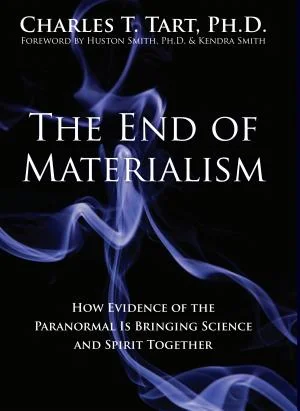
The End of Materialism
 79
79

The End of Materialism
Charles T. Tart's The End of Materialism offers a compelling, if sometimes dry, compilation of evidence challenging a strictly materialistic understanding of reality. Tart, a seasoned researcher in altered states of consciousness, navigates the often-controversial terrain of parapsychology with a commendable commitment to empirical data. His strength lies in presenting complex studies on telepathy and precognition in an accessible manner, particularly for those who appreciate a structured, scientific approach to unconventional topics. A notable limitation is the book's academic tone, which might alienate readers seeking more experiential or philosophical explorations. The section discussing the limitations of current scientific paradigms in explaining psychic phenomena, particularly the concept of "anomalous cognition," is a standout, highlighting the empirical challenges. While it doesn't offer definitive proof, it effectively argues for expanding the scientific purview. Tart's work serves as a valuable resource for skeptics willing to examine the evidence.
📝 Description
79
In 2009, Charles T. Tart's The End of Materialism questioned science's limits regarding consciousness.
Charles T. Tart, a psychologist known for his research into consciousness, published The End of Materialism in 2009. The book addresses the limitations of a strictly materialistic worldview when confronted with phenomena that conventional science has difficulty explaining. Tart examines data concerning telepathy, precognition, and psychic healing, aiming not to attack science but to suggest an expansion of its explanatory scope.
The work is intended for readers with a scientific background who are curious about subjective experience and the possibility of consciousness existing independently of the physical brain. It also appeals to those with spiritual or parapsychological interests who are looking for a rational, evidence-based perspective to validate their views. Tart's book seeks to connect empirical investigation with the study of anomalous experiences.
The core argument posits that a purely materialistic framework is insufficient to explain all observed events. Tart introduces terms like 'anomalous cognition' to categorize psi phenomena such as telepathy, precognition, and clairvoyance. He also considers how consciousness might interact with the physical world in ways not accounted for by current physics. Throughout the book, Tart stresses the need for careful methodology in researching these subjects, advocating for a scientific approach that is both open-minded and critical.
The End of Materialism is situated within a historical current of scientific inquiry into parapsychological phenomena, a field that saw considerable attention in the late 19th and early 20th centuries, notably through organizations like the Society for Psychical Research. Tart's research continues this tradition, engaging with a scientific community often skeptical of such topics. The book contributes to an ongoing discussion that contrasts reductionist materialism with broader understandings of reality, seeking to integrate anomalous findings into a more comprehensive worldview.
💡 Why Read This Book?
• You will learn how to critically evaluate evidence for psychic phenomena, understanding specific methodologies used in parapsychological research as outlined in sections discussing telepathy experiments from the 1970s. • You will gain a framework for reconciling spiritual beliefs with scientific inquiry, appreciating Tart's approach to "anomalous cognition" and its implications for consciousness studies. • You will discover how the limitations of a purely materialistic worldview are addressed by examining the history of psi research, including the work of contemporaries like J.B. Rhine.
⭐ Reader Reviews
Honest opinions from readers who have explored this book.
❓ Frequently Asked Questions
What is the primary argument of Charles T. Tart's 'The End of Materialism'?
The book argues that a purely materialistic worldview is insufficient to explain all observed phenomena, presenting evidence for psi abilities like telepathy, precognition, and psychic healing.
Who is Charles T. Tart and what is his background?
Charles T. Tart is a psychologist and parapsychologist, a distinguished professor emeritus at UC Davis, known for his pioneering research on altered states of consciousness and psi phenomena since the 1960s.
What specific examples of psychic phenomena does the book discuss?
The book examines evidence for telepathy (mind-to-mind communication), precognition (knowing future events), clairvoyance (perceiving distant objects or events), and psychic healing.
Is 'The End of Materialism' suitable for people with no scientific background?
While it presents scientific evidence, Tart aims for accessibility. However, readers with some comfort in discussing scientific concepts will likely find it most rewarding.
When was 'The End of Materialism' first published?
The book was first published in 2009, reflecting a culmination of decades of research and thought on the subject by the author.
Does the book claim to definitively prove psychic abilities?
No, the book presents evidence and argues for the expansion of scientific inquiry, rather than claiming absolute proof. It encourages open-minded but critical consideration of the data.
🔮 Key Themes & Symbolism
Challenging Materialist Dogma
Tart directly confronts the philosophical stance that only matter and energy are real. He posits that consciousness may be a fundamental aspect of reality, not merely an emergent property of the brain. The book systematically reviews empirical data that appears inconsistent with strict materialism, suggesting that current scientific models may be incomplete. This theme encourages readers to question assumptions about the nature of reality and the limits of empirical investigation, especially concerning subjective experience and anomalous mental events.
Evidence for Psi Phenomena
The core of the book lies in its detailed presentation and analysis of evidence for parapsychological abilities, often termed 'psi'. Tart focuses on telepathy, precognition, and clairvoyance, drawing from decades of research, including studies he himself conducted. He emphasizes the importance of rigorous methodology in this field, aiming to provide a rational basis for considering these phenomena as real, albeit poorly understood, aspects of human experience that defy conventional explanation.
Expanding Scientific Paradigms
Rather than rejecting science, Tart advocates for its expansion. He argues that science must be open to phenomena that do not fit neatly into existing frameworks. The book explores the concept of "anomalous cognition" and the potential for consciousness to operate independently of the physical body, pushing the boundaries of what is considered scientifically viable. This theme calls for a more inclusive and flexible scientific approach to understanding consciousness and its potential capabilities.
Consciousness Beyond the Brain
A central implication of the evidence presented is that consciousness might not be solely a product of brain activity. Tart explores the possibility that consciousness could be more fundamental or that the brain acts as a receiver or filter for a broader consciousness field. This challenges the reductionist view of the mind and opens avenues for exploring non-local consciousness and its implications for personal identity and the nature of existence.
💬 Memorable Quotes
“The evidence for psi phenomena is strong enough to warrant serious consideration.”
— This statement encapsulates Tart's thesis: the accumulated data from parapsychological research, despite skepticism, reaches a threshold where dismissal becomes scientifically untenable. It calls for an open, evidence-based approach rather than immediate rejection.
“Materialism is an assumption, not a proven fact.”
— Tart challenges the philosophical bedrock of materialism, suggesting it's a chosen framework rather than an empirically verified truth. This interpretation invites readers to consider alternative worldviews that might better accommodate anomalous experiences.
“Our current scientific models are incomplete.”
— This interpretation highlights Tart's view that existing scientific paradigms, particularly those rooted in strict materialism, fail to account for a range of observed phenomena. It suggests a need for new theoretical frameworks.
“Anomalous cognition requires a broader definition of reality.”
— This paraphrased concept suggests that phenomena like telepathy and precognition, collectively termed 'anomalous cognition,' necessitate a departure from purely physical explanations, implying that reality encompasses more than just the material world.
“Rigorous methodology is crucial for studying consciousness.”
— This interpretation emphasizes Tart's commitment to scientific rigor even when exploring unconventional topics. It underscores his belief that valid insights into consciousness and psi require careful, systematic research, not anecdotal evidence alone.
🌙 Esoteric Significance
Tradition
While not strictly adhering to a single esoteric lineage, Tart's work resonates with traditions that posit consciousness as primary or fundamental, such as certain interpretations within Neoplatonism or the Perennial Philosophy movement. It departs from rigid dogma by grounding its arguments in empirical research, bridging the gap between esoteric concepts of mind-over-matter and scientific inquiry. It aligns with the Hermetic principle 'As above, so below,' suggesting interconnectedness beyond the purely physical.
Symbolism
The book doesn't heavily rely on traditional esoteric symbols but uses concepts as symbolic anchors. 'Anomalous cognition' itself functions as a symbol for the unknown potential of consciousness, challenging the symbolic representation of the brain as the sole seat of mind. The persistence of psi phenomena in research can be seen as a symbol of reality's inherent mystery, resisting complete reduction to materialist explanations.
Modern Relevance
Tart's work remains relevant for contemporary researchers exploring consciousness, quantum physics interpretations, and the mind-body connection. Thinkers in fields like transpersonal psychology and Integral Theory, such as Ken Wilber, often cite or build upon Tart's research. His emphasis on rigorous methodology continues to influence those seeking to validate subjective experiences and subtle energies within a scientific framework.
👥 Who Should Read This Book
• Inquisitive scientists and students seeking to understand the empirical challenges to materialism, particularly regarding consciousness and anomalous mental phenomena. • Individuals with spiritual or metaphysical inclinations looking for evidence-based arguments that support the existence of non-physical aspects of reality. • Researchers and practitioners in parapsychology and consciousness studies who require a review of key experimental findings and methodological considerations.
📜 Historical Context
Published in 2009, The End of Materialism arrives decades after the peak of mainstream interest in parapsychology, a field that saw significant institutional support in the mid-20th century, notably through J.B. Rhine's work at Duke University. The intellectual climate of 2009 was still largely dominated by a reductive materialist framework, making Tart's empirical approach a counter-current. While figures like Daniel Dennett championed physicalist explanations for consciousness, Tart engaged directly with experimental data that seemed to defy such explanations. The Society for Psychical Research, founded in 1882, represented an earlier effort to scientifically investigate these phenomena, a lineage Tart implicitly acknowledges by building upon its research base. Reception was largely within academic and enthusiast circles, continuing the ongoing debate between materialistic science and broader conceptions of mind and reality.
📔 Journal Prompts
The concept of anomalous cognition and its implications for a materialist worldview.
Experiences that challenge your assumptions about the boundaries of consciousness.
The role of rigorous methodology in investigating subjective phenomena.
The evidence for telepathy presented in the book.
How the limitations of current scientific models affect your understanding of reality.
🗂️ Glossary
Materialism
A philosophical stance asserting that matter is the fundamental constituent of reality, and all phenomena, including consciousness, are the result of material interactions.
Psi Phenomena
An umbrella term used in parapsychology to describe purported psychic abilities, including telepathy, precognition, clairvoyance, and psychokinesis, which are not explained by known physical laws.
Anomalous Cognition
A term often used by Charles T. Tart to refer to cognitive processes (like ESP) that appear to operate outside the bounds of conventional sensory and physical mechanisms.
Telepathy
The purported direct transmission of thoughts or feelings from one person to another without the use of the known senses.
Precognition
The alleged ability to gain information about events occurring in the future, before they happen.
Clairvoyance
The supposed ability to perceive objects or events through means other than the known senses, such as seeing distant objects or future events.
Reductionism
An approach that explains complex phenomena by reducing them to their simplest, most fundamental components, often implying that the whole is nothing more than the sum of its parts.