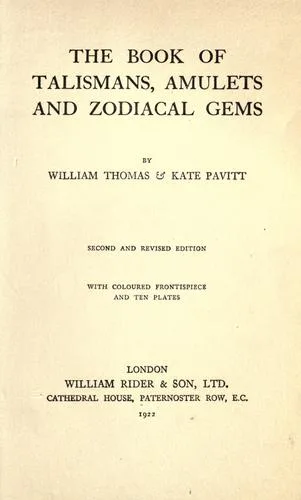
The Book of Talismans, Amulets, and Zodiacal Gems
 79
79

The Book of Talismans, Amulets, and Zodiacal Gems
William Thomas Pavitt's "The Book of Talismans, Amulets, and Zodiacal Gems" offers a valuable, if somewhat dry, compilation of historical magical objects. Its strength lies in its systematic approach, meticulously detailing the properties and uses of various gems and talismans without resorting to sensationalism. The preservation of original imagery, as noted by the publisher, is a significant advantage, allowing for closer study of the artifacts described. However, the text can feel encyclopedic, lacking the narrative flow found in more personal accounts of magical practice. A particularly illustrative section details the specific astrological conditions under which a talisman must be created to correspond with planetary intelligences, demonstrating a rigorous adherence to traditional occult principles. While not an easy read for the uninitiated, it is an indispensable resource for those seeking a factual grounding in the history of materia magica. It serves as a solid reference, but not a grimoire for immediate application.
📝 Description
79
### What It Is
The "Book of Talismans, Amulets, and Zodiacal Gems" presents a methodical examination of objects imbued with symbolic and protective power, drawing from historical occult traditions. Unlike texts relying on automated transcription, this edition prioritizes fidelity to the original publication, preserving intricate details and accurate imagery. It serves as a comprehensive guide to the materials, constructions, and intended applications of various enchanted items believed to influence human affairs and spiritual states.
### Who It's For
This volume is intended for serious students of Western esotericism, antiquarian collectors of occult literature, and practitioners seeking to understand the historical underpinnings of talismanic magic and gemology. Those with an interest in the intersection of folklore, astrology, and material culture will find its detailed explanations particularly valuable. It appeals to readers who appreciate scholarly rigor applied to subjects often relegated to speculative fiction.
### Historical Context
Published initially in the early 20th century (first published 2012-01, though the content reflects earlier research), this work emerged during a period of intense occult revival in Europe and America. Movements like Theosophy and the Hermetic Order of the Golden Dawn were actively exploring and codifying esoteric knowledge. Pavitt's book contributes to this milieu by systematically cataloging items of magical significance, providing a reference point for contemporary investigators of the arcane.
### Key Concepts
The book explores the inherent virtues attributed to specific gemstones, the astrological correspondences that dictate their use, and the construction of talismans designed to harness celestial energies. It details the symbolic language embedded in amulets, from planetary sigils to zodiacal representations, and explains the ritualistic preparation and consecration required to activate their latent powers. The work distinguishes between passive charms and actively consecrated objects.
💡 Why Read This Book?
• Gain a structured understanding of how specific gemstones like the ruby or sapphire were historically believed to be imbued with power, linked to planetary influences detailed in chapters concerning zodiacal gems. • Learn the precise methods and astrological timings for constructing talismans, as described in the sections on creating sigils for planetary or zodiacal purposes. • Appreciate the historical development of magical object traditions in the early 20th century, understanding the context of Pavitt's research alongside contemporaries in the occult revival.
⭐ Reader Reviews
Honest opinions from readers who have explored this book.
❓ Frequently Asked Questions
What is the primary focus of "The Book of Talismans, Amulets, and Zodiacal Gems"?
The book focuses on cataloging and explaining the historical use, construction, and perceived magical properties of talismans, amulets, and gemstones, particularly those linked to astrological and zodiacal significations.
When was "The Book of Talismans, Amulets, and Zodiacal Gems" first published?
While the specific edition available was first published in January 2012, the content reflects research and traditions from an earlier period, likely the early 20th century, during the height of occult revival movements.
Does the book use OCR technology?
No, the publisher explicitly states they avoided Optical Character Recognition (OCR) to maintain the quality of the original text and images, minimizing typos and preserving the integrity of the historical material.
What kind of images can be found in this book?
The book contains images such as portraits, maps, and sketches relevant to the study of talismans and amulets, with an effort made to retain the quality and accuracy of these original illustrations.
Who is the author, William Thomas Pavitt?
William Thomas Pavitt was an author and researcher interested in occultism and esoteric subjects, compiling historical information on magical objects during a period of significant interest in these areas.
Is this book suitable for beginners in magic?
While informative, the book is more of a historical reference and scholarly compilation. Beginners might find it dense, but it offers a solid foundation for understanding the theory and history behind talismans and amulets.
🔮 Key Themes & Symbolism
Zodiacal Gemstone Virtues
The work meticulously details the specific gemstones associated with each zodiacal sign and planet, outlining their purported virtues and influences. It explains how these gems were historically employed in amulets and talismans to attract specific qualities, ward off negativity, or enhance the wearer's connection to celestial forces. Pavitt delves into the symbolic language of colors, cuts, and inclusions, presenting a systematic framework for understanding gem-based magic prevalent in early 20th-century occultism.
Talismanic Construction and Consecration
Central to the book is the methodology of creating effective talismans. This involves not only the selection of appropriate materials, particularly zodiacal gems, but also the precise timing dictated by astrological charts. Pavitt outlines the importance of inscribing specific sigils, symbols, and divine names onto the talisman during auspicious planetary hours to imbue it with targeted power and intention. The process of consecration, or ritual activation, is presented as crucial for awakening the object's latent energies.
The Nature of Amulets
Beyond talismans, the book examines a broader category of amulets – objects believed to offer protection or bestow fortune. It differentiates between various types, from those worn for personal defense against unseen forces to those used in domestic or public spaces. The discussion explores the historical evolution of amuletic forms across different cultures and their integration into Western esoteric practices, highlighting their role as tangible focal points for belief and magical intent.
Planetary Correspondences
A foundational element throughout the text is the system of planetary correspondences. Pavitt explains how each celestial body (Sun, Moon, Mercury, Venus, Mars, Jupiter, Saturn) is linked to specific gems, metals, symbols, and energies. Understanding these connections is presented as essential for selecting the right materials and timing for the creation of potent talismans and for interpreting the influences of various gems and amulets on human life.
💬 Memorable Quotes
“The virtue of a gem is greatly increased by the circumstances under which it is cut and engraved.”
— This statement highlights the belief that the physical manipulation and symbolic inscription of a gemstone, particularly under specific astrological conditions, amplify its inherent magical properties beyond its natural state.
“Every talisman should be made under the auspices of the planet or planets which rule the purpose for which it is intended.”
— This emphasizes the core principle of sympathetic magic: the creator must align the talisman's creation with the celestial powers governing the desired outcome, ensuring the object acts as a conduit for specific cosmic energies.
“Amulets may be divided into two classes: those which protect the wearer from evil, and those which bring good fortune.”
— This offers a fundamental categorization of amuletic function, distinguishing between defensive magic (apotropaic) and beneficial magic (prosperous), providing a clear framework for understanding the diverse aims of protective charms.
“The planetary hours are of the utmost importance in the manufacture of talismans.”
— This underscores the critical role of astrological timing in talismanic magic, suggesting that the success or failure of an enchanted object is directly dependent on its creation during specific, favorable temporal windows aligned with planetary influences.
“The virtue of a stone is not only in its inherent qualities but in the intention and consecration bestowed upon it.”
— This points to a dual source of a gem's power: its natural properties and the focused will and ritualistic blessing of the practitioner, indicating that passive material attributes require active magical infusion.
🌙 Esoteric Significance
Tradition
This work firmly belongs within the Western Esoteric Tradition, specifically drawing from Hermeticism and traditional astrology. It systematizes practices related to materia magica and talismanic construction that have roots stretching back to classical antiquity and the medieval period. Pavitt's approach, while detailed, adheres to established correspondences and astrological principles prevalent in grimoires and esoteric manuals of earlier centuries, offering a bridge between ancient lore and early 20th-century occult scholarship.
Symbolism
Key symbols include planetary sigils, zodiacal emblems, and the inherent symbolic language of gemstones themselves. For instance, the ruby might symbolize Mars, representing courage and war, while a sapphire could be linked to Jupiter, signifying wisdom and authority. The arrangement and engraving of these symbols on a talisman are crucial, acting as visual anchors for the desired magical intention and as conduits for specific celestial influences.
Modern Relevance
Contemporary practitioners of traditional witchcraft, Hellenistic astrology, and modern Hermeticism often reference historical texts like Pavitt's for foundational knowledge. The resurgence of interest in astrological gemology and the practical application of talismans in personal development and spiritual practice means that this book remains a valuable resource for understanding the historical context and theoretical underpinnings of these pursuits.
👥 Who Should Read This Book
• Students of Western Esotericism: Those seeking a foundational understanding of historical talismanic magic and gem lore within the Hermetic and astrological traditions. • Antiquarian Occult Collectors: Individuals interested in acquiring and studying primary or well-reproduced secondary sources from the early 20th-century occult revival. • Astrologers and Gemstone Enthusiasts: Practitioners who wish to deepen their knowledge of the historical astrological correspondences and magical applications of specific gemstones.
📜 Historical Context
Emerging from the fertile ground of the late Victorian and Edwardian occult revival, William Thomas Pavitt's work on talismans and gems arrived during a period when figures like Aleister Crowley were challenging and redefining magical practices. The early 20th century saw a surge in interest in Hermeticism, Kabbalah, and ceremonial magic, fueled by organizations such as the Hermetic Order of the Golden Dawn, founded in 1888. Pavitt’s systematic cataloging of zodiacal gems and talismanic construction methods provided a scholarly, albeit traditional, counterpoint to more radical magical innovations. While not directly engaging with contemporaries like Annie Besant or Madame Blavatsky’s Theosophical interpretations, Pavitt's research into gem lore and astrological magic aligns with a broader academic and esoteric pursuit of ancient wisdom. The publication, reflecting earlier research, taps into a readership seeking verifiable historical frameworks for occult phenomena, distinct from the more speculative or Gnostic leanings present in other contemporary esoteric literature.
📔 Journal Prompts
Zodiacal Gemstone Virtues: Reflect on the specific gemstone associated with your birth sign and its purported virtues.
Talismanic Construction: Consider a personal goal and identify the planetary correspondences that might be relevant for creating a hypothetical talisman.
Planetary Correspondences: Explore the connection between the planet Mars and the ruby as detailed in the text.
Amulet Functionality: Differentiate between an amulet intended for protection and one for attracting fortune, using examples from the book.
Historical Contextualization: Consider how the emphasis on precise astrological timing in talisman creation differs from modern, less structured approaches.
🗂️ Glossary
Talisman
An object inscribed with symbols or gems, consecrated according to astrological principles, intended to attract certain influences or energies for a specific purpose.
Amulet
An object, often worn, believed to possess protective powers against evil, disease, or misfortune, or to bring good luck.
Zodiacal Gems
Gemstones specifically associated with the twelve signs of the zodiac, believed to derive their power and influence from the celestial energies of those signs.
Planetary Hours
Specific periods within a 24-hour cycle that are governed by one of the seven classical planets, considered auspicious for magical operations aligned with that planet.
Sigil
A symbolic representation, often a complex geometric or alphabetic design, used in magical rituals to represent a deity, spirit, or intention.
Consecration
The ritualistic act of dedicating an object, such as a talisman, to a specific purpose or divine power, thereby imbuing it with magical potency.
Materia Magica
Literally 'magical material,' referring to the substances, such as herbs, gems, metals, and symbols, used in the practice of magic.