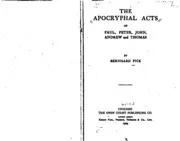
The Apocryphal Acts of Paul, Peter, John, Andrew and Thomas (Ancient Texts and Translations)

 84
84

The Apocryphal Acts of Paul, Peter, John, Andrew and Thomas (Ancient Texts and Translations)
Bernhard Pick's collection of apocryphal acts offers a vital counterpoint to the established New Testament narratives, presenting the apostles not merely as historical figures but as figures of mythic proportion in their own right. The strength of this volume lies in its presentation of these often-obscure texts in a coherent, translated format, allowing for direct engagement with their unique theological perspectives. Pick’s meticulous scholarship, evident in the annotations, provides crucial context for understanding the historical and religious milieu from which these stories arose. However, the sheer diversity and sometimes contradictory nature of the texts, as well as the scholarly apparatus, can make for a challenging read for those unfamiliar with early Christian literature. A particularly striking element is the portrayal of Paul in the 'Acts of Paul,' where his interactions and teachings diverge significantly from his canonical epistles, emphasizing a more radical asceticism and a different understanding of his conversion experience. This volume serves as an essential resource for anyone looking to grasp the full, untamed spectrum of early Christian imagination, though it demands patience and a willingness to grapple with challenging ideas.
📝 Description
84
Bernhard Pick's 2006 edition makes early Christian apocryphal acts by Paul, Peter, John, Andrew, and Thomas available.
This volume collects the apocryphal Acts of Paul, Peter, John, Andrew, and Thomas. These texts, excluded from the New Testament canon, present alternative accounts of the apostles' lives, miracles, and teachings. Pick's edition offers critical translations and annotations for modern readers.
These narratives circulated in early Christianity, between the 2nd and 4th centuries CE, a time of significant theological debate and textual creation. They often reflect views different from those that eventually became dominant. The collection allows insight into the varied beliefs and storytelling practices before a fixed Christian canon solidified.
These apocryphal acts belong to a period when early Christian communities produced a wide array of literature, much of which did not become canonical. They offer a glimpse into diverse theological currents and interpretive traditions that existed alongside, and sometimes in tension with, the developing orthodoxies. The texts engage with themes of spiritual practice, the nature of divine revelation, and the lives of key figures, reflecting a broader spectrum of early religious thought that extended beyond the scriptures accepted by later mainstream Christianity.
💡 Why Read This Book?
• Understand the diverse landscape of early Christian belief by examining the 'Acts of Paul,' which presents a different view of the apostle's ministry than canonical texts. • Explore early Christian views on asceticism and spiritual purity, as exemplified by the emphasis on celibacy and rigorous practices found within these apocryphal narratives. • Gain insight into the historical context of the 2nd-4th centuries CE by reading texts that circulated alongside, and sometimes in competition with, proto-orthodox Christian writings.
⭐ Reader Reviews
Honest opinions from readers who have explored this book.
❓ Frequently Asked Questions
What are the Apocryphal Acts of the Apostles?
These are ancient Christian writings that recount the deeds and teachings of apostles like Paul, Peter, John, Andrew, and Thomas, but were not included in the canonical New Testament.
When were these texts likely written?
The majority of these apocryphal acts were composed between the 2nd and 4th centuries CE, a period of significant theological diversification in early Christianity.
Why were they excluded from the Bible?
Reasons for exclusion varied, including perceived theological differences, authorship questions, or simply not aligning with the developing orthodox consensus by church leaders.
What kind of miracles are described in these texts?
The texts describe a wide range of miracles, including healings, resurrections, exorcisms, control over nature, and divine interventions against persecutors and pagan deities.
Who was Bernhard Pick?
Bernhard Pick (1842-1917) was a German-American theologian and scholar who translated and studied many early Christian apocryphal texts, making them accessible to modern readers.
Are these texts considered Gnostic?
Some of the apocryphal acts show Gnostic influences or were popular within Gnostic communities, but they represent a broader spectrum of early Christian thought, not all of which is strictly Gnostic.
🔮 Key Themes & Symbolism
Apostolic Journeys and Miracles
These texts vividly portray the apostles undertaking extensive missionary journeys across the Roman Empire and beyond. Their travels are marked by numerous miraculous events, from healing the sick and raising the dead to confronting pagan idols and sorcerers with divine power. These accounts often highlight the apostles' unwavering faith and the efficacy of their divine commission, serving to legitimize their teachings and establish the burgeoning Christian communities in challenging environments. The narrative structure emphasizes the expansion of the faith against formidable opposition.
Asceticism and Spiritual Purity
A recurring theme is the emphasis on ascetic practices as a means of achieving spiritual enlightenment and closer communion with God. Many of these acts promote celibacy, fasting, and abstinence from worldly pleasures as essential for discipleship. The texts often contrast the purity of the ascetical Christian life with the perceived decadence and corruption of pagan society. This focus on self-denial and spiritual discipline reflects a significant strand of thought within early Christianity, valuing detachment from the material world to attain spiritual freedom.
Christology and Divine Revelation
The nature of Christ, his divinity, and his salvific work are central to these narratives, though often presented through a distinct lens from the canonical Gospels. The apostles frequently receive divine revelations, visions, and instructions, underscoring the importance of direct spiritual experience. These texts explore various interpretations of Christ's passion, resurrection, and ascension, sometimes emphasizing his spiritual or immaterial nature. The divine authority of the apostles is consistently affirmed, as they act as conduits for God's will and truth.
Martyrdom and Persecution
The apostles' ministries are often depicted as fraught with danger, imprisonment, and ultimately, martyrdom. These accounts serve not only to glorify the apostles but also to provide examples of steadfastness and faith in the face of persecution by both Jewish authorities and Roman officials. The narratives often detail elaborate escapes from execution, divine protection, and the conversion of persecutors, underscoring the belief that even in suffering, God's plan prevails and the Christian message endures.
💬 Memorable Quotes
“Paul's encounters with the demon of lust and his subsequent ascetic teachings.”
— This highlights the intense spiritual battles described, where figures like Paul actively combat demonic forces and advocate for extreme self-control as a path to divine favor.
“Peter's confrontation with Simon Magus, showcasing miraculous power.”
— This passage exemplifies the common trope of apostles demonstrating superior divine power over pagan magicians and false prophets, asserting the truth of Christianity through supernatural feats.
“The detailed descriptions of baptismal rites and their transformative effects.”
— These accounts underscore the salvific importance placed on baptism in early Christianity, presenting it as a pivotal moment of spiritual rebirth and purification from sin.
“Andrew's preaching and conversion of multitudes in various cities.”
— This illustrates the missionary zeal and the perceived effectiveness of the apostles in spreading the Christian message, often depicting rapid and widespread conversions.
“The visions and divine instructions received by the apostles.”
— This points to the significant role of supernatural revelation in guiding the actions and doctrines of early Christian leaders, emphasizing a direct connection to the divine.
🌙 Esoteric Significance
Tradition
These texts belong to the broader tradition of early Christian literature that existed outside the canonical scriptures, often exhibiting Gnostic, Marcionite, or Montanist influences, though they represent a spectrum of heterodox thought. They diverge from later orthodox interpretations by emphasizing radical asceticism, direct divine revelation, and often a docetic or spiritualized view of Christ's humanity and resurrection. Their significance lies in revealing alternative pathways to salvation and spiritual understanding that were explored in the formative centuries of Christianity, challenging the singular narrative of orthodox development.
Symbolism
Key symbols include the serpent, often representing a deceptive or adversarial force, contrasted with the divine power of the apostles. Water frequently symbolizes purification and rebirth through baptism, a central sacrament. Light and darkness are common motifs, representing divine truth versus ignorance or evil. The resurrected body is often depicted as spiritual and ethereal, rather than physical, symbolizing a transcendence of earthly limitations and a transformed existence.
Modern Relevance
Contemporary esoteric and Gnostic studies draw heavily on these texts to understand the historical roots of alternative spiritualities. Practitioners of esoteric Christianity and comparative religion scholars utilize them to explore diverse interpretations of Christology, salvation, and spiritual practice. Elements of their emphasis on direct divine experience and mystical knowledge continue to resonate with modern seekers exploring non-traditional spiritual paths.
👥 Who Should Read This Book
• Students of New Testament Apocrypha: Those seeking primary source material to understand the variety of early Christian beliefs and narratives beyond the canonical texts. • Comparative Religion Researchers: Scholars interested in the development of religious traditions and the historical interplay between orthodox and heterodox Christian movements. • Esoteric and Gnostic Studies Enthusiasts: Individuals exploring the historical foundations of Gnosticism and other esoteric spiritual paths that emerged from early Christianity.
📜 Historical Context
The Apocryphal Acts of the Apostles emerged from a dynamic and often contentious period in early Christianity, roughly from the 2nd to the 4th century CE. This era saw a proliferation of diverse theological ideas and narrative traditions, many of which did not align with the developing proto-orthodox consensus. While canonical Gospels and Acts were gaining prominence, these alternative accounts circulated, offering different perspectives on the lives and teachings of the key figures. Scholars like Irenaeus of Lyons, writing in the late 2nd century, actively critiqued and refuted certain non-canonical texts, particularly those associated with Gnosticism, indicating a significant debate over scriptural authority and acceptable doctrine. The reception of these apocryphal texts was varied: some were widely read and influential in certain regions or circles, while others were actively suppressed or condemned by emerging church authorities, contributing to the gradual consolidation of the biblical canon and orthodox teachings.
📔 Journal Prompts
The concept of divine revelation through visions as depicted in the Acts of Thomas.
The apostles' methods for confronting pagan deities and sorcerers.
Reflect on the emphasis on asceticism in the Acts of Paul.
The portrayal of the resurrected body in these narratives.
The role of women in spreading the Christian message within these texts.
🗂️ Glossary
Apocrypha
Texts, typically religious, that are not part of an officially recognized canon of scripture but are often of historical or theological interest.
Canonical
Referring to texts that are accepted as part of the authoritative body of scripture within a religious tradition, such as the New Testament.
Gnosticism
A complex set of religious ideas and systems that emerged in the early centuries CE, characterized by a belief in salvation through esoteric knowledge (gnosis) and a dualistic worldview.
Docetism
An early Christian belief that Jesus Christ only appeared to be human and to suffer, but was in fact divine and did not have a physical body.
Asceticism
A lifestyle characterized by severe self-discipline and abstinence from all forms of indulgence, typically for religious or spiritual reasons.
Proto-orthodox
Referring to the early Christian beliefs and practices that eventually became the dominant or 'orthodox' form of Christianity.
Simon Magus
A figure from the New Testament (Acts 8) known for practicing sorcery, often depicted in apocryphal literature as a rival to the apostles.