Supernatural religion
 78
78

Supernatural religion
Cassels' monumental work, Supernatural Religion, offers a meticulous, almost forensic, dissection of religious claims that feels both exhaustive and, at times, relentlessly thorough. Its strength lies in its sheer breadth, cataloging and scrutinizing accounts of the miraculous from antiquity to its own time with an admirable commitment to detail. The extended analysis of biblical narratives and patristic writings, for instance, provides a solid foundation for his arguments about historical reliability. However, the book's dense argumentation, while intellectually rigorous, can also be its limitation. The sheer volume of material and the detailed, often dry, presentation may prove challenging for readers seeking a more accessible overview. A particularly compelling section is the examination of the criteria for historical evidence, which, while dated in its specific examples, still presents a potent challenge to accepting extraordinary claims without robust substantiation. It’s a scholarly edifice, built with precision, demanding considerable intellectual investment from its reader.
📝 Description
78
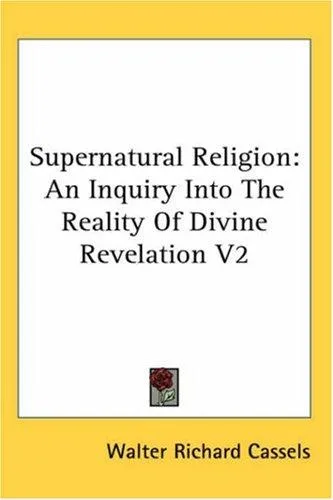
Walter Richard Cassels published Supernatural Religion in 1877, a critique of religious belief foundations.
Published in 1877, Walter Richard Cassels' Supernatural Religion scrutinizes the historical and philosophical arguments for the divine and miraculous. Cassels examines accounts of supernatural events across different cultures and time periods, offering a detailed critique of how religious beliefs are founded. The book directly addresses the scientific and rationalist critiques prevalent in the 19th century. Cassels aimed to present a balanced view of the evidence for and against divine intervention, engaging with the intellectual shifts of his time. This work is intended for those seriously studying comparative religion, the philosophy of religion, and intellectual history. It scrutinizes the standards of evidence used for religious claims and the historical debates surrounding miracles. Readers interested in the Victorian era's conflict between faith and reason will find its detailed arguments valuable. It is a text for dedicated scholarship rather than casual reading.
Supernatural Religion emerged during a period of significant intellectual change, with the rise of scientific naturalism and critical biblical scholarship. Cassels confronted the prevailing skepticism by analyzing extensive historical and theological material. His goal was to ground discussions of supernatural claims in rigorous examination. The book represents a notable contribution to the ongoing conversation between new scientific ideas and established religious doctrines. The central focus of Cassels' research is the critical assessment of historical accounts of miracles and divine revelation. He analyzes the trustworthiness of ancient texts, the psychological influences on belief, and philosophical arguments concerning religious claims.
While not strictly an esoteric text in the vein of occultism or mysticism, Supernatural Religion engages with the fringes of belief and the nature of evidence for phenomena outside the observable natural world. Cassels' work, published during a period of intense scientific advancement and skepticism, examines the very foundations upon which supernatural claims, including those found in various religious traditions, are built. It questions the historical and philosophical basis for accepting accounts of the miraculous, a topic that often intersects with esoteric thought which frequently relies on revelation, hidden knowledge, or experiences beyond ordinary perception. The book's rigorous examination of evidence and tradition can be seen as a critical counterpoint to less empirical approaches to the supernatural.
💡 Why Read This Book?
• Gain an understanding of the 19th-century debate between scientific rationalism and religious belief, as exemplified by the detailed critique of biblical miracles presented in the 1877 publication. • Learn to critically assess historical evidence for extraordinary claims by examining Cassels' methods for evaluating testimony and identifying potential biases in ancient texts. • Explore the philosophical underpinnings of natural law versus divine intervention, a core concept discussed throughout the work's extensive analysis of religious phenomena.
⭐ Reader Reviews
Honest opinions from readers who have explored this book.
❓ Frequently Asked Questions
What is the primary focus of Walter Richard Cassels' Supernatural Religion?
The book primarily focuses on a critical examination of historical and philosophical arguments for supernatural events and divine intervention, particularly within religious traditions, aiming to evaluate the evidence presented.
When was Supernatural Religion first published, and what was the intellectual climate like then?
Supernatural Religion was first published in 1877, during an era marked by the rise of scientific naturalism and critical historical scholarship, which challenged traditional religious doctrines.
Does the book argue for or against the existence of supernatural phenomena?
The book does not definitively argue for or against, but rather provides a rigorous critique of the historical evidence and philosophical arguments used to support supernatural claims, emphasizing critical evaluation.
Who would benefit most from reading Supernatural Religion?
Students of comparative religion, philosophy of religion, intellectual history, and those interested in the historical debates surrounding faith and reason in the 19th century would find it particularly valuable.
Is Supernatural Religion considered a primary source for understanding 19th-century religious skepticism?
Yes, it is considered a significant primary source, offering a detailed, scholarly perspective from the period that engaged directly with the challenges posed by scientific and rationalist thought.
What kind of evidence does Cassels analyze in Supernatural Religion?
Cassels analyzes a vast array of historical testimony, biblical texts, patristic writings, and philosophical arguments to scrutinize claims of miracles and divine revelation.
🔮 Key Themes & Symbolism
Historical Testimony and Miracles
The work meticulously dissects historical accounts of miracles, questioning the reliability of ancient sources and the methods used to verify extraordinary claims. Cassels scrutinizes the chain of transmission for religious narratives, exploring how testimonies evolve and how psychological factors might influence belief. This theme is central to understanding his approach to evidence, particularly concerning events that purportedly defy natural law, as explored in his critical analysis of biblical and patristic accounts.
Philosophy of Religion and Natural Law
Cassels engages deeply with the philosophical tension between divine intervention and the established principles of natural law. He examines arguments that posit a world governed by immutable laws, questioning the compatibility of supernatural events with such a framework. This exploration is crucial for understanding the intellectual currents of the 19th century, where scientific discoveries increasingly emphasized deterministic processes, prompting a re-evaluation of theological explanations for phenomena.
Comparative Religion and Doctrine Development
The book's scope extends to a comparative view of religious phenomena across different cultures and historical periods. Cassels traces the development of religious doctrines, observing how beliefs about the supernatural have been shaped by cultural contexts and historical circumstances. This comparative approach highlights the human element in the formation and perpetuation of religious traditions, suggesting that doctrines are often products of their time.
Rationalism vs. Faith
At its core, Supernatural Religion navigates the intellectual battleground between rationalist inquiry and religious faith. Cassels applies principles of critical reason to religious claims, seeking to establish objective criteria for belief. The work reflects the broader intellectual struggle of the Victorian era, where scientific advancement and philosophical critiques demanded a rigorous defense or re-evaluation of traditional spiritual tenets.
💬 Memorable Quotes
“The evidence for miracles is largely of the same kind as the evidence for historical events.”
— This statement encapsulates Cassels' core argument: that claims of the supernatural should be subjected to the same rigorous historical and evidential standards as any other historical assertion, implying a need for robust corroboration.
“Testimony is always subject to doubt, especially when it concerns events that are contrary to our experience.”
— Here, Cassels highlights the inherent skepticism warranted when evaluating accounts of extraordinary occurrences. He emphasizes that extraordinary claims require extraordinary proof, and personal or collective experience serves as a significant benchmark for assessing credibility.
“The development of religious doctrines often follows patterns observable in other forms of cultural and intellectual evolution.”
— This paraphrased concept suggests that religious beliefs and doctrines are not static or divinely revealed in their entirety, but rather evolve over time, influenced by human thought, societal changes, and historical context, much like secular knowledge.
“To believe in the supernatural is to accept that certain events transcend the established order of nature.”
— This quote defines the fundamental premise of supernatural belief systems. It frames the discussion around the very possibility of events occurring outside the predictable and observable laws of the natural world, a concept Cassels critically examines.
“The critical examination of religious texts reveals layers of interpretation and historical accretion.”
— This interpretation points to Cassels' method of textual analysis, suggesting that religious scriptures are not always simple, direct transmissions of truth but often composite works reflecting various historical periods, editorial interventions, and evolving theological perspectives.
🌙 Esoteric Significance
Tradition
While primarily a work of historical and philosophical critique rather than esoteric doctrine, Supernatural Religion indirectly engages with esoteric traditions by scrutinizing the very foundations of belief in the miraculous. Its rigorous examination of evidence and historical testimony provides a critical lens through which esoteric claims of divine revelation or supernatural efficacy can be evaluated. It operates outside any specific esoteric lineage, instead applying secular critical methods to religious phenomena that often form the basis of esoteric worldviews.
Symbolism
The book does not focus on specific esoteric symbols in the manner of occult texts. However, the concept of 'miracle' itself functions as a central motif, representing events that break or transcend the perceived natural order. Cassels examines these alleged miracles not as symbols of divine power in an esoteric sense, but as historical claims requiring empirical or logical validation. The 'supernatural' itself is treated as a category of phenomena to be critically analyzed, rather than a symbolic realm to be explored.
Modern Relevance
Contemporary thinkers in fields like comparative mythology, the history of skepticism, and the sociology of religion continue to engage with Cassels' meticulous approach to historical evidence and the critique of religious claims. His work serves as a foundational text for understanding the historical arguments that shaped modern secular thought and its relationship with religious belief. Scholars examining the evolution of skepticism and the methods of debunking extraordinary claims often cite Cassels as a significant precursor to later critical analyses.
👥 Who Should Read This Book
• Students of 19th-century intellectual history seeking to understand the impact of scientific rationalism on religious thought, particularly concerning the debate over miracles. • Scholars of comparative religion and philosophy of religion who need to engage with foundational critiques of historical religious evidence and the concept of divine intervention. • Skeptics and freethinkers interested in the historical arguments used to challenge traditional religious doctrines and the methods employed in such critiques.
📜 Historical Context
Published in 1877, Walter Richard Cassels' Supernatural Religion emerged during a pivotal era in Western intellectual history, the late Victorian age. This period was characterized by the ascendance of scientific materialism and the development of historical-critical methods applied to religion, notably by scholars like Ferdinand Christian Baur and David Strauss in Germany. Cassels' exhaustive work directly confronted the burgeoning skepticism fueled by Darwin's theories and the geological evidence for an ancient Earth. His comprehensive review of biblical and patristic accounts of miracles and divine intervention aimed to provide a rationalist counterpoint to prevailing theological defenses. The book's reception was significant; while lauded by rationalists and freethinkers, it also drew considerable criticism from religious defenders who sought to refute its conclusions, marking it as a key text in the ongoing debate between faith and reason.
📔 Journal Prompts
The reliability of historical testimony regarding supernatural events.
The philosophical tension between natural law and divine intervention.
How 19th-century scientific advancements influenced critiques of religious doctrines.
The criteria for accepting extraordinary claims in historical accounts.
The evolution of religious beliefs in response to intellectual shifts.
🗂️ Glossary
Supernatural
Pertaining to phenomena or events that are believed to exist outside or to transcend the known laws of nature and the material universe; often attributed to divine or spiritual agency.
Miracle
An extraordinary event attributed to divine intervention that defies explanation by natural law; a manifestation of supernatural power.
Natural Law
In philosophy and science, the principle that the universe operates according to consistent, discoverable, and immutable physical laws that govern cause and effect.
Testimony
Evidence or witness provided by someone, especially in a formal or legal context; in historical analysis, it refers to accounts recorded by individuals.
Patristic Writings
The body of theological and philosophical works produced by the early Christian writers (Church Fathers) from the 1st to the 8th centuries.
Rationalism
A philosophical approach that emphasizes reason as the primary source and test of knowledge, often leading to skepticism towards faith-based or revealed truths.
Biblical Criticism
The academic study and analysis of the Bible using historical-critical methods, examining its origins, authorship, historical context, and textual integrity.















![[Catalogue of Frederick Hockley's Book Sale]](/img/thumb/catalogue-of-frederick-hockley-s-book-sale-george-redway.webp)