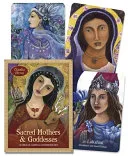
Sacred Mothers & Goddesses
 75
75

Sacred Mothers & Goddesses
Claudia Olivos’s Sacred Mothers & Goddesses offers a commendable effort to synthesize complex mythological and spiritual data concerning the feminine divine. The strength of the work lies in its systematic approach, connecting disparate deities and myths through overarching archetypal themes, particularly the mother-figure. Olivos’s analysis of how these archetypes manifest across cultures is detailed and well-researched. However, the book occasionally struggles with maintaining a singular voice, sometimes leaning towards academic dryness when discussing specific cultic practices, and then shifting to a more devotional tone without clear transition. A particularly illustrative section is the examination of the Sumerian goddess Inanna, where the author navigates her dual role as goddess of love and war with impressive clarity. Despite minor tonal inconsistencies, the work provides a valuable resource for understanding the enduring power of the goddess. It is a solid academic contribution to esoteric studies.
📝 Description
75
### What It Is
Sacred Mothers & Goddesses, authored by Claudia Olivos, is a scholarly exploration into the archetypal feminine divine across various mythologies and spiritual traditions. Published originally in 2020, the work meticulously examines the multifaceted roles, attributes, and symbolism associated with mother goddesses and female deities. It moves beyond simplistic veneration to analyze the psychological and cultural import of these figures, presenting them not merely as historical relics but as enduring forces that shape human consciousness and societal structures.
### Who It's For
This volume is intended for serious students of comparative mythology, esoteric studies, and women's spirituality. It appeals to academics seeking nuanced perspectives on ancient goddesses, as well as practitioners of modern paganism and earth-centered spiritualities who wish to deepen their understanding of the feminine divine. Readers will find value in its detailed analysis, whether they are exploring the lineage of matriarchal societies or seeking to integrate archetypal feminine energies into their personal spiritual practice.
### Historical Context
The study of goddesses and mother figures has a long lineage, stretching back to early 20th-century scholarship like that of Jane Ellen Harrison's work on Greek religion. Olivos's 2020 publication arrives in an era of renewed interest in feminist theology and the reclaiming of pre-patriarchal spiritual traditions. It engages with contemporary scholarship that re-evaluates ancient pantheons through lenses of gender studies and post-colonial theory, offering a contemporary perspective on figures previously interpreted through a predominantly patriarchal framework. The work implicitly contrasts with earlier, more romanticized interpretations of goddess worship.
### Key Concepts
The book investigates concepts such as the Great Mother archetype, the duality of creation and destruction embodied by goddesses, and the cyclical nature of life, death, and rebirth as represented by female deities. It examines the emergence of specific archetypes like the Maiden, Mother, and Crone, tracing their manifestations from ancient Sumerian Inanna to contemporary interpretations. Olivos also discusses the suppression and transformation of goddess imagery within monotheistic religions, highlighting how remnants of these older traditions persist in folklore and ritual.
💡 Why Read This Book?
• Gain a nuanced understanding of the mother archetype, moving beyond simplistic interpretations to explore its multifaceted roles in creation, destruction, and cyclical renewal, as exemplified by figures like Inanna. • Discover how ancient goddess traditions have been historically suppressed and reinterpreted, offering a critical lens for examining contemporary spiritual narratives and their patriarchal influences. • Learn to identify and integrate the archetypal feminine divine into your own spiritual framework, drawing practical wisdom from the varied manifestations of goddesses discussed in the book.
⭐ Reader Reviews
Honest opinions from readers who have explored this book.
❓ Frequently Asked Questions
When was Sacred Mothers & Goddesses first published?
Sacred Mothers & Goddesses by Claudia Olivos was first published in 2020, making it a contemporary contribution to the study of esoteric and mythological themes.
What are some key goddesses discussed in the book?
The book explores numerous goddesses, including prominent figures like the Sumerian Inanna, and delves into the archetypal representations of the Maiden, Mother, and Crone.
Does the book focus on a specific cultural tradition?
No, Sacred Mothers & Goddesses adopts a comparative approach, examining the feminine divine across various mythologies and spiritual traditions worldwide.
Is this book suitable for beginners in mythology studies?
While offering depth for advanced students, the book's structured approach and clear explanations make it accessible for beginners interested in comparative mythology and goddess studies.
What is the main goal of Sacred Mothers & Goddesses?
The primary aim is to analyze the multifaceted roles, symbolism, and psychological/cultural import of mother goddesses and female deities across different historical and spiritual contexts.
Does the author discuss the historical suppression of goddess worship?
Yes, Claudia Olivos addresses how goddess imagery and worship were transformed or suppressed with the rise of monotheistic religions, providing historical context for their diminished visibility.
🔮 Key Themes & Symbolism
The Great Mother Archetype
This theme centers on the primordial feminine principle responsible for creation, sustenance, and destruction. Olivos examines how this archetype manifests universally, from ancient earth goddesses to modern symbolic representations of the nurturing yet formidable feminine. The book traces its roots through various cultures, highlighting its fundamental role in human consciousness and spiritual traditions, emphasizing its cyclical nature of birth, death, and rebirth as a core aspect.
Dual Nature of Goddesses
A significant focus is placed on the often paradoxical attributes of goddesses, who embody both benevolent and destructive forces. The book uses examples like Inanna, the Sumerian goddess of love and war, to illustrate how these seemingly contradictory aspects are integral to the divine feminine's completeness. This duality reflects the natural world's cycles and the complex spectrum of human experience, challenging simplistic notions of 'good' and 'evil'.
Historical Trajectory of Goddess Worship
Olivos maps the historical evolution and often suppression of goddess veneration. The work discusses the transition from widespread matriarchal or goddess-centric societies to patriarchal structures and the subsequent reinterpretation or marginalization of female deities within emerging monotheistic faiths. This theme critically analyzes how the power and symbolism of goddesses were altered or hidden over centuries.
Feminine Divine in Modern Spirituality
The book connects ancient traditions to contemporary spiritual practices, exploring how the archetypes of Sacred Mothers and Goddesses are being rediscovered and integrated today. It examines the resurgence of interest in goddess spirituality, neo-paganism, and feminist theology, demonstrating the enduring relevance of these figures for personal empowerment and a balanced understanding of the sacred.
💬 Memorable Quotes
“The mother goddess is not merely a source of life but also the devourer, embodying the complete cycle.”
— This interpretation highlights the essential duality of the primordial feminine divine, encompassing both creation and destruction as inseparable components of existence and transformation.
“Inanna's reign over both love and war signifies the untamed power of the feminine.”
— This statement points to the complex and often fierce nature of certain goddesses, challenging patriarchal interpretations that often seek to domesticate or simplify the divine feminine's capabilities.
“The archetypes of the Maiden, Mother, and Crone represent distinct yet interconnected phases of female power.”
— This concept emphasizes the developmental and cyclical aspects of feminine energy, portraying these stages not as isolated identities but as a fluid continuum of experience and wisdom.
“Many goddess traditions were systematically marginalized with the rise of monotheistic religions.”
— This highlights a significant historical dynamic where older, often polytheistic or earth-based spiritualities centered on feminine deities were suppressed or transformed by the dominant patriarchal narratives of emerging world religions.
“Reclaiming goddess imagery is an act of spiritual and psychological restoration.”
— This suggests that the contemporary interest in goddesses is not just academic or cultural, but a deeply personal and collective effort to heal fragmented spiritual identities and re-establish a connection to potent, often neglected, feminine energies.
🌙 Esoteric Significance
Tradition
This work operates within the broad spectrum of esoteric studies, drawing heavily on comparative mythology and archetypal psychology, particularly the Jungian concept of archetypes. While not strictly adhering to a single tradition like Hermeticism or Kabbalah, it engages with the universal feminine divine that underpins many esoteric paths. Its focus on primal mother figures and cyclical cosmologies aligns with ancient earth-based spiritualities and pre-patriarchal belief systems, offering a bridge between historical practices and modern esoteric interpretations of the sacred feminine.
Symbolism
Central symbols include the Great Mother, representing universal creation, nurturing, and the cycle of life and death. The book also explores the symbolism of specific goddesses, such as Inanna's dual association with fertility and destruction, signifying the inherent paradoxes within divine power. The Maiden, Mother, and Crone archetypes serve as symbolic representations of feminine life stages and wisdom, illustrating the dynamic and transformative nature of female spiritual energy across time.
Modern Relevance
Sacred Mothers & Goddesses finds resonance with contemporary paganism, Wicca, and feminist spirituality movements that actively seek to reclaim and revitalize goddess imagery. Thinkers and practitioners interested in Jungian psychology, archetypal work, and the integration of the divine feminine into modern life will find its analyses pertinent. The book provides a scholarly foundation for those engaging with contemporary earth-centered spiritualities and seeking to understand the enduring power of ancient feminine deities in personal and collective transformation.
👥 Who Should Read This Book
• Students of comparative mythology and religious studies seeking in-depth analyses of female deities across cultures. • Practitioners of modern pagan, Wiccan, and earth-centered spiritualities looking to deepen their understanding of the goddess. • Scholars and readers interested in archetypal psychology, particularly Jungian approaches to the divine feminine and its manifestations.
📜 Historical Context
Claudia Olivos's Sacred Mothers & Goddesses, published in 2020, enters a field significantly shaped by early 20th-century feminist scholarship and archaeology, particularly the work of figures like Marija Gimbutas who proposed theories of Old European matriarchal cultures. The book arrives in an era where comparative mythology and religious studies increasingly embrace post-structuralist and gender-focused analyses, moving beyond the earlier, sometimes romanticized, 'goddess movement' narratives. It implicitly contrasts with the more straightforward theological or anthropological accounts that dominated mid-20th century scholarship. This contemporary work engages with a lineage of thought that seeks to reconstruct and understand pre-patriarchal spiritual expressions, offering a critical re-evaluation of figures like the Sumerian Inanna within a global mythological framework. The reception of such works often navigates between academic validation and the spiritual aspirations of contemporary practitioners.
📔 Journal Prompts
Reflect on the duality of the Great Mother archetype as both creator and destroyer.
Consider the historical trajectory of goddess worship and its impact on contemporary spiritual practices.
Analyze the symbolic representations of Inanna and her dual domains of love and war.
Explore the interconnectedness of the Maiden, Mother, and Crone archetypes in your own life experience.
Identify how ancient goddess imagery continues to manifest in modern cultural symbols.
🗂️ Glossary
Archetype
In Jungian psychology, a universal, archaic pattern and image that derive from the collective unconscious and are the psychic counterpart of instinct. In this book, it refers to fundamental patterns of the divine feminine.
Great Mother
A primordial archetypal figure representing the feminine divine principle of creation, nourishment, fertility, and destruction. It embodies the totality of the cyclical nature of life.
Inanna
The ancient Mesopotamian goddess of love, beauty, sex, desire, fertility, war, justice, and political power. She is a key figure in exploring the dualistic nature of goddesses.
Maiden, Mother, Crone
An archetypal model representing the three phases of a woman's life and the corresponding feminine divine energies: innocence/potential, nurturing/creation, and wisdom/completion.
Patriarchy
A social system in which males hold primary power and predominate in roles of political leadership, moral authority, social privilege, and control of property. Often associated with the suppression of goddess traditions.
Comparative Mythology
The study of myths and legends from different cultures and societies to identify common themes, origins, and patterns in human thought and belief systems.
Esoteric Studies
The study of spiritual or mystical traditions that are typically secret, hidden, or intended for initiates. This book falls within this broad category due to its focus on spiritual archetypes.