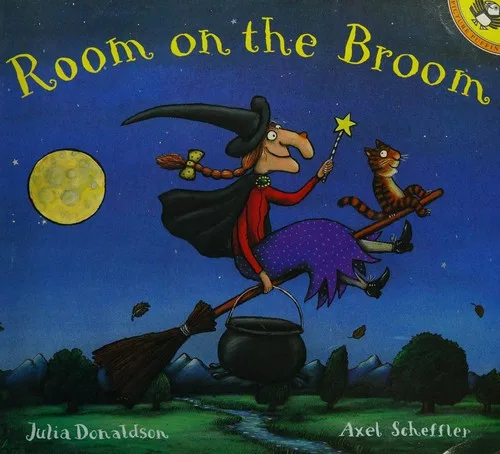
Room on the Broom
 78
78

Room on the Broom
The enduring appeal of Julia Donaldson's "Room on the Broom" lies in its deceptively simple yet effective narrative structure. The repetitive calls for passage on the broomstick, culminating in a shared danger and subsequent rescue, create a satisfying arc for young readers. Its primary strength is the gentle portrayal of a witch, far removed from any sinister archetypes, emphasizing kindness and community. However, the book's simplicity, while a boon for its target audience, offers little in the way of intellectual complexity for adult readers. A passage that particularly shines is the cumulative listing of animals and their requests, building anticipation before the story's turning point. Ultimately, "Room on the Broom" is a delightful, well-crafted tale that successfully champions empathy and cooperation.
📝 Description
78
Published in 2001, Julia Donaldson's 'Room on the Broom' features a witch sharing her ride with multiple animals.
A kind witch and her cat travel on a broomstick, picking up various animals who ask to join them. As more creatures join the ride, the broom becomes increasingly crowded. This repetitive structure is designed to engage young readers, reinforcing the story's unfolding events. The witch's generosity in making room for everyone, despite the growing discomfort, leads to a positive resolution. The narrative emphasizes the rewards of sharing and cooperation.
The book is suited for children aged 3 to 7. Its straightforward language, clear plot, and vibrant illustrations make it appropriate for read-alouds. Parents, educators, and librarians interested in stories that touch on kindness, mutual aid, and problem-solving will find it useful. The rhyming text also supports early literacy development, making it a valuable resource for young learners.
While not directly linked to a specific occult tradition, 'Room on the Broom' participates in a modern cultural shift that portrays magical figures, such as witches, in a benevolent light. This contrasts with older folklore where witches were often depicted with malevolent intent. The book aligns with a contemporary tendency to soften and humanize archetypal magical beings, making them accessible and positive figures for a young audience. The witch's actions, driven by kindness rather than power, reflect this modern reinterpretation of magical characters in popular media.
💡 Why Read This Book?
• You will learn about the power of generosity and cooperation, as demonstrated by the witch's repeated acts of sharing her broom with various animals in 2001. • You will experience the satisfying narrative build-up created by the cumulative listing of characters, a technique that enhances engagement for young readers. • You will feel the triumph of community over adversity as the witch and her animal companions overcome a shared threat, reinforcing the book's core message.
⭐ Reader Reviews
Honest opinions from readers who have explored this book.
❓ Frequently Asked Questions
When was "Room on the Broom" first published?
"Room on the Broom" was first published in 2001, marking its entry into the children's literature landscape at the turn of the millennium.
Who are the main characters in "Room on the Broom"?
The main characters are a kind witch and her black cat, who are joined by a dog, a bird, and a frog on their broomstick journey.
What is the central theme of "Room on the Broom"?
The central theme is generosity and how sharing and kindness can lead to positive outcomes and mutual aid, even in challenging situations.
What age group is "Room on the Broom" best suited for?
The book is ideal for preschool and early elementary children, generally aged 3 to 7, due to its simple language and engaging story.
Who illustrated "Room on the Broom"?
The illustrations for "Room on the Broom" were created by Axel Scheffler, known for his distinctive style in children's books.
Does "Room on the Broom" have any sequels?
While "Room on the Broom" is a standalone story, Julia Donaldson and Axel Scheffler have collaborated on many other popular children's books.
🔮 Key Themes & Symbolism
Generosity and Reciprocity
The narrative prominently features the witch's consistent generosity, offering space on her broom to various animals. This theme explores how acts of kindness, even when seemingly inconvenient, foster a sense of community and mutual support. The animals, in turn, reciprocate this generosity when the witch faces danger, highlighting the reciprocal nature of compassion. This aligns with certain philosophical traditions that emphasize interconnectedness and the ethical imperative of aiding others, suggesting that shared burdens become lighter and shared joys are amplified.
Community and Belonging
As more creatures join the witch on her broomstick, the story evolves from a solitary journey into a communal experience. This building of community, initially through simple acts of inclusion, becomes crucial for overcoming the story's central conflict. The shared space on the broom symbolizes a microcosm of society where individuals from different backgrounds find common ground and solidarity. This theme speaks to philosophical ideas about social cohesion and the strength derived from collective action and mutual acceptance.
The Benevolent Magical Figure
Julia Donaldson presents a witch who embodies positive attributes such as kindness, helpfulness, and a non-threatening demeanor. This contrasts with older, more ambiguous or fearful portrayals of witches in folklore. The book contributes to a modern narrative where magical figures are often depicted as benevolent guides or companions. This shift reflects changing cultural perceptions of the 'other' and the integration of magical elements into children's stories as sources of wonder and positive moral examples, rather than fear.
Problem-Solving Through Cooperation
The climax of the story hinges on the collective efforts of the witch and her animal companions to overcome a formidable obstacle – a dragon. Each animal contributes its unique ability or perspective, demonstrating that collaborative problem-solving is more effective than individual action. This underscores a practical application of the book's themes of community and reciprocity, showing how diverse skills can unite to achieve a common goal, a principle found in various ethical and social philosophies.
💬 Memorable Quotes
Direct passages from the work, attributed to the author.
“"A frog and a bird and a big black cat, and a dog who always goes "Woof! Woof!"”
— This cumulative description highlights the growing fellowship on the broomstick, emphasizing the diversity of the group that forms a core element of the story.
“"They flew on and on, higher and higher, and as they flew, the tangled wind blew."”
— This phrase evokes the magical flight and the challenges encountered, setting the scene for the narrative's escalating tension and eventual resolution.
“"But the broom was so heavy, it wiggled and waggled and tipped and tossed."”
— This descriptive line vividly illustrates the physical consequences of the increasing number of passengers, building suspense towards the story's climax.
💡 Key Ideas
Editorial paraphrase of the work's core concepts — not direct quotes.
"A dragon! cried the witch, "Oh dear!"
This line marks the story's turning point, introducing the primary conflict and the moment of greatest peril for the witch and her companions.
"So the witch flew on and on; and the frog, the bird, and the dog, and the cat all sang with glee."
This quote captures the joy and unity experienced by the characters as their shared journey progresses, underscoring the positive outcomes of their communal arrangement.
🌙 Esoteric Significance
Tradition
While not explicitly rooted in a specific esoteric tradition like Hermeticism or Kabbalah, "Room on the Broom" touches upon archetypal themes found across various mystical paths. The figure of the benevolent witch can be seen as a modern interpretation of nature spirits or wise women figures found in folk magic and animistic traditions, emphasizing a connection to the natural world and inherent magical potential. The journey on the broomstick itself evokes imagery of astral projection or spiritual ascent, common motifs in shamanic and neo-pagan practices, symbolizing movement beyond the mundane.
Symbolism
The broomstick is a potent symbol, representing not only magical transportation but also a vessel for collective experience and shared destiny. Its increasing weight signifies the accumulation of positive relationships and the strength derived from community. The various animals—dog, bird, frog—can be interpreted through different symbolic lenses: the dog often represents loyalty and companionship, the bird freedom and perspective, and the frog transformation and connection to water or the subconscious. The dragon, a classic antagonist, symbolizes primal fears or obstacles that must be overcome through unified effort.
Modern Relevance
In contemporary contexts, "Room on the Broom" continues to be relevant for its accessible portrayal of cooperation and inclusivity, themes increasingly emphasized in modern pedagogy and social discourse. Its gentle introduction to magical elements serves as a gateway for children to engage with fantasy and archetypal narratives. Thinkers and educators focused on social-emotional learning often cite the book for its demonstration of empathy and problem-solving. Its enduring popularity suggests a continued societal interest in positive, empowering narratives that feature non-traditional heroines and celebrate the strength found in diversity and mutual aid.
👥 Who Should Read This Book
• Parents and educators of young children (ages 3-7) seeking engaging, rhyming stories that promote positive social values like kindness, sharing, and cooperation. • Librarians and early childhood specialists looking for foundational texts that support literacy development and introduce basic narrative structures and character archetypes. • Readers interested in contemporary interpretations of folklore figures, specifically how the archetype of the witch has been adapted to represent benevolence and community in modern children's literature.
📜 Historical Context
Published in 2001, "Room on the Broom" by Julia Donaldson and illustrated by Axel Scheffler arrived in a children's literature landscape that was increasingly embracing diverse characters and positive portrayals of traditionally feared figures. Donaldson, already a successful author, continued a trend of creating accessible, rhyming narratives that resonated with young readers and parents alike. The book's success can be contextualized alongside the broader cultural shift towards softening the image of witches in popular media, moving away from the stark archetypes seen in earlier works or even the more ambiguous figures in some fairy tales. While not a direct engagement with specific esoteric movements, its benevolent witch aligns with a general societal tendency to explain and humanize magical figures. Contemporaries like Roald Dahl, though often darker in tone, also explored fantastical elements with unique characters, demonstrating a market for imaginative storytelling. The book’s reception was overwhelmingly positive, quickly becoming a staple in early years education and home libraries.
📔 Journal Prompts
The witch's shared broomstick and its increasing weight.
The distinct characteristics of the animals who join the witch.
The witch's consistent act of offering space on her broom.
The dragon as a shared threat requiring collective action.
The transformation of the broom from a solitary object to a communal vessel.
🗂️ Glossary
Witch
In the context of "Room on the Broom," a benevolent practitioner of magic, depicted as kind, helpful, and non-threatening, contrasting with darker folklore portrayals.
Broomstick
A traditional magical implement used for flight, serving as the central vehicle and symbol of shared experience and community in the narrative.
Cumulative Narrative
A storytelling technique where elements (characters, phrases, actions) are added sequentially in each repetition, building complexity and engagement, as seen in the animals joining the witch.
Archetype
A recurring symbol or motif in literature and mythology, such as the 'wise elder' or 'benevolent magical figure,' which this book modernizes with its portrayal of the witch.
Alliteration
The repetition of the same sound or letter at the beginning of words in close proximity, used extensively in the book's rhyming text for rhythmic effect (e.g., 'wiggled and waggled').
Rhyming Couplets
Two consecutive lines of poetry that rhyme, forming a basic unit of structure in many children's verse, including this book.
Dragon
A mythical, reptilian creature often depicted as a formidable antagonist, representing a significant obstacle or danger that characters must overcome together.
🔮 Readers Also Liked
Browse all →








More by Julia Donaldson
All books →





More Free Occult Philosophy Books
View all →