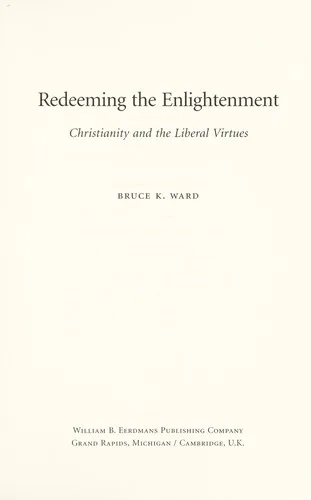
Redeeming the Enlightenment
 80
80

Redeeming the Enlightenment
Bruce Kinsey Ward’s "Redeeming the Enlightenment" offers a compelling counter-narrative to the standard celebration of the 18th-century intellectual awakening. Ward is particularly adept at dissecting how the era’s fervent embrace of empirical reason, exemplified by figures like Diderot and d'Alembert, inadvertently paved the way for a wholesale dismissal of the subjective and the spiritual. His argument that this intellectual pruning left Western thought impoverished is convincingly laid out, especially when he discusses the suppression of hermetic traditions. However, the book occasionally feels like it’s arguing against a straw man; the Enlightenment was not monolithic, and many thinkers of the period engaged with, or at least acknowledged, non-rational modes of understanding, even if only to refute them. Despite this, the work provides a valuable perspective for those questioning the limits of pure rationalism. Ward's critique is a stark reminder that intellectual progress can come at the cost of deeper human experience.
📝 Description
80
### What It Is Bruce Kinsey Ward's "Redeeming the Enlightenment" examines the intellectual and spiritual undercurrents of the 18th century's Age of Reason. Far from a straightforward history, the work critiques the era's foundational principles, particularly its embrace of pure rationalism and its perceived dismissal of the subjective, the occult, and the spiritual. Ward argues that a crucial dimension of human experience was sidelined by the dominant philosophical and scientific paradigms of the time.
### Who It's For This book is intended for readers interested in the philosophical underpinnings of Western thought, particularly those who question the completeness of purely materialist or rationalist explanations. It will appeal to individuals exploring the history of esoteric traditions, comparative philosophy, and the ongoing dialogue between science and spirituality. Those seeking a critical re-evaluation of historical intellectual movements will find substantial material here.
### Historical Context The "Redeeming the Enlightenment" engages directly with the intellectual milieu of the late 18th and early 19th centuries, a period dominated by figures like Immanuel Kant and the Encyclopédie project. This era saw a profound shift towards empiricism and scientific methodology, often at the expense of metaphysical speculation and mystical inquiry. Ward situates his critique against this backdrop, highlighting how the philosophical currents of the Enlightenment, while advancing certain forms of knowledge, may have simultaneously suppressed others, particularly those related to inner experience and non-rational understanding.
### Key Concepts Ward's central thesis revolves around the concept of a "de-spiritualized" reason. He posits that the Enlightenment's emphasis on quantifiable, observable phenomena led to an incomplete understanding of consciousness and reality. The work explores the tension between the material world and the inner life, challenging the notion that only what can be measured is real. It also scrutinizes the legacy of this intellectual movement on subsequent philosophical and societal developments, suggesting a need to reintegrate aspects of the esoteric and the intuitive into modern discourse.
💡 Why Read This Book?
• Understand the philosophical schism created by the Enlightenment's emphasis on rationalism, learning how it marginalized esoteric thought. • Gain insight into the 18th century's intellectual landscape, specifically how figures like Kant contributed to a shift away from metaphysical speculation. • Explore the concept of a "de-spiritualized" reason and its impact on modern Western thought, offering a new lens for examining consciousness.
⭐ Reader Reviews
Honest opinions from readers who have explored this book.
❓ Frequently Asked Questions
What is the central argument of Bruce Kinsey Ward's "Redeeming the Enlightenment"?
The book argues that the 18th-century Enlightenment, while championing reason, excessively dismissed subjective experience and esoteric traditions, leading to an incomplete understanding of reality and consciousness.
Which historical period does "Redeeming the Enlightenment" primarily focus on?
The book primarily focuses on the Age of Reason in the 18th century, examining the intellectual and philosophical currents that shaped Western thought during that era.
How does Ward critique the concept of Enlightenment reason?
Ward critiques Enlightenment reason by highlighting its tendency to prioritize empirical and quantifiable knowledge, often at the expense of intuition, spirituality, and the exploration of inner consciousness.
Who were some key intellectual figures or movements that influenced the Enlightenment context discussed in the book?
The book engages with the intellectual climate shaped by figures like Immanuel Kant and movements such as empiricism and the Encyclopédie project, which emphasized rational inquiry.
What does Ward mean by a 'de-spiritualized' reason?
Ward uses 'de-spiritualized reason' to describe a form of rationality that has become detached from spiritual or metaphysical dimensions, focusing solely on material and observable phenomena.
What is the intended audience for "Redeeming the Enlightenment"?
The book is aimed at readers interested in the history of philosophy, esoteric traditions, and critical re-evaluations of Western intellectual history, particularly those questioning the sufficiency of pure rationalism.
🔮 Key Themes & Symbolism
The Limits of Rationalism
Ward meticulously dissects the 18th-century Enlightenment's fervent dedication to empirical reason, arguing that this singular focus led to the suppression of vital aspects of human experience. The work scrutinizes how a worldview prioritizing only the quantifiable and observable inevitably marginalized subjective states, intuition, and mystical inquiry. This theme is crucial for understanding how a significant portion of Western intellectual heritage became disconnected from its more esoteric and spiritual roots, setting a precedent for modern philosophical divides.
Reclaiming the Spiritual Dimension
The core of "Redeeming the Enlightenment" lies in its call to reintegrate the spiritual and the intuitive into our understanding of reason and reality. Ward posits that the Enlightenment's "de-spiritualized" reason created an intellectual void, which subsequent esoteric movements attempted to fill. He argues for a more holistic approach to knowledge, one that acknowledges the validity of inner experience alongside external observation, thereby offering a path to a more complete human understanding.
The Legacy of Intellectual Suppression
Ward examines how the dominant paradigms of the Enlightenment era actively, or passively, suppressed alternative modes of knowing, particularly those associated with Hermeticism, alchemy, and other esoteric traditions. The book explores the consequences of this intellectual narrowing, suggesting that a more balanced engagement with these suppressed ideas could have led to a richer, more nuanced philosophical landscape. It questions the ultimate cost of prioritizing a singular vision of progress.
Critique of Materialist Foundations
A significant thread in Ward's work is the challenge to the materialist underpinnings that became ascendant during the Enlightenment. By highlighting the persistent human need for meaning, transcendence, and subjective experience, the book implicitly argues against philosophies that reduce consciousness and reality solely to physical processes. It seeks to demonstrate that a complete understanding of existence requires acknowledging dimensions beyond the purely physical, often explored in esoteric philosophy.
💬 Memorable Quotes
“The Enlightenment's crusade for reason inadvertently blinded it to profound aspects of the human psyche.”
— This statement captures Ward's central thesis: that the very tool celebrated by the Enlightenment—reason—became a source of limitation when applied too narrowly, excluding subjective and spiritual realities.
“By discarding the esoteric, the era lost a vital vocabulary for discussing inner experience.”
— This highlights the consequence of the Enlightenment's intellectual purge, suggesting that the rejection of traditions like Hermeticism left a gap in how human consciousness and subjective reality could be understood and articulated.
“A reason divorced from spirit becomes a sterile, incomplete faculty.”
— This paraphrase emphasizes Ward's view that reason, when severed from spiritual or intuitive dimensions, loses its vitality and capacity for holistic understanding, becoming merely a calculative tool.
“The intellectual currents of the 18th century created a framework that actively discouraged metaphysical inquiry.”
— This interpretation points to the systemic nature of the shift, suggesting that the dominant philosophical and scientific ideas of the Enlightenment created an environment where questions about ultimate reality or spiritual truths were increasingly seen as invalid or unproductive.
“True redemption requires acknowledging what the Age of Reason chose to overlook.”
— This reflects Ward's call to action, implying that a more complete and authentic understanding of ourselves and the world necessitates revisiting and re-evaluating the aspects of human experience that the Enlightenment so thoroughly devalued or dismissed.
🌙 Esoteric Significance
Tradition
This work engages with the Western Esoteric Tradition, particularly its Hermetic and Neoplatonic roots, which were largely sidelined during the Enlightenment. Ward's critique aligns with esoteric philosophy's perennial emphasis on the validity of subjective experience, intuition, and direct spiritual insight, which the rationalist paradigm of the 18th century often dismissed as mere superstition or delusion.
Symbolism
While not overtly symbol-laden in a narrative sense, the book implicitly engages with symbols of reason (e.g., light, clarity) and its perceived limitations. The 'enlightened' mind, as portrayed by the era, becomes a symbol of exclusive, purely intellectual pursuit, contrasted with the deeper, more holistic understanding sought by esoteric traditions, which often employ complex symbolic systems to represent cosmic and psychological truths.
Modern Relevance
Ward's ideas resonate with contemporary thinkers and practitioners within fields like consciousness studies, transpersonal psychology, and modern occultism. His critique of a purely materialist worldview finds echoes in current discussions about the limitations of science in explaining consciousness and the resurgence of interest in non-ordinary states of awareness and holistic philosophies.
👥 Who Should Read This Book
• Students of Western philosophy interested in critiques of the Enlightenment: You will gain a counter-perspective that challenges the foundational assumptions of modern rationalism and its historical trajectory. • Seekers of esoteric knowledge and history: You will find a compelling argument for the continued relevance of Hermetic and other suppressed traditions within the broader intellectual landscape. • Comparative religion and spirituality scholars: You will benefit from an analysis of how dominant intellectual movements can shape and marginalize alternative spiritual and philosophical systems.
📜 Historical Context
Bruce Kinsey Ward's "Redeeming the Enlightenment" emerges from a critical re-examination of the 18th century, a period dominated by the philosophical and scientific revolutions. The era's intellectual fervor, epitomized by the Encyclopédie project and the works of figures like Immanuel Kant, championed empirical observation and rational deduction as the primary paths to knowledge. This ascendance of scientific rationalism, however, led to a significant marginalization of metaphysical speculation and esoteric traditions, which had been influential in earlier centuries. Ward engages with this intellectual climate by contrasting the Enlightenment's focus on the external, quantifiable world with the internal, subjective explorations found in Hermeticism and Gnosticism. While contemporaries like Voltaire engaged with religious thought, often critically, Ward’s work specifically targets the broader philosophical exclusion of non-rational ways of knowing. The reception of such critical perspectives on the Enlightenment gained traction in later decades as philosophical trends shifted, allowing for a reappraisal of its limitations.
📔 Journal Prompts
The concept of a 'de-spiritualized' reason and its personal implications.
How the Enlightenment's critique of superstition contrasts with the esoteric understanding of hidden knowledge.
The role of subjective experience in validating knowledge, beyond empirical proof.
Reflecting on the intellectual currents that prioritize external observation over inner exploration.
The potential for integrating rational analysis with intuitive insight.
🗂️ Glossary
Age of Reason
A historical period, primarily the 18th century, characterized by an emphasis on rationality, scientific inquiry, and empirical evidence as the primary sources of knowledge and authority.
Empiricism
A philosophical theory stating that knowledge comes primarily or exclusively from sensory experience, a key tenet of the Enlightenment.
Rationalism
A philosophical approach that emphasizes reason as the primary source of knowledge, often contrasting with or subordinating sensory experience and intuition.
Esoteric Traditions
Systems of knowledge and practice that are secret, hidden, or intended for a select group of initiates, often involving spiritual or mystical insights beyond ordinary understanding.
Hermeticism
A philosophical and religious tradition based on writings attributed to Hermes Trismegistus, emphasizing divine wisdom, alchemy, astrology, and the interconnectedness of the cosmos and the human soul.
Metaphysics
A branch of philosophy that examines the fundamental nature of reality, including the relationship between mind and matter, substance and attribute, and potentiality and actuality.
Subjective Experience
Consciousness and perception from an individual's personal point of view, including feelings, thoughts, and sensations, often contrasted with objective, verifiable facts.