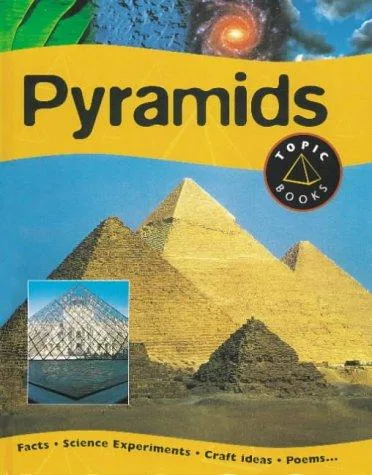
Pyramids
 78
78

Pyramids
MacDonald's "Pyramids" presents a clear, if somewhat dry, account of these ancient wonders. The author excels in detailing the evolution of pyramid construction, from the Step Pyramid of Djoser at Saqqara to the Giza complex, grounding the reader in the practicalities of engineering and labor. One particularly strong section details the quarrying and transport of massive stone blocks, illustrating the sheer scale of human endeavor involved. However, the book occasionally falters in its engagement with the more speculative, yet widely discussed, esoteric interpretations of the pyramids. While factual accuracy is commendable, a deeper dive into the symbolism and the philosophical underpinnings that have fascinated occultists and mystics for centuries would have enriched the narrative. The work’s strength lies in its archaeological rigor, its limitation in its reluctance to engage with broader mystical significances. MacDonald provides a solid foundation, but one must look elsewhere for the speculative heights.
📝 Description
78
### What It Is Fiona MacDonald's "Pyramids" offers a focused examination of the monumental structures of ancient Egypt. Published in 2000, this work moves beyond simple architectural descriptions to explore the cultural, religious, and astronomical significance attributed to these iconic edifices. It details the construction techniques and the evolution of pyramid design, from early mastabas to the Great Pyramid of Giza.
### Who It's For This book is best suited for students of Egyptology, ancient history enthusiasts, and those interested in the intersection of architecture, religion, and cosmology. Readers seeking a detailed, fact-based account of pyramid construction and its associated beliefs will find substantial material here. It’s for individuals who appreciate rigorous scholarship grounded in archaeological evidence and historical analysis.
### Historical Context MacDonald's work emerged at a time when Egyptology continued to build upon foundational discoveries of the late 19th and early 20th centuries. While earlier scholars like Flinders Petrie had meticulously surveyed and cataloged Egyptian sites, MacDonald’s 2000 publication benefits from decades of further excavation, dating techniques, and comparative studies of ancient Near Eastern cultures. It stands in contrast to more speculative theories that often gain popular traction, focusing instead on established archaeological findings and scholarly consensus.
### Key Concepts The book meticulously unpacks concepts such as the "pyramid texts" – the earliest known religious inscriptions in Egyptian – and their role in funerary rituals. It also addresses the astronomical alignments of the pyramids, exploring theories about their connection to celestial bodies like Orion and the circumpolar stars. The divine kingship of the pharaohs and the pyramids as eternal residences for their souls are central tenets explored throughout the text.
💡 Why Read This Book?
• Gain a precise understanding of the architectural progression of Egyptian pyramids, from the early mastabas to the grand structures of the Old Kingdom, citing specific examples like Djoser's Step Pyramid. • Explore the function of the Pyramid Texts, understanding their role in ancient Egyptian funerary beliefs and cosmology as detailed in the text. • Grasp the logistical and engineering feats involved in constructing these monuments, learning about the methods used to quarry, transport, and place millions of tons of stone.
⭐ Reader Reviews
Honest opinions from readers who have explored this book.
❓ Frequently Asked Questions
What is the earliest known pyramid in Egypt?
The earliest known pyramid is the Step Pyramid of Djoser at Saqqara, built by the architect Imhotep during the Third Dynasty, around 2670 BCE. This structure marked a significant departure from earlier mastaba tombs.
What are the Pyramid Texts?
The Pyramid Texts are a collection of ancient Egyptian religious spells and inscriptions found on the walls of pyramids from the Old Kingdom, beginning with the pyramid of Unas. They are the oldest known body of religious literature in the world.
Who was Imhotep?
Imhotep was a brilliant architect, physician, and high priest of Ra who lived during the Third Dynasty of Egypt. He is credited with designing the Step Pyramid of Djoser, considered a revolutionary architectural achievement.
What was the primary purpose of the Egyptian pyramids?
The primary purpose of the Egyptian pyramids was to serve as elaborate tombs for pharaohs and their consorts, ensuring their safe passage and eternal sustenance in the afterlife. They were also symbolic representations of the primeval mound.
When were the Great Pyramids of Giza built?
The Great Pyramids of Giza were constructed during the Fourth Dynasty of the Old Kingdom. The Great Pyramid of Khufu was built around 2580–2560 BCE, followed by the pyramids of Khafre and Menkaure.
Did Fiona MacDonald's book discuss theories beyond standard Egyptology?
Fiona MacDonald's "Pyramids" primarily focuses on established archaeological and historical evidence. While it touches upon the symbolic and religious contexts, it generally avoids the more speculative theories often found in esoteric literature.
🔮 Key Themes & Symbolism
Architectural Evolution
This theme traces the development of pyramid design from simple mastabas to the complex structures of Giza. It details the innovations of architects like Imhotep, the engineering challenges faced, and the progression of construction techniques across different dynasties. The focus remains on the physical manifestation and the historical stages of these monumental projects.
Funerary Rites and Beliefs
Central to the book is the exploration of the pyramids as tombs and conduits to the afterlife. It examines the beliefs surrounding the pharaoh's divine status and the necessity of preserving the body and providing for the spirit. The inscriptions within the pyramids, such as the Pyramid Texts, are analyzed for their role in guiding the deceased.
Cosmology and Astronomy
MacDonald discusses the presumed astronomical alignments of the pyramids, exploring how these structures may have related to celestial observations. Theories regarding their connection to constellations like Orion and the circumpolar stars are presented, highlighting the ancient Egyptians' sophisticated understanding of the cosmos and its integration into their monumental architecture.
Social and Labor Organization
The book touches upon the immense societal organization required for pyramid construction. It considers the labor force, resource management, and logistical planning necessary to quarry, transport, and erect millions of tons of stone. This aspect underscores the pyramids as reflections of the pharaoh's power and the state's organizational capacity.
💬 Memorable Quotes
“The evolution from simple mastaba tombs to the Step Pyramid represents a monumental leap in architectural ambition.”
— This highlights the innovative spirit and progression in Egyptian funerary architecture, pointing to the transition towards larger, more complex structures that would eventually culminate in the smooth-sided pyramids.
“Quarrying, transporting, and lifting massive stone blocks required sophisticated planning and execution.”
— This emphasizes the practical engineering challenges faced by the ancient builders, underscoring the logistical prowess and skilled labor that underpinned the construction of these enduring monuments.
“The Pyramid Texts offer the earliest evidence of Egyptian religious thought concerning the afterlife.”
— This points to the profound spiritual and theological significance of the pyramids, framing them not just as tombs but as vessels for complex religious doctrines and rituals aimed at ensuring eternal life.
“Astronomical alignments suggest a deep connection between the pyramids and the celestial realm.”
— This interpretation focuses on the cosmological dimension, suggesting that the placement and orientation of the pyramids were deliberate, reflecting an ancient worldview that integrated earthly structures with cosmic order.
“The sheer scale of the Giza complex demonstrates an unprecedented mobilization of resources and manpower.”
— This statement emphasizes the economic and social power of the Old Kingdom pharaohs, illustrating how these projects served as a focal point for national effort and state administration.
🌙 Esoteric Significance
Tradition
While MacDonald's "Pyramids" adheres to mainstream Egyptology, its subject matter is intrinsically linked to esoteric traditions. Ancient Egyptian religion, with its emphasis on the afterlife, divine kingship, and cosmic order, forms a foundational pillar for many Western esoteric systems, including Hermeticism and Theosophy. The pyramids, as focal points of this civilization, are often interpreted through an esoteric lens as repositories of ancient wisdom, energy centers, or even extraterrestrial communication devices, interpretations that this book largely bypasses in favor of archaeological fact.
Symbolism
The pyramid itself is a potent symbol across many traditions, representing ascent, stability, and the divine. In esoteric thought, the apex is often seen as the point of connection between the material and spiritual realms. The geometric perfection and astronomical alignments of structures like the Great Pyramid are interpreted as encoded knowledge, reflecting a universal divine blueprint or advanced scientific understanding far beyond what is conventionally accepted for the era.
Modern Relevance
Contemporary esoteric practitioners and researchers continue to draw inspiration from ancient Egypt, viewing the pyramids as sites of immense spiritual power and historical mystery. Schools of thought focused on sacred geometry, consciousness studies, and alternative history often reference the pyramids, seeking to uncover hidden meanings and lost knowledge. Works like MacDonald's, even by their factual focus, provide a baseline of information that these esoteric interpretations often build upon or react against.
👥 Who Should Read This Book
• Aspiring Egyptologists and archaeology students seeking a factual overview of pyramid construction and context. • History buffs interested in the Old Kingdom period and the logistical achievements of ancient civilizations. • Readers curious about the basic religious beliefs and funerary practices that motivated the construction of these iconic structures.
📜 Historical Context
Fiona MacDonald's "Pyramids," published in 2000, arrived in a field shaped by over a century of intense archaeological discovery and academic debate. The late 19th and early 20th centuries saw pioneers like Flinders Petrie establish rigorous methods of excavation and documentation, laying the groundwork for subsequent scholarship. By 2000, Egyptology had moved beyond mere cataloging, engaging more deeply with issues of social structure, economic organization, and religious ideology. MacDonald's work, while not groundbreaking in its theoretical approach, benefits from advances in dating techniques and comparative studies. It implicitly contrasts with more sensational, pseudoscientific theories that often recirculate in popular culture, reaffirming a commitment to evidence-based analysis. While not directly engaging with a specific contemporary author in its text, its factual grounding situates it within the mainstream scholarly tradition, distinct from the speculative output of authors like Erich von Däniken, who were still prominent in popular discourse.
📔 Journal Prompts
The architectural evolution from mastaba to smooth-sided pyramid.
The purpose and content of the Pyramid Texts.
The engineering challenges of quarrying and moving massive stone blocks.
The astronomical alignments of key pyramids.
The concept of divine kingship in Old Kingdom Egypt.
🗂️ Glossary
Mastaba
An early form of tomb architecture in ancient Egypt, characterized by a flat-roofed, rectangular structure with sloping sides, built over a subterranean burial chamber. Mastabas preceded the development of the true pyramid.
Pyramid Texts
A collection of ancient Egyptian funerary spells written in hieroglyphs on the walls of pyramids during the Old Kingdom. Their purpose was to aid the deceased pharaoh's journey to the afterlife.
Imhotep
A brilliant Egyptian architect, physician, and sage who served Pharaoh Djoser during the Third Dynasty. He is credited with designing the Step Pyramid at Saqqara, a groundbreaking architectural achievement.
Djoser
A pharaoh of the Third Dynasty of Egypt, for whom the Step Pyramid at Saqqara was built. His reign marked a significant period of architectural innovation and consolidation of royal power.
Circumpolar Stars
Stars that are so close to the celestial poles that they never set below the horizon as viewed from a particular latitude. Their constant visibility held symbolic importance in ancient Egyptian cosmology.
Ka
In ancient Egyptian belief, the life force or spiritual double of a person, which needed sustenance and protection in the afterlife. Pyramids were designed to safeguard the pharaoh's Ka.
Old Kingdom
A period in ancient Egyptian history spanning roughly from the 27th to the 22nd century BCE. It is known as the "Age of the Pyramids" due to the construction of major pyramid complexes, including those at Giza.