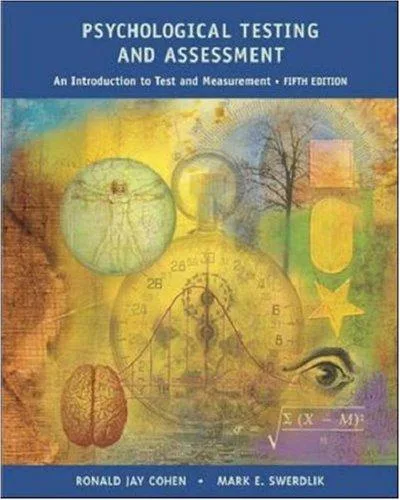
Psychological testing and assessment
 82
82

Psychological testing and assessment



Cohen's "Psychological Testing and Assessment" approaches its subject with a systematic rigor that is commendable, particularly in its detailed explication of psychometric principles. The clarity with which concepts like construct validity are presented is a significant strength, offering a solid foundation for understanding test development. However, the work sometimes leans heavily into technical jargon, which may present a barrier for readers less familiar with advanced statistical methodologies. A particularly illuminating section is the discussion on the ethical considerations in testing, highlighting the responsibility of the assessor. While comprehensive, the book could benefit from more contemporary case studies that illustrate the application of these principles in the rapidly evolving landscape of digital assessment. It serves as a robust, albeit dense, resource for the serious student of psychometrics.
📝 Description
82
### What It Is Psychological Testing and Assessment, first published in 2017 by Ronald Jay Cohen, offers a comprehensive examination of the principles, methods, and applications of psychological measurement. This work details the construction, validation, and interpretation of various assessment tools used to evaluate cognitive abilities, personality traits, and emotional states. It serves as a foundational text for understanding how psychological constructs are quantified and utilized in diverse settings, from clinical diagnosis to educational placement.
### Who It's For This text is principally aimed at advanced students in psychology, counseling, and related fields, as well as practicing clinicians and researchers. It is essential for anyone involved in administering, scoring, or interpreting psychological tests. Professionals in human resources, education, and forensic science who rely on psychological evaluations will also find valuable information within its pages. Its depth makes it suitable for those seeking to deepen their theoretical understanding and practical skills in assessment.
### Historical Context The field of psychological testing has a rich history, with early developments emerging in the late 19th and early 20th centuries. Pioneers like Alfred Binet, with his intelligence scales developed for French schoolchildren, laid crucial groundwork. The mid-20th century saw significant advancements, particularly during and after World War II, with the development of group-administered tests for military selection. Cohen's work builds upon this legacy, integrating modern psychometric theory and statistical advancements that have refined assessment practices over decades. The evolution from early, often biased, measures to more standardized and validated instruments reflects a broader scientific progression.
### Key Concepts Central to this assessment framework are concepts such as reliability, validity, and standardization. Reliability addresses the consistency of a measurement tool, ensuring that repeated administrations yield similar results. Validity concerns whether a test measures what it purports to measure, with various forms like content, criterion, and construct validity. Standardization involves establishing uniform procedures for test administration and scoring, allowing for meaningful comparisons between individuals. The book also explores differential psychology, the study of individual differences, and norm-referenced versus criterion-referenced testing.
💡 Why Read This Book?
• Understand the foundational psychometric principles, such as reliability and validity, as outlined in the 2017 publication, to critically evaluate the trustworthiness of any psychological measure. • Grasp the methodology behind test construction, learning how instruments are designed and validated, a process detailed in the sections on measurement theory. • Gain insight into the ethical responsibilities of test administrators, a crucial aspect discussed concerning the proper use and interpretation of assessment results.
why_read
⭐ Reader Reviews
Honest opinions from readers who have explored this book.
❓ Frequently Asked Questions
What are the primary types of reliability discussed in Cohen's "Psychological Testing and Assessment"?
The book details several types of reliability, including test-retest reliability, internal consistency (e.g., Cronbach's alpha), and inter-rater reliability, explaining how each measures the consistency of test results over time, across items, or between observers.
How does "Psychological Testing and Assessment" explain construct validity?
Cohen explains construct validity by detailing how well a test measures the theoretical construct it's designed to assess. This involves examining correlations with other measures, factor analysis, and experimental manipulations to confirm the underlying theory.
What historical developments in psychological testing are covered?
The work touches upon the historical progression of testing, referencing early pioneers like Alfred Binet and the impact of World War II on group testing methodologies, illustrating the evolution of assessment practices.
What is the difference between norm-referenced and criterion-referenced testing according to the book?
Cohen differentiates norm-referenced tests, which compare a score to a representative sample, from criterion-referenced tests, which measure performance against a predefined standard or mastery level.
Who would benefit most from reading "Psychological Testing and Assessment"?
Students of psychology, counseling, and educational measurement, as well as practicing clinicians and researchers who administer or interpret psychological assessments, will find this book invaluable for its detailed technical coverage.
When was "Psychological Testing and Assessment" by Ronald Jay Cohen first published?
The first publication of Ronald Jay Cohen's "Psychological Testing and Assessment" occurred in 2017, reflecting contemporary approaches and research in the field.
🔮 Key Themes & Symbolism
Psychometric Foundations
This work meticulously details the bedrock of psychological measurement: reliability and validity. It explains how consistency (reliability) and accuracy (validity) are established and quantified, moving beyond mere assertion to empirical demonstration. Concepts like Cronbach's alpha and convergent validity are explored, providing a framework for discerning the scientific merit of any assessment tool, crucial for anyone seeking to understand the underlying structures of the psyche as revealed through measurement.
Test Construction and Application
Cohen provides a procedural roadmap for creating psychological instruments, from initial conceptualization to final validation. It examines how abstract psychological constructs are translated into measurable items and how these items are assembled into coherent tests. The application of these tools in diverse fields, including clinical, educational, and organizational psychology, is discussed, underscoring the practical utility and ethical considerations inherent in their deployment.
Individual Differences
The text delves into differential psychology, the study of variations among individuals. It highlights how psychological tests serve to map these differences in abilities, personality, and behavior. Understanding these variations is key to appreciating the diversity of human experience and how assessment can illuminate unique cognitive profiles or emotional landscapes, offering a lens through which individual potentials and challenges can be objectively viewed.
Ethical Assessment Practices
A significant focus is placed on the responsible use of psychological assessments. This includes ensuring fairness, preventing misuse, maintaining confidentiality, and interpreting results with professional integrity. The work emphasizes that the power of assessment tools necessitates a strong ethical framework to protect individuals and uphold the scientific and professional standards of psychology.
💬 Memorable Quotes
“Reliability refers to the consistency of measurement.”
— This concise statement underscores a core principle: a dependable psychological test should yield similar results under similar conditions, whether tested repeatedly or across different items.
“Validity indicates the degree to which a test measures what it claims to measure.”
— This highlights the crucial distinction between a test's consistency and its actual accuracy in capturing the intended psychological construct, a fundamental consideration in assessment.
“Standardization ensures uniform procedures for test administration and scoring.”
— This principle is vital for comparing scores across individuals, ensuring that observed differences are attributable to the person being tested, not variations in the testing process itself.
“Norm-referenced tests compare an individual's score to those of a standardization sample.”
— This defines a common approach where an individual's performance is understood in relation to the performance of a larger, representative group.
“Criterion-referenced tests measure performance against a specified standard.”
— This contrasts with norm-referenced testing, focusing instead on whether an individual has met a particular level of mastery or competency, irrespective of others' scores.
🌙 Esoteric Significance
Tradition
While "Psychological Testing and Assessment" is a secular academic text, its methodologies can be viewed through an esoteric lens, particularly concerning the mapping of internal states. In traditions that emphasize self-knowledge and the exploration of consciousness, assessment principles echo the desire to understand and categorize subtle aspects of the psyche. The rigorous pursuit of reliable and valid measurement can be seen as a modern, empirical approach to defining and understanding the energetic or spiritual potentials and limitations of the individual, akin to cartography of the inner world.
Symbolism
The core concepts of reliability and validity, while technical, can be viewed symbolically. Reliability, the consistency of a measure, might symbolize the enduring nature of certain truths or archetypes within the psyche. Validity, the accuracy of measurement, could represent the alignment of the external manifestation with the inner essence or truth of a phenomenon. Standardization, in its imposition of order, may echo the structured pathways found in some esoteric disciplines designed to guide practitioners toward specific states of awareness.
Modern Relevance
Contemporary esoteric practitioners, particularly those engaged in depth psychology or Jungian analysis, often draw on psychological assessment principles. The focus on understanding individual archetypes, shadow aspects, and the structure of the psyche resonates with the goals of many esoteric paths. Thinkers exploring consciousness studies and transpersonal psychology also find utility in the precise language and empirical methods of psychometrics to articulate and investigate subjective experiences and altered states of awareness.
👥 Who Should Read This Book
• Beginning students of psychology and counseling seeking a foundational understanding of how mental attributes are measured scientifically. • Practicing clinicians and educators who need to select, administer, and interpret psychological assessments accurately and ethically. • Researchers in fields like differential psychology and psychometrics who require a comprehensive overview of current testing methodologies and theoretical underpinnings.
📜 Historical Context
The intellectual landscape surrounding psychological testing in the early 20th century was profoundly shaped by nascent scientific psychology and the urgent needs of institutions. Figures like Wilhelm Wundt were establishing experimental psychology, while simultaneously, figures like Alfred Binet in France (around 1905) were developing practical tools for identifying children needing educational support. The period after World War I, particularly, saw a surge in interest in objective measurement, fueled by the military's need for efficient personnel selection, leading to the development of large-scale group tests. This era also saw the rise of psychometrics as a distinct discipline, grappling with statistical methods to quantify mental abilities and traits. Competing schools of thought, such as the more intuitive or trait-based approaches versus emerging psychometric rigor, were evident. The work of figures like Charles Spearman, who pioneered factor analysis to uncover underlying mental abilities, significantly influenced this developing field. Cohen's 2017 text builds upon this legacy, integrating advancements in statistical modeling and psychometric theory that have refined assessment practices over the century.
📔 Journal Prompts
The concept of construct validity and its measurement.
Reliability coefficients and their implications for test interpretation.
Ethical dilemmas in psychological assessment scenarios.
The role of standardization in ensuring fair comparisons.
Applications of norm-referenced versus criterion-referenced testing.
🗂️ Glossary
Reliability
The degree of consistency or stability of a measurement. A reliable test produces similar results under consistent conditions.
Validity
The extent to which a test measures what it is intended to measure. It addresses the accuracy and appropriateness of inferences made from test scores.
Standardization
The process of establishing uniform procedures for test administration, scoring, and interpretation to ensure consistency and comparability of results.
Norm-Referenced Testing
A testing approach where an individual's score is compared to the scores of a representative sample (the norm group) to determine relative performance.
Criterion-Referenced Testing
A testing approach where an individual's performance is measured against a predetermined standard or criterion, indicating mastery of specific skills or knowledge.
Psychometrics
The field of study concerned with the theory and technique of psychological measurement, including the measurement of knowledge, abilities, attitudes, and personality traits.
Construct Validity
The degree to which a test measures the theoretical construct it is designed to assess, supported by empirical evidence and theoretical reasoning.