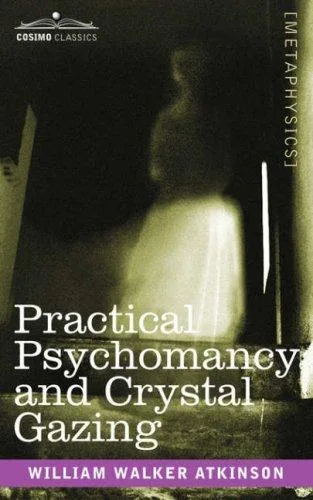
Practical Psychomancy and Crystal Gazing
 80
80

Practical Psychomancy and Crystal Gazing
William Walker Atkinson's "Practical Psychomancy and Crystal Gazing" presents a surprisingly grounded approach to a subject often shrouded in mystique. Rather than relying on arcane pronouncements, Atkinson breaks down the process of scrying into discernible mental techniques, emphasizing visualization and concentration. A notable strength lies in his methodical exposition, treating psychic ability as a faculty to be cultivated through disciplined practice, much like any other skill. The section detailing the preparation of the scrying medium, whether a bowl of water or a crystal sphere, offers clear, actionable steps. However, the work's primary limitation stems from its era; some of the psychological explanations, while pioneering for their time, feel dated when viewed through a modern lens of neuroscience and cognitive psychology. The conceptualization of the 'astral light' as a literal medium, for instance, requires considerable interpretative effort for contemporary readers. Despite this, Atkinson's insistence on the power of focused intent remains a compelling element, particularly his assertion that 'the will is the motor of the mind.' Overall, it functions as a valuable historical document and a practical primer for those willing to engage with its foundational, albeit sometimes anachronistic, framework.
📝 Description
80
### What It Is William Walker Atkinson's "Practical Psychomancy and Crystal Gazing" offers a foundational exploration into the mechanics and application of psychical perception, specifically focusing on the use of crystal spheres for divination and mental projection. First published in 1912, this work demystifies concepts often relegated to the occult by presenting them as accessible mental disciplines. It guides the reader through understanding the latent psychic abilities within, the principles of visualization, and the methods to employ a scrying mirror or crystal ball for obtaining intuitive information. The text aims to bridge the gap between the theoretical possibility of psychic phenomena and their practical, repeatable execution.
### Who It's For This book is primarily for individuals interested in developing their innate psychic faculties, particularly those drawn to the practice of scrying or crystal gazing. It serves those who approach esoteric studies with a desire for systematic instruction and practical exercises, rather than purely theoretical contemplation. Readers seeking to understand the psychological underpinnings of divination, or those looking for a guide to self-exploration through altered states of consciousness induced by focused intent and sensory input, will find value here. It is also relevant for historians of early 20th-century occultism and parapsychology.
### Historical Context "Practical Psychomancy and Crystal Gazing" emerged during a fervent period of interest in spiritualism, psychical research, and the occult sciences in the late 19th and early 20th centuries. This era saw the rise of societies like the Theosophical Society, founded in 1875, which popularized Eastern philosophies and esoteric concepts globally. Atkinson, a prolific writer under various pseudonyms, was a key figure in disseminating these ideas to a wider audience, often drawing from Hermeticism and New Thought principles. His work appeared alongside that of contemporaries like Aleister Crowley and Dion Fortune, though Atkinson's approach was generally more didactic and less tied to specific ritualistic traditions, focusing instead on mental discipline and universal psychic laws. The book reflects a broader cultural fascination with tapping into unseen forces and expanding human consciousness beyond the material realm.
### Key Concepts The book delves into several core concepts essential for understanding psychic phenomena. 'Psychomancy' itself refers to the art of psychical influence or communication, framed by Atkinson as a trainable mental faculty. 'Crystal Gazing' or scrying is presented not as a mystical act but as a method of focusing the mind to access subconscious or supra-conscious information, facilitated by the visual stimulus of the crystal. Visualization is emphasized as a crucial tool for both projecting one's consciousness and receiving impressions. The text also touches upon the nature of the 'astral light' or 'etheric plane' as a medium for psychic impressions and the importance of mental purity and concentration in achieving reliable results. The idea of 'thought forms' and their influence is also implicitly present.
💡 Why Read This Book?
• Gain practical techniques for developing psychic perception through focused visualization and concentration, directly applicable to scrying practices as outlined in Atkinson's method. • Understand the historical development of psychical research in the early 20th century by examining Atkinson's approach, which emerged during the era of the Theosophical Society's influence. • Learn to utilize a crystal or other reflective surface as a tool for introspection and intuitive insight, moving beyond mere superstition to a disciplined mental exercise.
⭐ Reader Reviews
Honest opinions from readers who have explored this book.
❓ Frequently Asked Questions
What is psychomancy according to William Walker Atkinson?
William Walker Atkinson defines psychomancy as the art of psychical influence or communication. He presents it not as an innate, rare gift, but as a mental faculty that can be cultivated and developed through specific exercises and concentration.
How does Atkinson explain crystal gazing?
Atkinson explains crystal gazing, or scrying, as a technique for focusing the mind to access subconscious or higher-consciousness information. He views the crystal as a visual aid that helps to quiet the rational mind and allow intuitive impressions to surface.
When was 'Practical Psychomancy and Crystal Gazing' first published?
William Walker Atkinson's "Practical Psychomancy and Crystal Gazing" was first published in 1912, a period of significant interest in spiritualism and esoteric studies in the Western world.
What mental disciplines are emphasized in the book?
The book heavily emphasizes mental disciplines such as concentration, visualization, and the control of the will. Atkinson believed these were foundational for developing and effectively using psychic abilities like scrying.
Does Atkinson discuss alternative methods to crystal gazing?
Yes, while crystal gazing is a primary focus, Atkinson also mentions other reflective surfaces like bowls of water as viable mediums for scrying, suggesting the principle lies in the focused mental state rather than the specific object.
Is this book suitable for absolute beginners in occult studies?
The book is suitable for beginners interested in practical psychic development. Atkinson's clear, step-by-step instructions aim to demystify the process, making it accessible to those new to concepts like psychomancy and scrying.
🔮 Key Themes & Symbolism
Cultivating Psychic Faculties
Atkinson posits that psychic abilities are not solely inherent but can be systematically developed. The book details exercises designed to hone one's intuitive senses, focusing on the power of visualization and directed mental energy. He treats psychomancy as a trainable skill, accessible through disciplined practice rather than exclusive to a select few. This theme underscores the book's practical, almost scientific, approach to exploring consciousness and perception beyond the mundane.
The Mechanics of Scrying
Central to the work is the detailed explanation of scrying, primarily through crystal gazing. Atkinson breaks down the process into manageable steps, from preparing the scrying medium (crystal ball, bowl of water) to achieving the correct mental state. He emphasizes the role of the crystal as a focal point to bypass the analytical mind and access deeper levels of intuition or subconscious knowledge, presenting it as a tool for mental exploration.
Visualization and Willpower
The book consistently highlights the critical role of visualization and willpower in psychic practice. Atkinson argues that the ability to form clear mental images and to direct one's mental energy with strong intent is paramount for both receiving impressions and influencing psychic phenomena. This theme connects the esoteric practice of psychomancy to fundamental principles of mental discipline, framing it as an extension of conscious control over one's inner world.
The Nature of Psychic Impressions
Atkinson explores how psychic impressions are received and interpreted. He discusses the subtle nature of these insights, which may manifest as images, feelings, or intuitive knowledge. The text encourages readers to develop sensitivity to these impressions and to learn to distinguish them from mere imagination or wishful thinking. This involves understanding the mind's capacity to perceive beyond the ordinary senses, often through altered states of consciousness induced by focused attention.
💬 Memorable Quotes
“The crystal is but a tool to aid the mind.”
— This statement emphasizes that the power in crystal gazing originates from the user's mind, not the object itself. The crystal serves as a focal point, a visual anchor that helps the user to concentrate and access their inner faculties.
“Concentration is the key that unlocks the door to the unseen.”
— Here, Atkinson highlights the paramount importance of focused attention. He suggests that the ability to maintain unwavering concentration is the essential prerequisite for perceiving or interacting with psychic phenomena or hidden realities.
“Thought is a force, and the will is its motor.”
— This paraphrase captures Atkinson's view on the efficacy of mental power. It posits that thoughts are not passive but active forces, and the directed will is the driving power that propels these thoughts into manifestation or perception.
“The untrained mind is a chaotic sea; the trained mind is a controlled current.”
— This analogy illustrates Atkinson's belief in mental discipline. He contrasts the uncontrolled, scattered nature of an untrained mind with the focused, directed power of a mind that has undergone systematic training and control.
“See, not with the eye, but with the mind's eye.”
— This captures the essence of visualization and inner perception. Atkinson encourages the reader to cultivate inner sight, to perceive truths and images through mental faculties rather than solely through physical senses.
🌙 Esoteric Significance
Tradition
Atkinson's work draws heavily from the New Thought movement, which emphasized the power of the mind to influence reality and health, and from Hermetic principles concerning the correspondence between the macrocosm and microcosm. While not strictly Kabbalistic or Gnostic, it shares the Hermetic tenet of 'As Above, So Below' by suggesting inner mental states correspond to outer perceptions and potential influences. It represents a practical, psychologically-oriented interpretation of occult principles, aiming to democratize psychic development.
Symbolism
The primary symbol is the crystal ball itself, which functions as a symbolic gateway to the subconscious and intuitive mind. It represents clarity, reflection, and a focal point for concentration. Another motif is the 'mind's eye,' symbolizing inner vision and the ability to perceive realities beyond the physical senses. The concept of 'astral light' or etheric substance, though not deeply elaborated, symbolizes a universal medium through which psychic impressions travel, akin to a cosmic information field.
Modern Relevance
Modern practitioners of mindfulness, lucid dreaming, and introspection often find Atkinson's emphasis on concentration and visualization directly applicable. His work serves as a precursor to contemporary explorations of neuroplasticity and the power of focused intention in self-development and altered states of consciousness. The principles of using focused attention and reflective surfaces for self-inquiry continue to influence modern divination practices and therapeutic techniques involving guided imagery.
👥 Who Should Read This Book
['• Aspiring psychics and divination practitioners interested in learning foundational techniques for crystal gazing and developing intuitive perception.', '• Students of early 20th-century esoteric literature and the New Thought movement seeking to understand popular occultism of the era.', '• Individuals interested in practical mental discipline and self-improvement through focused visualization and concentration exercises.']
📜 Historical Context
William Walker Atkinson's "Practical Psychomancy and Crystal Gazing," first published in 1912, emerged during a period of intense Western engagement with spiritualism, occultism, and the burgeoning field of psychical research. This era saw the popularization of esoteric ideas, partly fueled by movements like Theosophy, which introduced concepts from Eastern religions and philosophies to a global audience. Atkinson, a highly prolific writer often publishing under pseudonyms like Yogi Ramacharaka, was instrumental in making these complex subjects accessible. His work appeared alongside that of figures like Aleister Crowley, though Atkinson's style was generally more didactic and focused on mental training rather than elaborate ceremonial magic. While not directly engaging in public debates or facing significant censorship as some occult texts did, Atkinson's writings contributed to a broader intellectual current exploring the potential of the human mind beyond materialist scientific paradigms. His approach synthesized elements of New Thought, Hermeticism, and practical psychology, offering a distinctly American flavor to the esoteric landscape.
📔 Journal Prompts
Reflect on your personal definition of 'psychomancy' before and after reading Atkinson's exposition.
Document your initial attempts at visualization exercises as described in Chapter III, noting any challenges or unexpected imagery.
Consider the role of the 'will' as described by Atkinson; how does it function in your daily decision-making?
Explore the concept of the 'mind's eye' by attempting to recall a detailed memory and describe the mental sensations.
Analyze the difference between passive observation and active scrying as presented in the text.
🗂️ Glossary
Psychomancy
The art of psychical influence or communication, viewed by Atkinson as a trainable mental faculty rather than an innate gift.
Crystal Gazing
A form of scrying using a crystal sphere or other reflective surface as a focal point to access subconscious or intuitive information.
Scrying
The practice of looking into a reflective surface (like a crystal ball or water) to gain visions or intuitive insights.
Visualization
The mental act of forming a clear and vivid image or picture in the mind; a key technique in Atkinson's psychomancy.
Astral Light
A concept referring to a subtle, pervasive medium or energy field through which psychic impressions are believed to travel.
Will
In Atkinson's context, the faculty of directing mental energy and intention; described as the 'motor' of thought.
Mind's Eye
The faculty of inner sight or imagination; the ability to perceive mental images and concepts independent of physical sight.